Every electric scooter sold today, every battery-powered car added to India’s roads, and every energy storage system connected to a solar or wind project carries an inevitable question: what happens when that battery reaches the end of its life? For years, that question remained largely in the background. Understandably, India’s focus was on fast-tracking electric mobility, scaling renewable energy capacity, and building up domestic battery manufacturing capabilities. But with batteries becoming a key part of the country’s energy transition, the focus is quickly moving to what comes next. And this is placing Battery Recycling Companies in India in the spotlight.
Once a niche waste-management activity, it’s now becoming one of the most strategically important segments of the clean-energy economy. The companies recycling these batteries are no longer just collecting and processing spent batteries, they are becoming suppliers of critical minerals, contributors to resource security and key players in the development of a circular battery economy.
The timing could hardly be more significant. Electric vehicle adoption is accelerating across passenger vehicles, commercial fleets, two-wheelers and three-wheelers. At the same time, utility-scale Battery Energy Storage Systems (BESS) are being deployed to support India’s renewable energy ambitions. Together, these sectors will generate a growing stream of end-of-life batteries over the coming decade.
Inside those batteries lies something increasingly valuable. Lithium, cobalt, nickel, graphite, copper and manganese are among the materials needed to manufacture the next generation of batteries. Recovering them through recycling not only reduces waste but also helps reduce dependence on imported raw materials.
Battery recycling firms in India are making significant investments to develop and apply more advanced and effective recovery technologies; expanding their processing; and creating the infrastructure necessary to convert battery waste into a strategic resource. These companies’ activities will transform the concept of recycling from a moral responsibility to an industrial opportunity.
In many ways, the story of India’s battery recycling sector is no longer about waste. It is about materials, manufacturing, energy security, and the creation of a circular economy capable of supporting the country’s long-term clean-energy ambitions.
Why Battery Recycling Matters for India
The race for India’s clean energy transition is accelerating at a breakneck pace, but it has created an insatiable appetite for battery materials. Whether we are talking about two-wheelers zip-lining through metro streets, utility-scale storage backing up our grid, or the smartphones in our pockets, lithium-ion technology is the undisputed heavy lifter. But here is the catch: the essential minerals that make these batteries perform—lithium, cobalt, and nickel—are neither infinite nor easily accessible within our borders.
Right now, India is essentially exposed on the global commodity stage. We are very dependent on importing these raw materials through international supply chains that are continually shaken by geopolitical friction, a severe concentration of resources and wild price swings. As our gigawatt-hour needs soar, securing a steady, uninterrupted supply of these minerals is no longer just an engineering challenge; it is a huge strategic issue for our national energy security.
This is exactly where the strategic value of battery recycling companies in India completely changes the equation.
Instead of treating a dead battery pack as an environmental liability to be pushed out of sight, the industry is shifting toward “urban mining.” Think of every retiring EV pack or discarded electronic device not as scrap, but as a highly concentrated, pre-processed reservoir of strategic minerals. By reclaiming these precious elements locally, we effectively create a secondary, domestic tap of battery-grade raw materials. It keeps the value inside our borders, bypasses volatile maritime shipping corridors, and creates a predictable supply loop for upcoming domestic cell manufacturing plants.
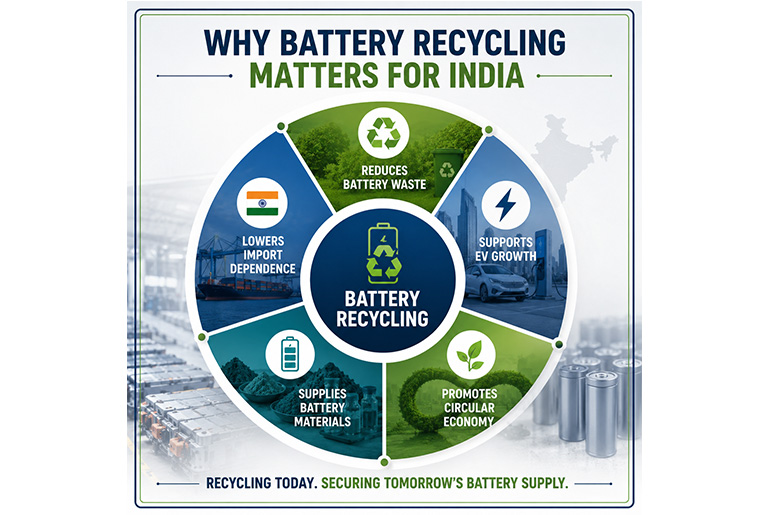
The environmental logic here is just as undeniable. If a lithium-ion pack is simply dumped or handled by informal scrap markets, it becomes a ticking time bomb—capable of causing toxic groundwater leaching, soil contamination, and volatile landfill fires that are notoriously difficult to put out. Advanced, formal recycling completely mitigates these hazards. By closing the loop, we protect our local ecosystems and radically reduce the heavy carbon and water footprint that comes with traditional mining overseas. It is one of those rare industrial shifts where environmental protection and smart business economics align perfectly.
More importantly, the opportunity is growing alongside India’s clean-energy ambitions. Every electric vehicle sold today will eventually contribute to a future recycling stream. Every battery installed in an energy storage project will one day reach the end of its operational life. The cumulative effect is the creation of a substantial secondary resource base that can support future battery manufacture.
For battery recycling companies in India, this is a rare combination of environmental necessity and economic opportunity. The industry sits at the cross-section of resource security, sustainability and industrial growth and is one of the most important enablers of India’s long term battery ecosystem.
Recycling is no longer just about taking care of waste responsibly. It is becoming a critical part of India’s energy and manufacturing plans.
The Rise of Battery Recycling Companies in India
Not long ago, recycling was largely viewed as the final stop—a necessary house-cleaning chore to manage waste and prevent environmental damage. Today, the ecosystem sees it as the exact opposite: the starting line of an incredibly lucrative new value chain.
As India’s electric mobility and stationary storage markets scale up, a highly competitive network of battery recycling companies in India is racing to deploy the infrastructure needed to extract, refine, and reintroduce critical materials back into the production loop. What makes this transition a game-changer is that these players are no longer just waste handlers. They are actively stepping up as domestic critical mineral producers, offering a strategic cushion that can shield India from its heavy reliance on raw material imports.
This structural evolution has caught the attention of every major stakeholder in the industry. For cell manufacturers, local recyclers represent a reliable, secondary tap of lithium, nickel, cobalt, and graphite that would otherwise be subject to volatile global markets. For EV automakers, securing tight partnerships with these recyclers is the most practical pathway to stay compliant with tightening Extended Producer Responsibility (EPR) mandates while backing up their corporate sustainability targets. For policymakers, it provides a blueprint for a self-sustaining circular economy that can fuel long-term industrial growth.
The sheer scale of this opportunity is massive. Industry projections indicate that by the end of the decade, India will be generating hundreds of thousands of tonnes of battery waste annually across the EV, tech, and energy storage sectors. On top of that, as domestic gigafactories begin setting up shop, their internal manufacturing scrap will create an immediate, high-grade secondary feedstock stream for recyclers to capture.
Market Dynamics & The Capacity Gap
India has a huge amount of growth taking place with regards to recycling, however they have a major shortage in capacity to sucessfully recycle. The electric vehicle (EV) market will ultimately provide the long-term volume projections for this industry but currently they are dealing with a unique “feedstock squeeze”.
- The Valuation Surge: The Indian battery recycling market value is estimated at $531.84 million, with projections soaring to nearly $2 billion by 2034, growing at an aggressive 17.98% CAGR (nearly double the global average).
- The Volume Pipeline: NITI Aayog projects that India will generate 128 GWh of recyclable batteries annually by 2030, with roughly 46% of that volume originating directly from EVs reaching their first end-of-life cycle.
- The Supply-Demand Mismatch: Currently, India’s organized recycling capacity stands at approximately 60,000 Tonnes Per Annum (TPA).
However, only about 50% of this throughput converts efficiently into high-grade “black mass” (the intermediate powder containing lithium, nickel, and cobalt).
Industry estimates indicate this current capacity is nearly 40 times below what the country will require at scale by 2030 to achieve full material circularity.
Even though the industry is still finding its footing, a pioneering group of companies has already moved to the forefront, actively scripting the rules for India’s circular energy economy.
Leading Battery Recycling Companies in India
Attero
Development of the Urban Mining Ecosystem in India has commenced through the efforts of Attero, a company established in India in 2008 to be part of the formal electronic and battery recycling industry. Backed by a formidable global portfolio of 45+ patents, the company relies on its proprietary hydrometallurgical refining process to extract critical metals like lithium, cobalt, and nickel at a staggering extraction efficiency of over 98%.
• Capacity: 1.44 Lakh MT/annum (Roorkee base)
• Target Run Rate: ₹2,000 Crore
• Output Purity: 99.9% Battery-Grade Green Metals
Instead of looking outward to unstable global markets, Attero treats India’s massive wave of end-of-life cells as a localized, highly concentrated mineral reserve. The company is currently deploying a ₹150 crore capital infusion to add 1 lakh tonnes of automated processing capacity across Pune, Bengaluru, Faridabad, and Rajasthan—solidifying its role as a key supplier for India’s upcoming gigafactories.
Lohum: Creating a Circular Battery Economy
If Attero pioneered the space, Lohum is the champion of building a truly circular battery economy. Founded in 2018 by Rajat Verma, the Noida-based climate-tech firm goes beyond basic recycling, integrating AI-driven cell diagnostics to maximize battery life through refurbishment and second-life applications before cells ever hit the shredder.
Lohum has aggressively expanded its domestic footprint, scaling its current recycling capacity to 25,000 metric tonnes per annum.
• Current Capacity: 25,000 MT/annum (~2 GWh)
• Market Share: ~70% of India’s Lithium-Ion recycling
• Purity Standard: 99.8%+ Battery-Grade Minerals
• Major Expansion: ₹2,000 Cr plant in Krishnagiri, TN
By refining recovered lithium, cobalt, and nickel back to 99.8%+ purity, Lohum is closing the loop for India’s upcoming gigafactories. To ensure localized resource independence, the company is investing ₹2,000 crore into a massive 20 GWh Cathode Active Material (CAM) facility in Tamil Nadu, alongside India’s first integrated rare earth magnet plant in Meerut.
Recyclekaro: Scaling for the Next Wave of Battery Waste
Among the newer generation of recyclers, Recyclekaro has rapidly established itself as a massive volume player. Founded by Rajesh Gupta, the Navi Mumbai-based company recently completed a major expansion at its flagship facility in Palghar, near Mumbai, scaling its lithium-ion battery processing capacity from 4,200 to 10,000 metric tonnes per annum.
• Base Facility: Palghar, Maharashtra (17 Acres)
• Li-ion Battery Capacity: 10,000 MT/annum
• Extraction Efficiency: >95% (99.5% metal purity)
• Future Tech: ₹500 Cr investment in Rare Earths by 2030
The biggest reason to choose Recyclekaro is their aggressive setup for processing/recycling through their infrastructure scale and raw processing volume. In addition, Recyclekaro operates a zero-discharge hydrometallurgical facility that can recycle high-restore lithium, cobalt and nickel from batteries with a greater than 95% recovery efficiency. Also, the company has established significant high-volume collection agreements with leading Indian automotive manufacturers such as; Tata Motors, Bajaj Auto and Ather Energy.
Positioning itself for the next decade of supply-chain pressure, Recyclekaro is moving deep into advanced material extraction. The company recently launched a 5-acre Rare Earths and Advanced Materials Research Centre in Wada, aiming to scale up a massive 20,000 MT processing capacity dedicated entirely to recovering critical rare earth elements.
BatX Energies: Turning Waste into Strategic Resources
BatX Energies, based in Gurugram, is one of India’s emerging deep-tech recyclers with a green, low-carbon approach to mineral recovery. The startup was founded in 2020 by Utkarsh Singh and Vikrant Singh, focused on converting end-of-life lithium-ion cells into high-purity, battery-grade materials and closing the loop directly for local cell manufacturing.
• Key Facility: HUB-1 (Operational Jan 2025, U.P.)
• Operating Capacity: Scalable range of 4,000 to 20,000 MT/annum
• Process purity: Black mass with impurities < 1%
• Key Partner (2026) : VinFast India (Global EV maker) (High Voltage battery recycling)
BatX avoids the conventional, high-emission smelting route. Instead, they use a proprietary chemical extraction process that operates on low energy and has no liquid discharge.
BatX has transitioned from producing basic black mass to ultra-pure lithium carbonate, nickel and cobalt by commercialising their industrial scale HUB-1 plant in Sikandrabad. Their recent strategic tie-up with global EV major VinFast to deal with factory and after-sales battery waste underscores how critical agile tech startups have become to the supply chains of mainstream automakers.
Ace Green Recycling: Preparing for the LFP Wave
While most of the early industry focus locked onto nickel-rich chemistries, Lithium Iron Phosphate (LFP) batteries are rapidly capturing massive market share across both electric vehicles and stationary energy storage systems. Bengaluru- and US-based Ace Green Recycling is positioning itself to lead this shift.
• Technology: Scope 1 Zero-Emission, Room-Temperature Hydrometallurgy
• Core Focus: High-efficiency LFP and Lead-Acid recycling
• Global Footprint: Facilities in India (Karnal), Thailand, and the US
• Commercial Target: Up to 20,000 MT/annum total global capacity
LFP batteries have traditionally been notoriously hard to recycle profitably because they lack high-value metals like cobalt and nickel. Ace Green’s proprietary hydrometallurgical process operates at room temperature, produces zero greenhouse gases and zero effluent, and dramatically reduces operating costs.
Their chemical extraction method extracts high-purity lithium carbonate and iron phosphate from dead cells without burning or smelting. As India’s market shifts aggressively to LFP for utility scale storage and affordable EVs, Ace Green’s ability to efficiently process these lower value chemistries gives them a strong competitive advantage for the next wave of battery scrap.
Gravita India and Rubamin: Experience Meets Opportunity
Not every firm entering the battery recycling space is starting from scratch.
Gravita India has developed expertise in battery recycling and metal recovery through its lead-acid battery business for decades. The company is using its operational experience to explore new opportunities for critical mineral recovery as the market moves to lithium-ion technologies.
Rubamin’s intrinsic strengths in the processing of non-ferrous metals also make it a key player in the larger resource recovery ecosystem of India. It may not be solely focused on recycling batteries but its metallurgical expertise could be more relevant as demand for recovered battery materials grows.
How Battery Recycling Companies Recover Critical Minerals
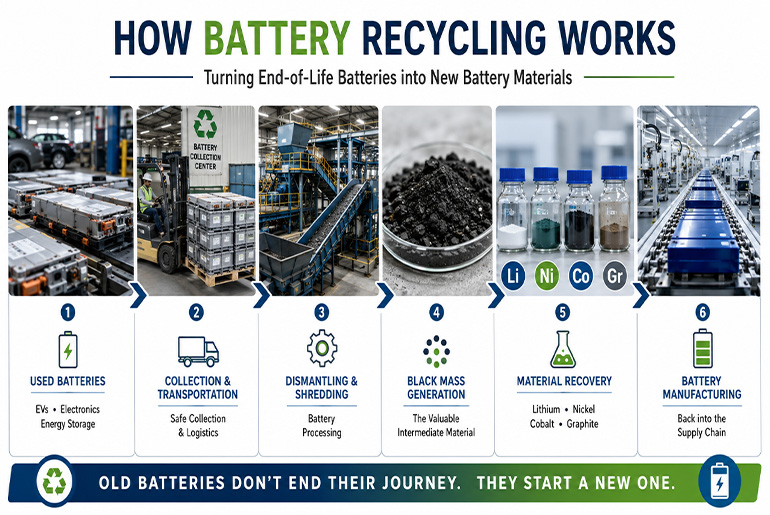
At the heart of the battery recycling business lies one simple objective: extracting valuable materials from dead cells so they can be used to build brand-new ones.
The most sought-after material is undoubtedly lithium. Often called the “white gold” of the energy transition, lithium is the backbone of modern battery chemistries. With global demand skyrocketing, pulling lithium out of old batteries is no longer just an environmental good deed—it is an economic and strategic necessity for India.
Nickel and cobalt are equally valuable. These heavy-hitter metals are what give electric vehicle batteries their long range and high energy density. Because India has virtually no domestic reserves of these elements, recovering them from scrap is the fastest way to shield local manufacturing from volatile global supply chains.
Graphite, although often overlooked, represents another massive opportunity. It makes up a huge portion of a lithium-ion battery’s weight, meaning large-scale graphite recovery will be essential as recycling volumes climb.
Finally, copper and aluminum contribute heavily to the day-to-day cash flow of a recycling plant. Because these metals are found in the structural wiring and foils of a battery pack, they are relatively easy to separate and sell quickly, providing steady revenue that keeps recycling operations viable.
Industry Growth Driven by Policy Support.
The rapid development of battery recycling in India is not driven by market forces alone. Regulatory mandates are tightening and the industry is being forced to mature.
The game-changer was notification of Battery Waste Management Rules, 2022 by Ministry of Environment, Forest and Climate Change (MoEFCC) replacing the old 2001 guidelines. This framework set mandatory Extended Producer Responsibility (EPR) targets, making battery manufacturers and importers legally responsible for the collection and recycling/refurbishment of dry cells at their end-of-life.
EPR target escalation roadmap
• FY 2024-25: 30% baseline goal for collection & recycling.
• FY 2027-28: Rises sharply to 70%
• FY 2030-31: Requires full life cycle accountability 100%
The rules not only require collection, but also impose high minimum recovery efficiencies for critical materials. By FY 2024-25, recyclers will have to recover a minimum of 70% of the total battery weight and must reach 90% by FY 2026-27. The policy also requires that recycled materials be used in new batteries. From FY 2027-28, new cells must contain a minimum percentage of cobalt, copper, lithium and nickel recovered domestically.
This framework, in effect, legalises collaboration. Automotive OEMs and cell manufacturers can no longer rely on informal scrap dealers. They need to enter into formal take-back agreements with registered and tech compliant recyclers to get EPR certificates. These certificates are traded through a centralised Central Pollution Control Board (CPCB) portal and companies failing to comply are penalised with heavy compensation on the environment.
In addition, the Ministry of Mines is working on critical mineral security. The government has slashed import duties on key mineral machinery and announced financial incentives for high-yield hydrometallurgical processing under circular economy grants, seeing recycling as a major “urban mine” to protect India’s economy from volatile global supply chains.
The Road Ahead: Building India’s Circular Battery Economy
The future of battery recycling in India is so much more than waste management.
With the increased adoption of electric vehicles and energy storage, the number of batteries that will reach end-of-life will increase dramatically. Meanwhile, the country’s battery-making capacity is also slated to grow substantially in the same timeframe, thus raising the need for battery materials from domestic sources.
This convergence offers a unique opportunity.
Battery recycling companies in India can become strategic suppliers of lithium, cobalt, nickel, graphite and other critical materials that will be needed by future gigafactories and battery makers. This can help reduce import dependence and strengthen the resilience of domestic supply chains.
 Electrify your feed! Click here to join our Whatsapp group and to get the latest updates, expert insights, and innovations driving India’s energy storage revolution.