
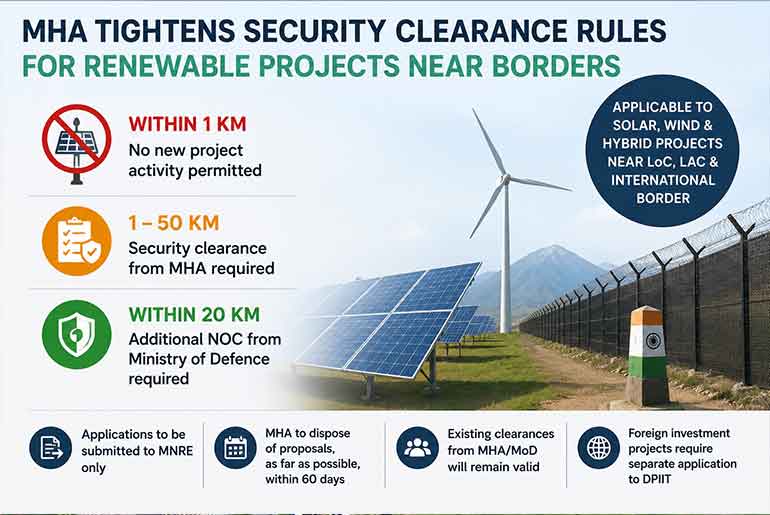
The Ministry of Home Affairs (MHA) has introduced a national security-clearance framework for solar, wind and hybrid renewable energy projects in border areas, restricting new project activity within 1 kilometre of the Line of Control (LoC), Line of Actual Control (LAC) and International Border, while bringing projects within 50 kilometres of these sensitive boundaries under a mandatory security-clearance process. The framework comes amid a rise in applications seeking to establish renewable energy projects in border areas, which the government has identified as having potential national-security implications.
Under the new guidelines of MHA, any area within 50 km of the LoC, LAC or International Border is classified as a Sensitive Area. All solar, wind and hybrid energy projects proposed within this 50-km zone will require security clearance from the MHA.
The guidelines establish an even stricter restriction closest to India’s borders. Areas within 1 km of the LoC, LAC or International Border constitute a Restricted Area, where no new project activity will be permitted. This means the framework is not simply a clearance requirement across the entire 50-km belt; the first kilometre is subject to a prohibition on new renewable project activity.
Case-by-Case Assessment Between 1 Km and 50 Km
For projects proposed between 1 km and 50 km from the LoC, LAC or International Border, security clearance will be assessed on a case-by-case basis.
There is an additional requirement for projects located close to the International Border. Projects proposed within 20 km of the International Border will require a separate No Objection Certificate (NOC) from the Ministry of Defence (MoD). The MHA/MoD will assess applicable proposals on a case-by-case basis.
Applications to Be Routed Through MNRE
Under the Standard Operating Procedure (SOP), applications for covered solar, wind and hybrid projects will be submitted only to the Ministry of New and Renewable Energy (MNRE).
The MNRE will coordinate the process and ensure that land allocation is undertaken in a manner that prevents construction of a renewable energy project from extending over a long distance parallel to the International Border.
The final decision will be conveyed to the project developer only after the required MHA security clearance and MoD NOC, wherever applicable, have been obtained.
The MHA will, as far as possible, dispose of proposals within 60 days, providing a defined processing timeline for developers.
Existing Clearances Do Not Require Reapplication
The new framework provides an exemption for projects that have already completed the applicable security process.
Projects located along the LoC or LAC that had already received MHA security clearance before issuance of the guidelines will not be required to apply again.
Similarly, applicants that had already obtained an NOC from the Ministry of Defence will not have to re-apply under the new framework.
Foreign Investment Projects Face Additional Requirement
Where a proposed project involves foreign investment, a separate application will be required to be submitted to the Department for Promotion of Industry and Internal Trade (DPIIT) under the government’s Foreign Direct Investment (FDI) Policy.
The guidelines also place restrictions around foreign involvement in project land, with the framework requiring prior approval of the Central Government for transfer of land to a foreign company, including security clearance from the MHA, according to reports on the guidelines.
The new framework creates a clear security-screening structure for renewable energy development in India’s strategically sensitive border regions. Large solar, wind and hybrid projects require significant land, transmission infrastructure and permanent installations, making their location particularly relevant from a national-security perspective.
For developers, the biggest practical change is that security considerations will now have to be incorporated into site selection and project planning much earlier, particularly for projects within the 50-km sensitive zone.
At the same time, routing applications through the MNRE and providing a defined 60-day MHA processing target is intended to give developers a clearer regulatory pathway while allowing security agencies to assess projects according to their location and circumstances.
The framework therefore establishes a three-tier regulatory structure: no new project activity within 1 km, security scrutiny within 1–50 km, and an additional MoD NOC requirement for projects within 20 km of the International Border.
The new framework is likely to make site selection, security assessment and regulatory planning increasingly important for renewable energy developers operating near India’s borders. The defined process could provide greater clarity while ensuring that future clean-energy infrastructure is developed in line with national-security requirements.
 Electrify your feed! Click here to join our Whatsapp group and to get the latest updates, expert insights, and innovations driving India’s energy storage revolution.