
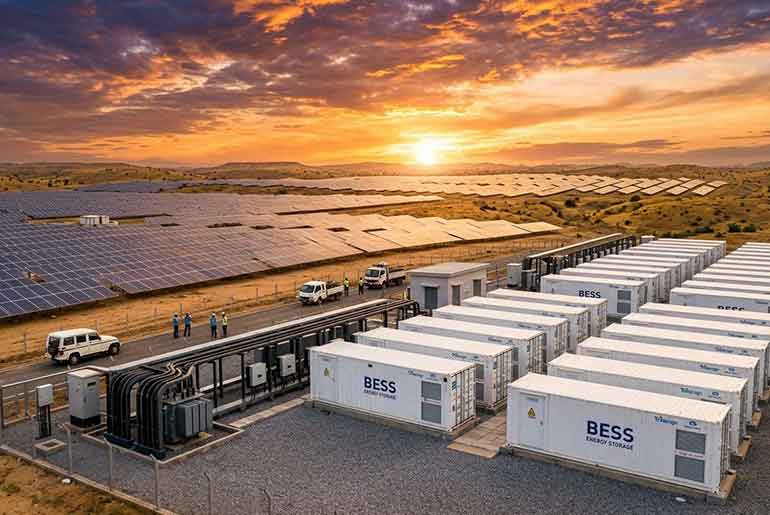
Solar power is growing rapidly in India, but generating electricity from sunlight is only half the job. The bigger challenge is making sure that the electricity produced actually reaches consumers when they need it. Solar panels generate most of their electricity during the day, particularly around noon. However, electricity demand often increases in the evening, when solar generation begins to fall. When the grid cannot absorb all the electricity being generated, some of that potential power goes unused.
Battery energy storage systems (BESS) can help bridge this gap. They store excess electricity when solar generation is high and release it later, allowing more of the energy produced during the day to be used after sunset. As India adds more renewable energy capacity, battery storage is becoming an important part of the conversation around grid reliability, energy management and the efficient use of solar power.
Why Does Solar Power Go to Waste?
Solar power generation changes throughout the day. Output usually increases in the morning, reaches its peak around midday and declines as the sun sets. Electricity demand, however, does not always follow the same pattern. In areas with substantial solar capacity, electricity generation can sometimes exceed local demand during the middle of the day. At the same time, transmission networks may not have enough capacity to carry all the available electricity to other regions.
When the grid cannot accommodate the additional supply, operators may have to reduce the output of solar plants. This is known as renewable energy curtailment. Curtailment is not the only reason solar electricity may go unused. Limited distribution infrastructure, difficulties in balancing supply and demand, and lower-than-expected consumption can also affect how much electricity the system can absorb. The challenge is not simply to generate more solar power. It is to make better use of the electricity already being produced.
How Battery Storage Makes a Difference
Battery storage allows electricity to be saved for a later time rather than being used or exported immediately. In a solar-plus-storage system, solar panels generate electricity during the day. When production exceeds immediate consumption, the surplus can charge a battery. The stored electricity can then be used when solar output falls or demand increases.
A typical system includes solar panels, battery cells, a battery management system, power conversion equipment and an energy management system. Together, these components monitor electricity generation, control charging and discharging, and help deliver power according to the system’s requirements.
Consider a solar plant generating more electricity than the local grid can accommodate around noon. If a connected battery has sufficient charging capacity, it can store some of that surplus energy. Later in the evening, the battery can supply electricity when solar generation has declined and demand may be higher. In simple terms, battery storage helps shift electricity from the time it is generated to the time it is needed.
Can Batteries Reduce Solar Power Curtailment?
One of the main advantages of battery storage is its ability to absorb electricity that might otherwise be curtailed Grid operators sometimes ask renewable energy plants to reduce generation because the network cannot safely accommodate additional electricity or because supply is higher than demand. A battery with available capacity can store some of that excess power instead.
The stored electricity can then be discharged when demand rises or when the grid has more room to accept it. This can improve the utilisation of solar installations and reduce the amount of renewable electricity that goes unused. However, batteries are not a complete solution to curtailment. Their storage capacity is limited, and they cannot continue charging once they are full. They also have restrictions on how quickly they can charge and discharge.
Grid constraints can create another problem. If electricity cannot be transported from a battery to the areas where it is needed, storing the power may not resolve the underlying issue. For this reason, battery projects need to be planned around local grid conditions, the amount of surplus electricity available and the period for which that electricity needs to be stored.
Using Daytime Solar Power After Sunset
The difference between daytime solar generation and evening electricity demand is one of the clearest examples of where battery storage can help. During the day, a battery can charge when solar generation is strong. As the sun sets and electricity consumption increases, it can release the stored energy to support the grid.
This can help meet periods of high demand and reduce the need to bring additional conventional power generation online, depending on the type of generation being displaced and the battery’s operating characteristics. The same principle applies to homes and businesses with rooftop solar installations. Without a battery, electricity generated during the day may be exported to the grid, while the consumer purchases electricity later in the evening. With storage, some of the daytime generation can be saved for use after sunset.
Whether this arrangement makes financial sense depends on several factors, including battery prices, electricity tariffs, system efficiency and the rules governing net metering. Battery storage does not create additional electricity. Instead, it makes some of the electricity already generated available at a different time.
Why Battery Storage Matters for India’s Renewable Energy Growth
As India expands its solar capacity, managing the changing pattern of electricity generation is becoming increasingly important. More solar power means greater access to clean electricity, but it also increases the need for a grid that can respond to variations in supply. Battery energy storage can provide some of that flexibility. Large battery installations can be located alongside solar parks or connected directly to the electricity grid. Smaller systems can serve residential, commercial and industrial users.
Storage can also operate independently of a solar plant. Depending on electricity market rules and project arrangements, a grid-connected battery may charge when electricity is available and discharge during periods when power is more valuable or demand is higher. These applications can help balance electricity supply, improve the use of renewable generation and support grid operations.
Still, batteries are only one part of the solution. Expanding transmission lines, strengthening distribution networks, improving renewable energy forecasts and encouraging consumers to use electricity during periods of high generation can also help reduce curtailment. Pumped-storage hydropower and other flexible resources can provide additional options. The most effective approach will depend on the needs of each region and the cost of the available solutions.
Which Battery Technologies Are Suitable for Solar Storage?
Not every battery technology is suited to every application. The right choice depends on how much electricity needs to be stored, how long it must be supplied and how frequently the system will be used. Lithium iron phosphate (LFP) batteries are widely used in stationary energy storage. Their combination of efficiency, cycle life and performance makes them an option for utility-scale projects as well as commercial and residential solar systems. Other lithium-ion chemistries may be selected where specific performance requirements justify their use.
Vanadium redox flow batteries are another option, particularly for applications where long discharge durations and frequent cycling are important. Their design differs from that of conventional lithium-ion batteries, which can make them suitable for certain stationary storage requirements. Sodium-ion batteries are also attracting interest as the technology develops. Their potential advantages include the use of more widely available raw materials, although commercial performance and costs depend on the particular battery design and application.
There is no single technology that works best for every project. Developers must weigh factors such as upfront cost, efficiency, operating temperature, safety, degradation, cycle life and available installation space. A system intended to supply electricity for a few hours may require a different technology from one designed to provide power over much longer periods.
The Cost and Operational Challenges
Battery storage can help reduce solar power wastage, but installing and operating a system requires considerable investment. The overall project cost includes battery cells, power conversion equipment, control systems, installation, grid connectivity and ongoing maintenance. Developers must also account for battery degradation, which gradually reduces the amount of energy a system can store and deliver over its lifetime.
Energy losses are another consideration. Batteries do not return all the electricity used to charge them. Some energy is lost during charging, storage and discharging, so the electricity delivered is lower than the amount initially stored. The financial case for a battery depends largely on how it is used. A project may earn value by supplying electricity during peak-demand periods, shifting energy to more valuable hours or providing eligible grid services. The opportunities available depend on local market rules, tariffs and contractual arrangements.
Safety also needs careful attention. Battery installations require appropriate thermal management, monitoring systems, fire detection, emergency planning and designs that account for the risks associated with the selected technology. For developers, the goal is to find a balance between storage capacity, operating costs and the value of the electricity the battery can deliver.
What Lies Ahead for Solar and Battery Storage?
Solar power has become an important part of the transition to cleaner electricity, but its value depends partly on how effectively the power system can use what is generated. Battery storage offers one way to address this challenge. By capturing surplus electricity during periods of high solar output and supplying it later, batteries can reduce certain forms of renewable energy curtailment and make solar power more useful beyond daylight hours.
The benefits, however, depend on where the batteries are installed, how they are operated and whether the surrounding grid can accommodate the stored electricity. In some cases, new transmission infrastructure or changes in electricity demand may offer a more economical way to address the same problem. For India, the next stage of solar expansion will involve more than adding generating capacity. It will also require investment in the infrastructure needed to store, transport and deliver electricity efficiently.
Battery storage can play a significant role in that process. Combined with stronger grids, better planning and other flexible energy resources, it can help India make better use of the solar electricity it already produces.
 Electrify your feed! Click here to join our Whatsapp group and to get the latest updates, expert insights, and innovations driving India’s energy storage revolution.