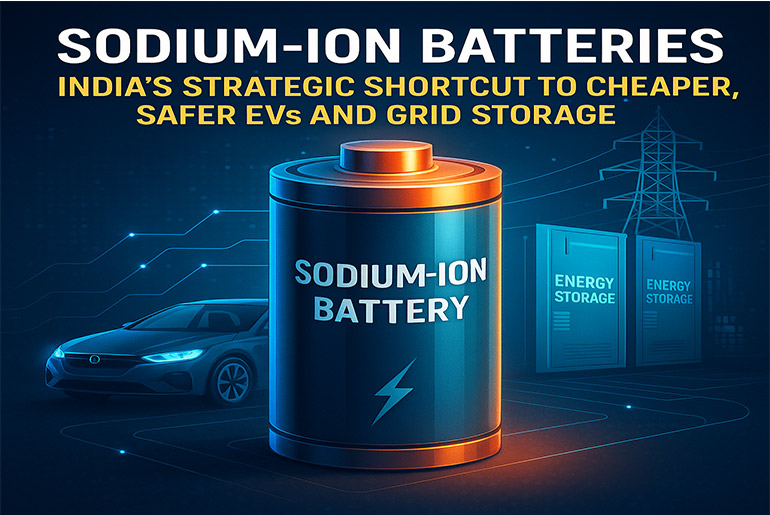
Imagine a battery that draws on sea salt, costs materially less than lithium chemistry, and is inherently safer for mass-market vehicles and heavy-duty storage. That’s the promise of sodium-ion batteries, and over the next five years this technology could become India’s low-cost lever for faster EV adoption and domesticised energy storage. The race is on — from Chinese scale-up to Indian labs and strategic acquisitions — to turn salt and abundant sodium into practical, factory-ready cells.
What are sodium-ion batteries?
At their core, sodium-ion batteries use sodium ions (Na⁺) to shuttle charge between electrodes during charge/discharge cycles — similar in principle to lithium-ion but swapping sodium for lithium. The chemistry tradeoffs are straightforward: sodium is abundant and cheap, lowering raw-material risk and cost; however, sodium ions are slightly larger, which has historically limited energy density and cycle characteristics compared with lithium. Modern cell designs (NASICON-type cathodes, improved hard-carbon anodes and optimized electrolytes) are closing those gaps and improving charge rates, cycle life and safety. The result: sodium-ion batteries that are highly competitive for use-cases where energy density is not the only priority — affordability, safety, and domestic sourcing matter as much.
(Technical note: advances such as NASICON cathodes and engineered hard carbons have been central to recent sodium-ion performance improvements.)
Market snapshot: how big and how fast?
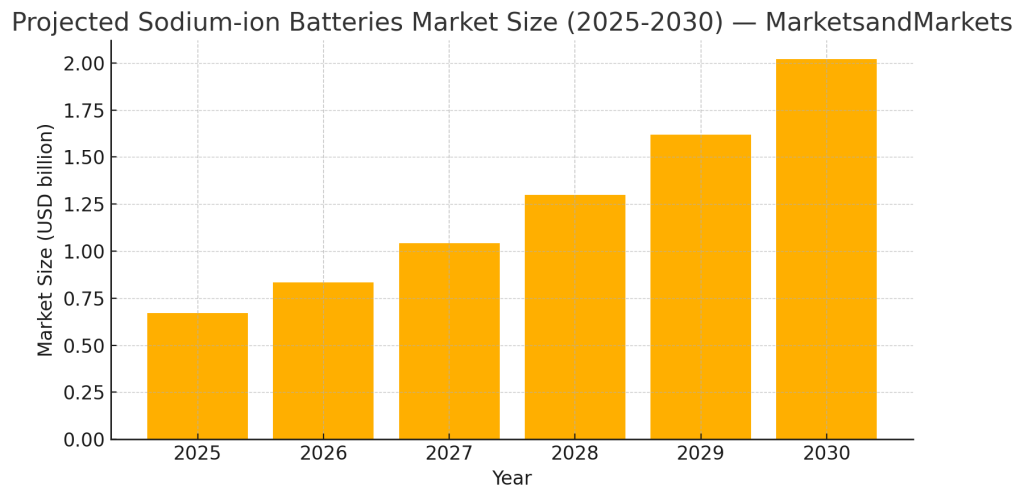
Market estimates vary, but independent reports converge on a robust growth trajectory for sodium-ion batteries over the rest of the decade. MarketsandMarkets projects the global sodium-ion battery market to expand rapidly from modest base values in 2025 to multi-billion-dollar scale by 2030, reflecting strong interest from EV makers and energy project developers. The projection used in this article (MarketsandMarkets) shows a clear compound growth path to 2030 — see the chart above for year-by-year illustration.
Several other market analysts provide a range of estimates, reflecting uncertainties in commercialization pace and lithium price trajectories. That variance points to one conclusion: adoption will depend on both continued technical improvement and commercial-scale manufacturing.
Who’s moving first: major players & proof points
The technology has graduated from labs to industrial pilots and commercial announcements:
- CATL (China) — the world’s largest battery maker — has unveiled a new brand and next-gen sodium-ion product family and announced plans for mass production. CATL’s push signals serious industrial confidence that sodium-ion can serve passenger EVs and other segments at scale.
- Faradion → Reliance New Energy (India) — Faradion’s sodium-ion IP and pilots are now part of Reliance’s new-energy playbook. The Reliance–Faradion tie-up (completed stake acquisition) positions India to access commercial sodium-ion designs and potentially integrate them in local gigafactories.
- Academic breakthroughs in India — teams at JNCASR / DST-supported labs have reported prototypes that push charging speeds and cycles for sodium-ion cells, tackling two traditional weak spots (fast charging and longevity). If these lab breakthroughs scale, they can materially shift application economics.
- New entrants & pilots globally — companies like Natron, various European startups (Altris/Tiamat), and Chinese OEMs are already piloting sodium-ion packs for scooters, microcars and stationary systems. There are consumer devices (e.g., power banks) using sodium-ion cells that demonstrate manufacturability and safety benefits.
Case study — CATL’s Naxtra / Reliance–Faradion playbook (why it matters)
CATL’s announcement (new sodium-ion product family) and its push into mass production show how economies of scale can change the cost calculus for sodium-ion batteries. Simultaneously, Reliance’s acquisition of Faradion consolidates IP and gives India direct access to commercial sodium-ion cell designs — a strategic move that short-circuits years of incremental development. These two threads (Chinese scale + Indian IP acquisition) could create a two-channel global pipeline for sodium-ion commercialization: (a) large Chinese gigafactories supplying Asian EV and scooter markets; (b) Indian gigafactories using acquired IP to serve domestic stationary storage and mass-market EVs.
Where sodium-ion batteries fit (realistic use cases)
Not every vehicle or application needs the highest energy density. Sodium-ion batteries are already looking ideal for:
- Electric two-wheelers and scooters (cost & safety win).
- Microcars and small city EVs where range targets are moderate and cost sensitivity is high.
- Stationary energy storage (C&I, microgrids, solar-plus-storage), especially where domestic sourcing, cycling stability, and safety matter.
- Cold-climate applications and certain fast-charge scenarios where specific sodium chemistries show advantages.
India’s opportunity: policy, R&D & manufacturing
India’s policy environment is already thinking beyond lithium: MNRE/ASPIRE assessments have evaluated sodium-ion’s potential and the country’s labs (DST/JNCASR) have published fast-charging sodium-ion milestones — all signposts for active interest. If policymakers pair targeted incentives (CAPEX support, demand-side procurement, incubation for cell manufacturing) with strategic IP and JV frameworks, India could localize much of the value chain. The combination of local IP (Faradion → Reliance), strong lab breakthroughs, and supportive procurement could help India move from import dependence to domestic production of sodium-ion batteries for cost-sensitive EVs and storage.
Risks, unknowns & contrarian views
Skeptics point to three main constraints for sodium-ion batteries:
Energy density gap — despite improvements, sodium-ion still lags top-end lithium chemistries for long-range passenger EVs.
Lithium price dynamics — if lithium prices stay low, the cost advantage of sodium shrinks .
Scaling & standards — rapid scaling requires supply chain maturity, new standardization for packs and safety certification, plus OEM validation cycles.
These are real and mean that sodium-ion will likely complement rather than fully replace lithium-ion over the next decade.
Roadmap & recommendations (for OEMs, policy makers and investors)
- OEMs: Pilot sodium-ion packs in scooters, microcars and fleet vehicles to validate life-cycle cost advantages. Build modular battery architectures that allow chemistry substitution.
- Policymakers: Offer technology-agnostic procurement incentives and pilot tenders (microgrid + school-bus fleets) to create early demand signals for sodium-ion batteries. Support cell-line capex in early gigafactories and fund scale-up of promising lab leads (NASICON, hard-carbon manufacturing).
- Investors: Back integrated projects combining IP (cell chemistry) with local manufacturing and long-term offtake agreements (EV makers or utilities). Look for partners who can convert lab breakthroughs (e.g., JNCASR work) into reproducible factory processes.
Conclusion — practical optimism
Sodium-ion batteries are not a silver bullet, but they are a pragmatic, near-term lever to lower cost, improve safety and reduce critical-material dependency in both EVs and storage. With global players industrializing the chemistry and India seeding its own IP and acquisitions, the next two years will determine whether sodium-ion scales into a mainstream, complementary battery technology. For India, the playbook is clear: combine lab innovation, strategic IP access, and smart policy to make sodium-ion a home-grown advantage in the evolving electrified mobility landscape.
 Electrify your feed! Click here to join our Whatsapp group and to get the latest updates, expert insights, and innovations driving India’s energy storage revolution.