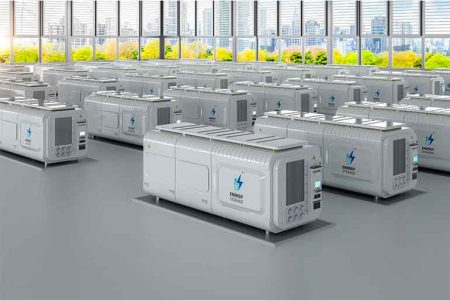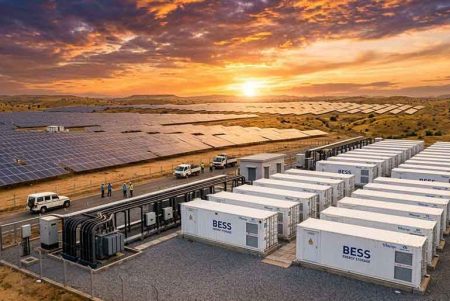
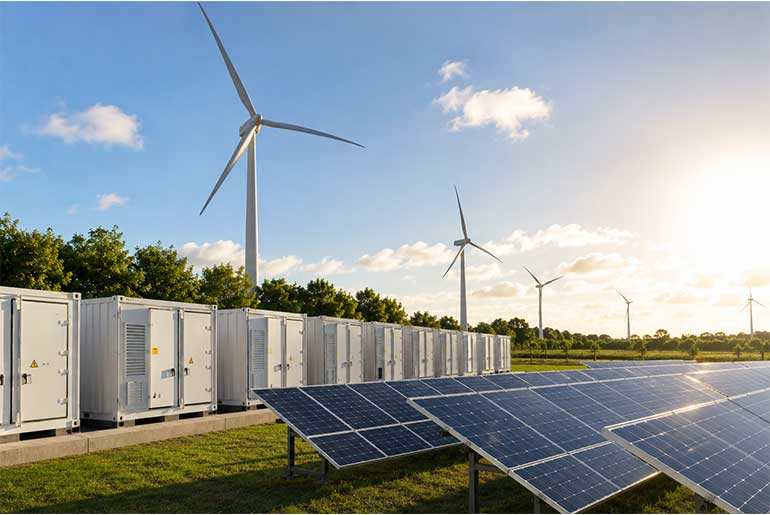
For nearly a decade, India’s renewable energy success was measured in one number—how many gigawatts of solar capacity the country could install each year. That strategy worked. India has emerged as one of the world’s fastest-growing solar markets, transforming vast stretches of Rajasthan, Gujarat, and other states into renewable energy hubs. But as Solar Plus Storage Projects in India gather unprecedented momentum, the conversation is rapidly shifting from how much clean electricity can be generated to how reliably it can be delivered. In other words, India’s next energy revolution will not be driven by solar panels alone—it will be driven by what happens after the sun goes down.
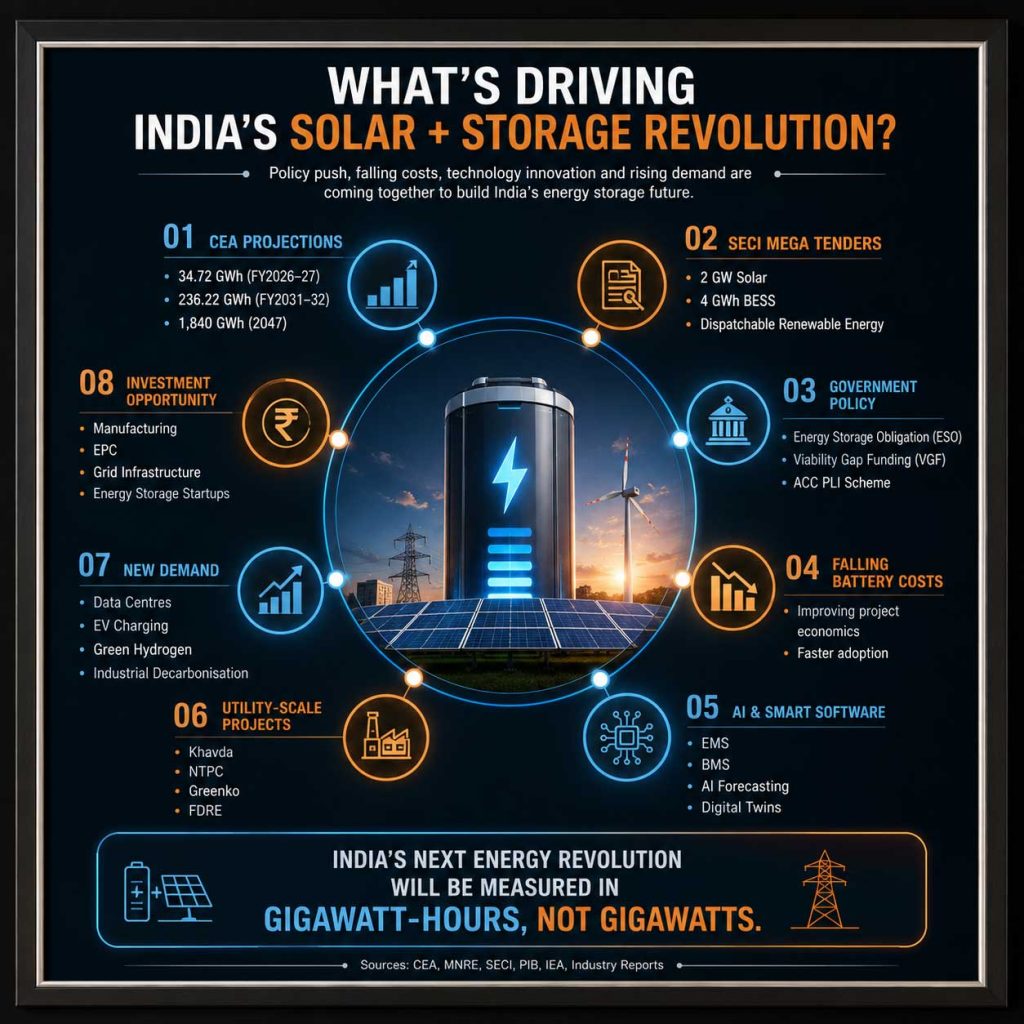
The numbers tell the story. By 2026-27, India will require 34.72 GWh of Battery Energy Storage Systems (BESS) and this is expected to grow by almost seven times to 236.22 GWh by 2031-32, according to Central Electricity Authority (CEA). The National Electricity Plan estimates that the country may need 1,840 GWh of battery storage by 2047 and energy storage is thus one of the fastest-growing segments of power sector in India. These projections reflect a simple fact: adding capacity of renewable energy is no longer sufficient. Now, the grid needs to be able to store clean electricity when there is surplus power and deliver it exactly when it’s needed most.
This shift is already redefining the industry. SECI’s 2 GW solar and 4 GWh battery storage project along with NTPC Green Energy’s 3,300 MWh battery storage project in Khavda is paving the way for the redevelopment of the battery storage technology from a support technology to the main component of renewable energy infrastructure in today’s world. The big question now facing developers, utilities, investors, and decision-makers is not whether the battery storage technology will become an important part of the energy industry but rather when it will happen.
In this article, we explore the technologies, policies, landmark projects, and market trends driving Solar Plus Storage Projects in India, while examining why battery-backed renewable energy is becoming the blueprint for the country’s clean energy future.
When Solar Success Created a New Energy Challenge
India’s solar story is one of the country’s greatest clean energy achievements. From just a few gigawatts a decade ago, the nation has built one of the world’s largest renewable energy programmes, crossing 100 GW of installed solar capacity and moving steadily towards its ambitious target of 500 GW of non-fossil fuel capacity by 2030. Falling module prices, competitive auctions, and supportive government policies transformed solar power from an expensive alternative into one of the cheapest sources of electricity in India.
Yet, success created an unexpected problem.
Solar plants generate their highest output between late morning and early afternoon, precisely when electricity demand is often lower than the evening peak. After sunset, millions of homes turn on lights, air conditioners, televisions and appliances, and solar generation starts to fall off a cliff. This increasing mismatch between renewable energy generation and electricity consumption has become one of the biggest operational challenges for India’s power grid.
The impact is already apparent in the states with abundant renewables. When there’s a lot of solar generation and relatively little demand, grid operators often have to curtail renewable power because they don’t have the flexibility to absorb or store the excess electricity. For every megawatt hour of lost solar energy, there are lost clean power, lost project revenues and underutilised infrastructure.
Recognising this challenge, the Central Electricity Authority (CEA) fundamentally changed the conversation around India’s energy transition. Instead of focusing on increasing the capacity of renewable energy sources only, the National Electricity Plan projects that the nation will need 34.72 GWh of Battery Energy Storage Systems (BESS) in FY2026-2027 and that this will increase to 236.22 GWh in FY2031-34. Looking into the long term, the energy roadmap of India predicts that the country will need about 1,840 GWh of battery storage by 2047, a significant milestone indicating the development of the electric grid.
The changing reality is also shifting government policy. The Energy Storage Obligation (ESO) mandates that certain providers of electricity deploy energy storage in conjunction with renewable power, and programs like the Viability Gap Funding (VGF) are improving the commercial viability of large scale battery projects. These policy measures, covered in our guide to Battery Storage Policy Updates, represent a broader shift in national priorities, from building renewable capacity to ensuring renewable electricity is available when consumers want it.
For developers, utilities, and investors, the message is becoming increasingly clear. The next phase of India’s clean energy transition won’t be won by those who generate the most solar power. It will be led by those who can store it, use it wisely and deliver reliably after sunset. That is why Solar Plus Storage Projects in India are no longer an optional upgrade, but the backbone of a modern, resilient and dispatchable power system.
The Projects That Are Redefining India’s Renewable Energy Future
It is no longer policy announcements driving India’s move to solar-plus-storage, but projects that are changing the way renewable electricity is procured, generated, stored and dispatched. The newest generation of projects is focused on reliability, flexibility and grid resilience, not just adding capacity like the first wave of solar parks. Taken together, these projects give a sense of what India’s power system will look like over the next decade.
The biggest turning point came in 2025, when the Solar Energy Corporation of India (SECI) launched its landmark 2 GW Solar + 4 GWh Battery Energy Storage System (BESS) tender. The tender was the largest procurement of integrated solar-plus-storage in India and a fundamental shift in renewable energy policy. Developers have competed over the years for the lowest solar tariff. SECI changed that equation, focusing on the ability to deliver electricity even after the sun set. Storage was no longer a support technology, but central to the value proposition of the project. The auction demonstrated that the future of renewable energy would be defined not only by how cheaply electricity could be generated but also by how reliably it could be be supplied.
Another milestone is the Khavda Renewable Energy Park in Gujarat. Khavda is emerging as a model for next generation renewable infrastructure and is being developed as the world’s largest renewable energy park with an aggregate capacity of ~30 GW. In addition to the massive solar and wind installations, NTPC Green Energy Limited (NGEL) is also developing a 3,300 MWh Battery Energy Storage System to store renewable electricity before dispatching it to the grid during periods of higher demand. Khavda does not first build solar farms and then add storage, but integrates both technologies into one integrated energy ecosystem – a model that is likely to shape future mega renewable parks in India.
Khavda shows the evolution of renewable parks, while SECI’s Firm and Dispatchable Renewable Energy (FDRE) tenders are changing how renewable power itself is bought. Developers need to deliver scheduled electricity supply through the smart combination of solar, wind and battery storage. The practical effect is that developers are no longer rewarded for simply producing the cheapest renewable electricity, but are rewarded for delivering dependable electricity regardless of weather conditions. This is one of the most significant changes in India’s renewable procurement strategy, as it will incentivise investments in larger battery systems, advanced forecasting tools and AI-driven Energy Management Systems.
India’s largest power producer, NTPC, is also accelerating this transformation. The company has announced plans to deploy nearly 5 GWh of Battery Energy Storage Systems across multiple locations to absorb surplus renewable generation, reduce curtailment, and strengthen grid flexibility. This programme reflects an important industry reality: battery storage is no longer viewed as an experimental technology but as essential infrastructure for balancing India’s rapidly expanding renewable energy fleet.
The private sector is moving just as aggressively. Greenko’s Integrated Renewable Energy Storage Project at Pinnapuram, Andhra Pradesh, combines solar, wind, and pumped hydro storage into one of the world’s largest integrated renewable energy developments. Unlike conventional projects that rely on a single technology, Pinnapuram shows how multiple storage options can operate together to deliver clean power 24/7. At the same time, organisations such as SJVN are advocating large scale procurement of batteries and utilities such as Tata Power Delhi Distribution Limited (TPDDL) have begun procuring Firm and Dispatchable Renewable Energy to ensure reliability of supply. Utilities in states such as Gujarat, Rajasthan, Karnataka and Tamil Nadu are increasingly opting for hybrid renewable projects rather than standalone solar plants. This indicates a larger shift in how electricity will be generated and consumed.
These projects highlight another major trend as well: India’s renewable energy transition is becoming increasingly regional. Mega renewable parks in Gujarat, emerging renewable zones like Dholera, storage-backed projects in Andhra Pradesh, and hybrid procurements across multiple states are proving that the shift is no longer confined to a handful of pilot installations. As we wrote in our feature on State-wise BESS Projects in India, battery storage is rapidly becoming an integral part of renewable planning across the country.
These developments combine to send a clear message. India’s next renewable energy milestone will not be marked by more gigawatts of solar capacity. It will be measured by the country’s capacity to build smart energy systems, where generation, storage and digital control work together. Already, many of these landmark deployments are shaping the future of Utility-Scale Battery Projects in India, building a power system that can deliver clean electricity not only when the sun shines but whenever the nation needs it.
Beyond Batteries: The Technology Quietly Powering India’s Solar-Storage Revolution
While gigawatt-scale projects often grab the headlines, the real transformation in Solar Plus Storage Projects in India is happening behind the scenes. Batteries may be the most visible component of these projects, but they are only one part of a much larger technological ecosystem. Increasingly, the success of a solar-plus-storage project depends as much on intelligent software and advanced energy management as it does on the battery cells themselves.
Unlike conventional solar parks that simply inject electricity into the grid whenever it is generated, modern storage-backed renewable projects continuously analyse thousands of operational variables.Developers are using AI-powered forecasting models to improve predictions of solar generation, electricity demand and weather conditions. This allows battery systems to anticipate changes early on, which decreases the amount of curtailment of renewables and increases the accuracy of dispatch of the Firm and Dispatchable Renewable Energy (FDRE) programs. With growing renewable energy, the software that predicts it is as important as the physical storage. In utility-scale projects worth hundreds of crores, even a small improvement in battery efficiency or degradation can significantly improve project economics over its lifetime.
The optimization process is being improved even more by AI technologies. Developers now utilize forecasting models employing artificial intelligence algorithms in the prediction of solar generation output, the power consumption, and the weather conditions. Thanks to this, battery systems can predict changes in advance, hence lowering the degree of renewable energy curtailment and improving the precision of energy dispatching in the Firm and Dispatchable Renewable Energy (FDRE) systems.
The shift is creating opportunities for a new generation of innovators. Across the country, the Top Energy Storage Startups in India are developing advanced battery analytics, cloud-based monitoring platforms, predictive maintenance tools, digital twins, and AI-driven optimisation software. These technologies allow developers to detect faults before they become failures, reduce operational downtime, improve battery safety, and maximise the return on multi-million-dollar storage assets. In many ways, India’s energy transition is becoming as much a software story as a hardware story.
The change is also redefining the role of Battery Energy Storage System Companies in India. Previously, the industry mainly manufactured battery packs, containers and power conversion equipment. The leading companies today are delivering integrated solutions that consolidate the battery, inverter, power conversion systems, cybersecurity, remote monitoring, lifecycle management, and intelligent software into a single platform. Today customers are no longer buying a battery, they are investing in an energy management solution that can provide reliable electricity for 15 to 20 years.
This technological evolution is likely to accelerate as India scales its renewable ambitions. According to the CEA, the country’s battery storage requirement is expected to increase from 34.72 GWh by FY2026–27 to 236.22 GWh by FY2031–32, creating demand not only for more battery capacity but also for smarter systems capable of managing it efficiently. As storage deployments grow across utility-scale renewable parks, industrial facilities, data centres, and commercial campuses, digital intelligence will become a key competitive advantage.
In the end, it won’t be about who builds the biggest battery, the future of Solar Plus Storage Projects in India. It will be a question of who can use that battery most wisely. Algorithms, forecasting models and real time optimisation may prove to be as critical to India’s clean energy transition in the next decade as solar panels and lithium-ion cells themselves.
Why Solar Plus Storage Is Becoming India’s Next Multi-Billion-Dollar Opportunity
Just a few years ago, battery storage was often viewed as an expensive addition to renewable energy projects. Today, it is rapidly becoming one of the fastest-growing investment opportunities in India’s energy sector. The reason is simple: the country’s renewable energy ambitions can no longer be achieved by adding solar capacity alone. They require an entirely new layer of infrastructure capable of storing, balancing, and intelligently dispatching clean electricity at scale.
The numbers illustrate how quickly this market is evolving. According to the Central Electricity Authority (CEA), India’s requirement for Battery Energy Storage Systems (BESS) is projected to increase from 34.72 GWh by FY2026–27 to 236.22 GWh by FY2031–32. Looking further ahead, the National Electricity Plan estimates the country could require nearly 1,840 GWh of battery storage by 2047. Few segments within India’s power sector are expected to expand at this pace, creating opportunities across manufacturing, project development, engineering, software, financing, and grid infrastructure.
Policy is accelerating this momentum. Through initiatives such as the Energy Storage Obligation (ESO), Viability Gap Funding (VGF) for battery projects, and the Advanced Chemistry Cell (ACC) Production Linked Incentive (PLI) scheme, the government is encouraging developers not only to deploy battery storage but also to manufacture advanced battery technologies within India. Together, these measures are reducing investment risk while strengthening the country’s domestic energy storage ecosystem. Readers interested in the evolving regulatory landscape can explore our detailed guide on Battery Storage Policy Updates.
The opportunity is far beyond utilities. Hyperscale data centres require a constant flow of electricity to support cloud computing and artificial intelligence workloads. Manufacturers are turning to renewable energy more, but also want more reliability in their operations. Electric vehicle charging networks require stable power at all times of the day, while new green hydrogen projects need reliable renewable electricity to improve production efficiency. “These industries are generating new demand for solar-plus-storage solutions that can provide reliable clean energy in place of intermittent generation.”
For developers, this represents a fundamental change in project economics. Earlier, success depended largely on winning auctions with the lowest solar tariff. Today, the market increasingly rewards projects that can guarantee electricity during evening peak hours, minimise renewable curtailment, and participate in emerging ancillary service and grid-balancing markets. In other words, value is shifting from how cheaply electricity can be generated to how intelligently it can be delivered.
This is exactly why many of the leading Battery Energy Storage System Companies in India are moving away from just selling battery hardware. They are investing in integrated storage platforms, digital monitoring, lifecycle management and grid optimisation services to allow developers to maximise technical performance and financial returns. At the same time, innovation from the Top Energy Storage Startups in India is helping reduce operational costs via AI-driven analytics, predictive maintenance and smarter battery management systems.
The message to the industry is getting clearer and clearer. Solar panels may still be the face of India’s renewable energy transition, but battery storage is the country’s fastest-growing economic engine. With more investment, India’s Solar Plus Storage Projects are moving from niche infrastructure projects to one of the country’s biggest long-term clean energy opportunities.
Challenges That Could Define the Next Phase of Growth
Despite the strong momentum, scaling Solar Plus Storage Projects in India will require more than ambitious government targets and record-breaking tenders. The industry’s next phase of growth depends on solving a series of technical, financial, and supply chain challenges.
The first is economics. Utility-scale storage projects still require a lot of up-front capital, although the costs of lithium-ion batteries have fallen dramatically over the past decade. While schemes such as Viability Gap Funding (VGF) are helping improve project viability, the challenge of financing large storage assets remains, especially as developers balance battery costs, project returns and long-term performance guarantees.
The second challenge is manufacturing and supply chain resilience. India is rapidly expanding domestic battery production through the Advanced Chemistry Cell (ACC) Production Linked Incentive (PLI) scheme, but the sector continues to rely heavily on imported lithium, cobalt, nickel, and other critical minerals. As deployment accelerates, securing raw materials, developing local manufacturing capabilities, and establishing battery recycling infrastructure will become just as important as building new renewable capacity.
Another critical factor is grid readiness. India will need more transmission, advanced forecasting, cyber security and skilled workers able to operate increasingly digitised energy systems to support hundreds of gigawatt-hours of storage on its electricity grid. And so the challenge now isn’t just to deploy batteries, but to ready the entire power ecosystem to work around them.
Yet these challenges should be viewed in perspective. Every major energy transition has required new infrastructure, new technologies, and new business models. India’s shift towards battery-backed renewable energy is no different, and many of today’s challenges are already shaping tomorrow’s opportunities.
Conclusion: India’s Next Energy Revolution Will Be Measured in Gigawatt-Hours, Not Gigawatts
India’s first renewable energy revolution was defined by one objective—install as much clean energy capacity as possible. That strategy transformed the country into one of the world’s largest solar markets and proved that renewable electricity could compete with conventional power on cost.
The next revolution is fundamentally different.
Success will no longer be measured solely by the number of solar panels installed or the gigawatts added each year. It will be measured by how effectively India can store, manage, and deliver renewable electricity when homes, industries, data centres, electric vehicles, and future green hydrogen plants need it most.
Solar transformed how India generates clean electricity. Battery storage will determine how effectively that clean electricity powers the nation.
As India moves towards its long-term energy and climate goals, Solar Plus Storage Projects in India will no longer represent the future of renewable energy—they will define it.
 Electrify your feed! Click here to join our Whatsapp group and to get the latest updates, expert insights, and innovations driving India’s energy storage revolution.