The story of India’s clean energy transition does not begin inside a battery container. It begins across the vast solar parks of Rajasthan, the wind corridors of Gujarat, and the transmission networks that carry electricity to millions of homes and industries every day. As renewable energy capacity continues to expand, the country’s biggest challenge is no longer generating clean electricity—it’s ensuring that this power remains available even when the sun sets or the wind slows down. This is where the Utility-Scale Battery Projects in India are quietly transforming the power sector.
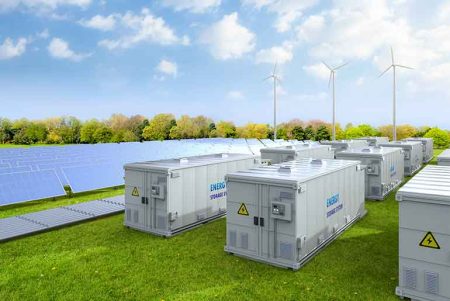
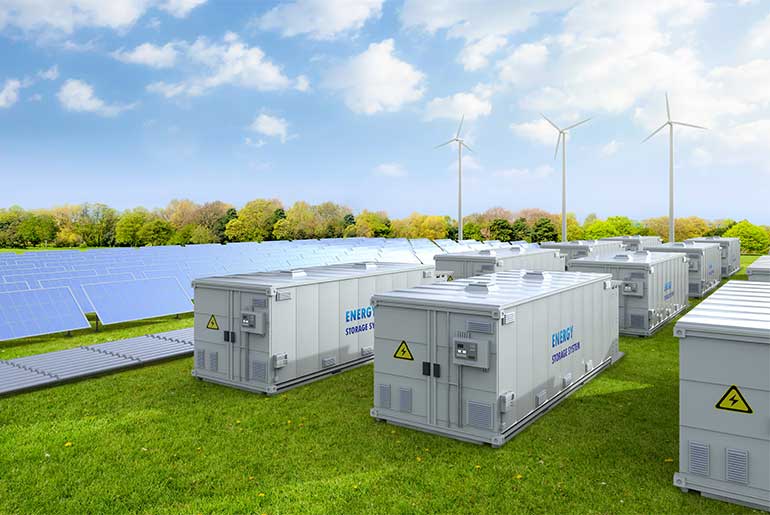
Large Battery Energy Storage Systems (BESS), once thought of as pilot installations, are rapidly becoming critical grid infrastructure. They enable utilities to store excess renewable energy, manage peak demand, increase grid stability and provide reliable electricity when it is needed.
Based on the assessment of the Central Electricity Authority (CEA), it is expected that India will demand a battery energy storage of 236.22 GWh by the years 2031-32. Government schemes like the Viability Gap Funding (VGF) scheme, the Energy Storage Obligation (ESO) scheme, along with competitive bidding from organizations like SECI, NTPC, and POWERGRID have enabled a smooth transition from pilots to commercial deployment of the battery power market.
In this article, we will look at India’s landmark Utility-Scale Battery Projects, the policies driving their growth, and why these large-scale storage systems are becoming the backbone of India’s next-generation power grid.
When Renewable Energy Grows, Storage Must Grow With It
For years, India’s renewable energy story was one milestone after another – more solar parks, taller wind turbines and a steady rise in clean energy capacity. Every new installation moved the country closer to its ambitious target of 500 GW of non-fossil fuel-based power capacity by 2030. But as renewables grew, another question crept up: What happens when clean power is produced but can’t be used right away?
Picture a sunny summer afternoon in western India. Large solar parks are producing electricity at full tilt, often generating more power than the grid can absorb in real time. A few hours later the sun begins to dip below the horizon and demand for electricity begins to rise. Homes are still illuminated, factories still running, metro systems still operating, businesses open through the evening—but solar generation has already ceased. That discrepancy between the timing of when electricity is produced and when it is required has become one of the defining challenges of India’s energy transition.
This is precisely where Utility-Scale Battery Projects in India are changing the conversation. Large-scale Battery Energy Storage Systems (BESS) store excess renewable electricity (which would otherwise be wasted) and release that energy when demand is high. These systems are helping utilities smooth out fluctuations in renewable generation, reduce grid congestion, improve frequency regulation and provide a more steady supply of electricity.
The necessity for such infrastructure is expected to only increase. According to the Central Electricity Authority’s (CEA) National Electricity Plan 2023, the battery energy storage requirements of India are expected to reach 236.22 GWh by the year 2031-32 whereas the power ministry has projected a requirement of around 208 GWh of BESS by 2030 for supporting renewable energy integration. These figures indicate only one thing and that is battery storage is no longer an optional addition to the grid; it is becoming one of the more important foundations.
As India moves towards a cleaner and more flexible power system, the role of utility-scale batteries is expanding beyond energy storage. They are rapidly evolving into strategic grid assets, supporting renewable integration, improving power reliability, and laying the foundation for a resilient electricity network that can meet the country’s future energy demands.
From Pilot Projects to Power Infrastructure
It wasn’t so long ago that utility-scale battery storage in India was limited to pilot projects and demonstration sites. Batteries have often been seen as supporting technologies – good for testing renewable integration, but not yet central to the country’s electricity planning. That perception has changed a lot today.
As India’s renewable energy capacity continues to grow, policymakers have recognised that generating clean electricity alone is not enough. The power system also needs the flexibility to store energy when generation is abundant and deliver it back to the grid precisely when demand rises. This shift has transformed battery storage from an emerging technology into a strategic national infrastructure.
The Government of India recognises this need and has initiated several policy measures to speed up the utility-scale deployment. One of the major contributors to financial viability of independent Battery Energy Storage Systems is Viability Gap Funding (VGF) programme initiated by the Ministry of Power. The scheme was first declared to enable 13.2 GWh of storage but was then increased to 30 GWh, which is indicative of the growing faith of the government in battery storage as one of the main constituents of the power industry.
Policy support has extended beyond financial incentives. The Energy Storage Obligation (ESO) has led obligated entities to gradually bring storage into their energy portfolios, and the Production Linked Incentive (PLI) scheme for Advanced Chemistry Cells is supporting indigenous battery manufacturing. These efforts are working together to build a complete ecosystem – from manufacturing and project development to deployment and long-term operation.
The impact of these reforms is already visible. Central agencies such as SECI, NTPC, and POWERGRID, along with state utilities like GUVNL, are no longer issuing isolated pilot tenders. They are procuring battery storage at gigawatt-hour scale, signalling that utility-scale BESS has entered the mainstream of India’s power planning.
The transformation is also changing how utilities think about batteries. They are not simply investing in storage to keep the electricity on. Modern Battery Energy Storage Systems are anticipated to perform several functions simultaneously including balancing renewable energy, handling peak demand, providing frequency regulation, increasing transmission efficiency, and increasing resilience of the grid.
Every new tender, every commissioned project, and every policy reform tells the same story: India is no longer experimenting with utility-scale batteries. It is building the foundation of a power system where renewable energy and energy storage grow together.
Across India, Utility-Scale Battery Projects Are Redefining the Power Grid
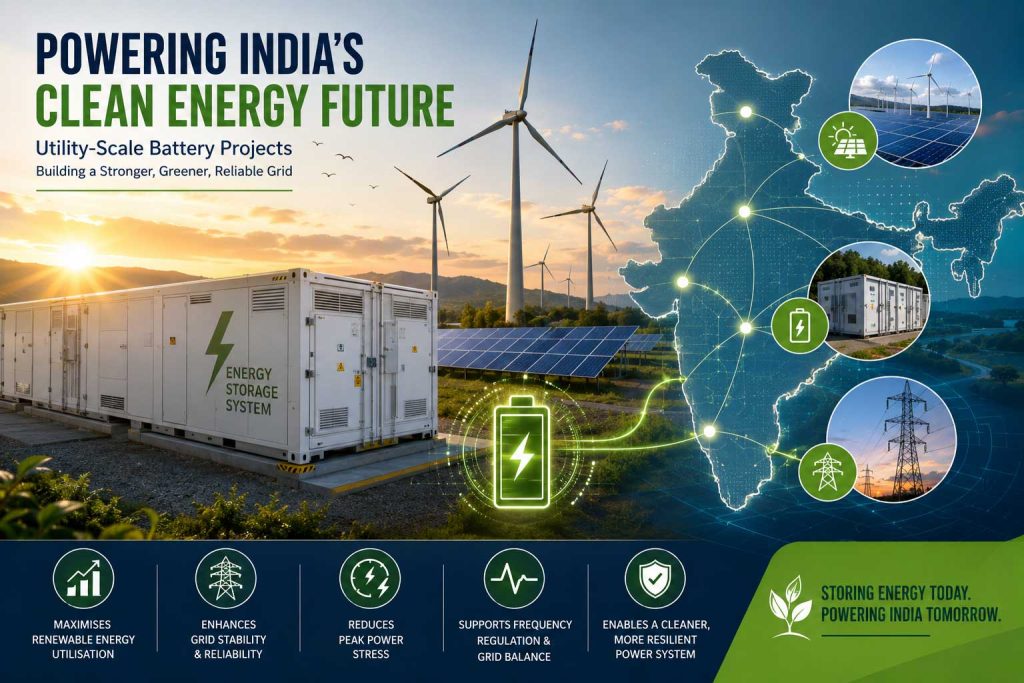
India’s battery storage story cannot be narrated from one particular location. This story starts from Gujarat’s salt deserts and reaches Tamil Nadu’s renewable corridors. It encompasses projects emerging from national level procurement schemes to state-run initiatives in order to transform the way we generate and manage energy. The projects speak of a ceremony—the times of battery storage as an experiment are over and now it’s an important component of India’s energy supply infrastructure.
Khavda: India’s Biggest Renewable Energy Ambition Finds Its Battery Backbone
If there is one place that epitomises India’s clean energy ambitions, it is Khavda in Gujarat’s Kutch district. The area hosts one of the world’s largest renewable energy parks and is expected to host nearly 30 GW of solar and wind capacity once fully developed. A renewable energy hub of that size would also require storage infrastructure to be equally robust to provide clean electricity well after renewable generation begins to vary.
Recognising this requirement, NTPC Green Energy Limited (NGEL) invited bids in 2026 for the development of a 3,300 MWh Battery Energy Storage System (BESS) at its Khavda renewable energy project. The storage facility is designed to soak up surplus renewable electricity during periods of high generation and discharge it during times of peak demand, thereby increasing grid flexibility and reducing the curtailment of renewable energy.
Khavda is not merely an infrastructure project. This is a new planning philosophy where renewable generation and battery storage are designed together rather than separate investments.
SECI Is Taking Battery Storage to a National Scale
While individual projects demonstrate technological progress, it is the Solar Energy Corporation of India (SECI) that has helped create a nationwide market for utility-scale battery storage.
Under the Government of India’s Viability Gap Funding (VGF) programme, SECI has launched one of the country’s largest standalone battery procurement initiatives through its 600 MW/1,200 MWh BESS Tranche-II tender. Unlike early demonstration projects, this programme has been designed to attract competitive private investment while making large-scale battery deployment commercially viable.
But the value of SECI’s programme goes beyond capacity creation. It has built a confidence across the industry. Protracted competitive bidding, long-term procurement arrangements and government backing have encouraged developers, investors and technology suppliers to regard battery storage as a scalable infrastructure opportunity, rather than a niche market.
NTPC Is Integrating Storage into Conventional Power Infrastructure
India’s largest power producer is also redefining the role of battery storage within the country’s electricity system.
NTPC announced that it will place around 5 GWh of Battery Energy Storage Systems at its thermal plants. The batteries are meant to be used alongside current practices. Their main role will be to store renewable energy that has been generated but is not currently being used. This allows NTPC to provide energy during high-demand hours without switching to standard power generation methods.
This approach underscores an important evolution in India’s power sector. Battery storage is no longer confined to renewable energy parks. It is becoming an operational tool that strengthens both renewable and conventional generation assets, while improving overall grid reliability.
POWERGRID Is Strengthening the Transmission Network
As renewable energy capacity increases, transmission infrastructure must become more flexible to handle rapidly changing electricity flows.
Recognising this challenge, POWERGRID has initiated the development of a 375 MW/1,500 MWh standalone Battery Energy Storage System programme across multiple locations in Tamil Nadu by inviting bids to select an implementation partner. The project is expected to support grid stability, improve transmission efficiency, and facilitate higher renewable energy integration in one of India’s leading clean energy states.
Unlike generation-focused projects, POWERGRID’s initiative demonstrates how battery storage is becoming an integral part of transmission planning, ensuring that renewable electricity can be delivered more reliably across the network.
States Are Building the Next Wave of Battery Projects
Alongside central government agencies, several state utilities are accelerating their own battery storage programmes.
Gujarat Urja Vikas Nigam Limited (GUVNL) is continuously enhancing its standalone battery energy storage systems (BESS) procurement process in order to enhance the fast-growing portfolio of renewable energy in the state and make Gujarat the top battery storage market in India. Other states such as Karnataka, Rajasthan, Tamil Nadu and Andhra Pradesh are also incorporating battery storage in their renewable energy projects and grid modernisation projects and are realising the importance of battery storage technology in balancing the intermittent renewable generation and improving power supply reliability. These projects differ in scale and purpose but all point to one significant development: battery storage is slowly morphing into a necessary part of India’s energy infrastructure.
More Than Individual Projects, A New Power System Is Emerging
Viewed individually, these projects are impressive. Viewed together, they reveal something much larger. India is no longer deploying batteries simply to store electricity; it is redesigning its power system around flexibility, reliability, and renewable integration. Utility-scale Battery Energy Storage Systems are becoming the invisible link between renewable generation and uninterrupted power supply, ensuring that clean energy remains available whenever the country needs it.
Beyond Projects: A Market Entering a New Era
Until a few years ago, India’s story of battery storage was all about pilot installations and feasibility studies. The talk today has shifted to commercial deployment, large-scale procurement and long-term planning. Once considered an emerging technology, it is now on its way to becoming a mainstream investment for utilities, transmission companies and renewable energy developers.
One of the biggest changes is the scale at which projects are being planned. Instead of procuring battery systems in a few megawatts, agencies are now issuing tenders measured in megawatt-hours (MWh) and even gigawatt-hours (GWh). This is part of a wider shift in thinking – battery storage is now valued not just for its power capacity, but also for its ability to deliver electricity over a longer duration, and provide multiple services to the grid.
Another key trend is the growth of hybrid renewable energy projects. Increasingly, Battery Energy Storage Systems are being co-planned with solar and wind projects, rather than as an afterthought. The integrated approach increases the use of renewable energy, cuts curtailment and enables developers to offer more reliable power across the day.
The market is also attracting a wider range of participants. The early projects were mostly driven by renewable energy developers, but today’s ecosystem includes transmission utilities, distribution companies (DISCOMS), industrial consumers, data centres and infrastructure operators looking to enhance energy reliability. This growing demand is driving investment not only in battery systems but also in advanced Energy Management Systems (EMS), artificial intelligence-based battery optimisation and digital monitoring platforms.
Despite this momentum, the industry is entering a phase where sustainable growth will depend on balanced economics. Developers are closely watching battery prices, financing costs, and global supply chains, while policymakers continue refining support mechanisms to ensure that large-scale battery deployment remains commercially viable.
The direction, however, is unmistakable. India’s battery storage market is no longer preparing for growth—it has entered it.
Challenges That Could Shape the Next Phase
There is no denying the momentum behind Utility-Scale Battery Projects in India, but scaling the market will require more than ambitious targets and huge tenders. Upfront capital costs are still high and the economics of projects are still affected by reliance on imported battery cells and critical minerals, evolving safety standards and the need for long-term financing. Developers must also balance competitive tariffs with commercial viability and ensure reliable system performance over decades of operation. Scaling up domestic manufacturing, creating a resilient supply chain, and building skilled technical expertise will be as important as deploying additional storage capacity as battery deployments increase’, they said.
The Road Ahead: Building a Grid Ready for Tomorrow
Every major transformation begins with a simple idea. For India’s renewable energy journey, that idea was generating electricity from the sun and the wind. Today, the next chapter is about ensuring that this clean energy is available whenever the country needs it.
Across renewable energy parks, transmission corridors and substations, utility-scale battery projects are quietly emerging to become the bridge between clean energy generation and reliable electricity supply in India. They are helping utilities to manage renewable power, advance grid resiliency and ready the nation’s electricity system for increasing demand from industries, electric vehicles, digital infrastructure and emerging technologies.
The road ahead will certainly present new challenges, but it also offers unprecedented opportunities. In the years ahead, deployment is expected to accelerate thanks to continued policy support, higher private investment, better battery technology and growing domestic manufacturing. As more projects move from planning to commissioning, the outlook for battery storage will no longer be a supporting technology but one of the defining pillars of India’s power sector.
Ultimately, the success of India’s clean energy transition will not just depend on how much renewable electricity the country can generate, but also how well it can store, manage and deliver that energy. “With the scale of projects in the pipeline, utility-scale battery storage is set to be a defining element in powering India’s next generation of sustainable development.”
 Electrify your feed! Click here to join our Whatsapp group and to get the latest updates, expert insights, and innovations driving India’s energy storage revolution.