For years, India’s clean energy journey was measured by one question: how much renewable power can we generate? The country built large solar parks, expanded the number of wind farms, strengthened transmission networks and steadily moved towards its target of 500 GW of non-fossil fuel capacity. The mission was simple — replace conventional electricity generation with cleaner sources. And India made impressive strides. But as the country moved toward more renewable energy, another challenge was quietly emerging. What happens when millions of solar panels stop producing electricity after the sun goes down? What happens when wind generation slows down? And how does a grid continue delivering reliable electricity when renewable energy depends on changing weather conditions? The next phase of India’s energy transition needed more than clean power generation. It needed flexibility. It needed reliability. It needed storage. This is where Battery Storage Policy Updates in India began writing a new chapter in the country’s clean energy transition.
According to the latest announcements made by policy makers, batteries will be one of the essential elements of India’s power infrastructure due to the introduction of several financial support programs, investment incentives, regulatory measures, etc.
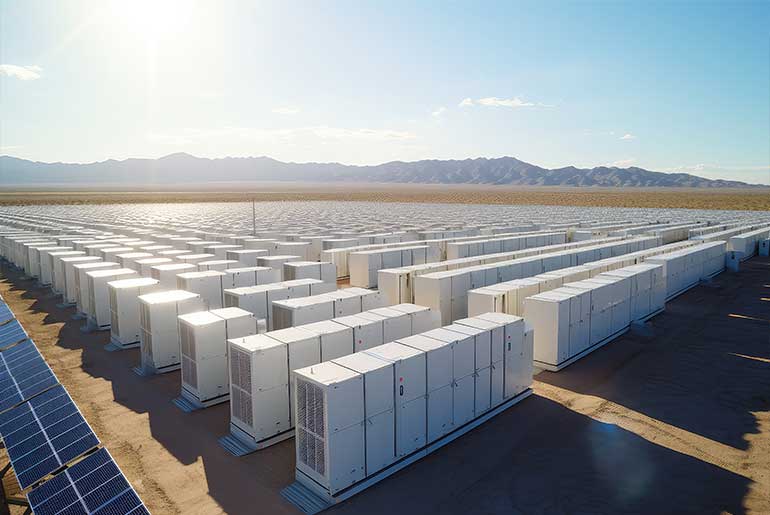
BESSS work as an effective solution to store renewable electricity produced during favorable conditions for later use when demand peaks. It also helps in stabilizing the grid by responding quickly to fluctuations in generation and usage of electric power.
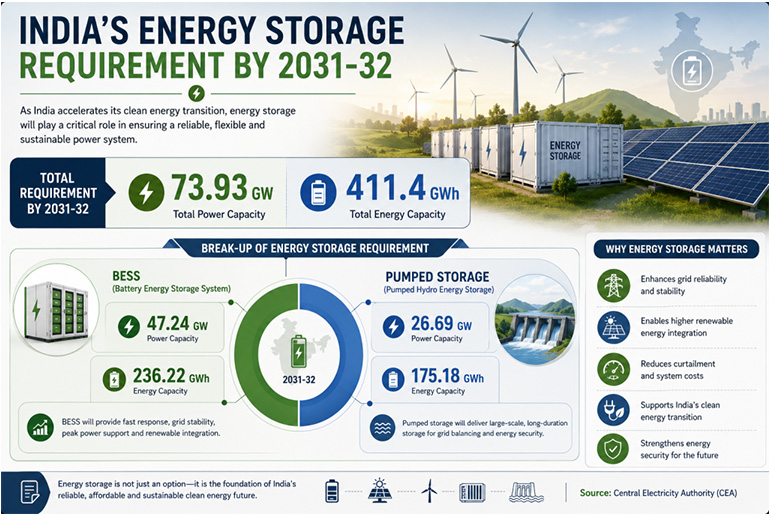
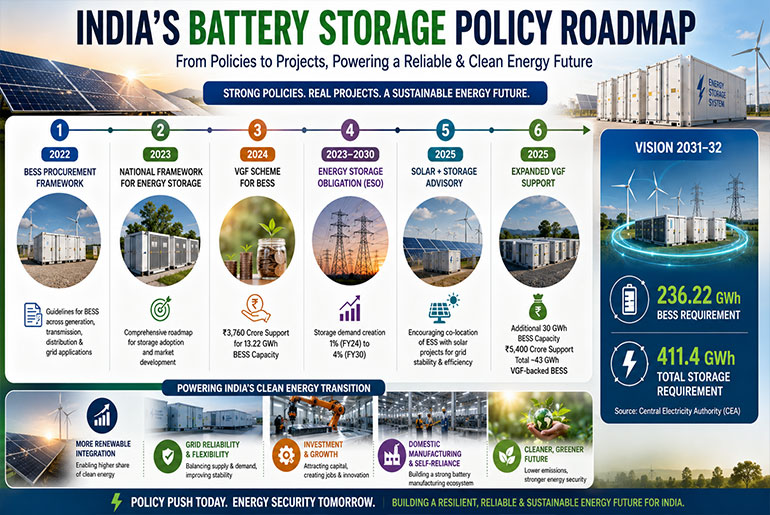
India will need about 236.22 GWh of Battery Energy Storage Systems by FY2031-32, the Central Electricity Authority (CEA) said, highlighting the scale of storage infrastructure required to support future renewable growth.
This policy change is a huge game changer for Battery Energy Storage System companies in India. Manufacturers, developers, technology providers and startups are getting ready for a future in which storing clean electricity is just as important as creating it.
Beyond electricity reliability, these policies also support a larger national objective — strengthening energy security, reducing import dependence, and building a domestic battery manufacturing ecosystem.
Simply put, India’s next energy challenge is not only about producing more green electricity. It is about ensuring that clean power is available whenever and wherever the country needs it.
Major Battery Storage Policy Updates in India
India’s battery storage journey did not accelerate because of a single announcement. It’s been shaped through a series of policy decisions looking at different parts of the same challenge: affordable, bankable, scalable energy storage that can integrate into the electricity grid.
The latest Battery Storage Policy Updates in India, from financial incentives to manufacturing support and regulatory reforms, provide a sense of how policymakers are laying the groundwork for a storage-led clean energy economy.
Viability Gap Funding (VGF) Scheme: Making Large-Scale BESS Projects Affordable
One of the most important developments was the Viability Gap Funding (VGF) scheme of the Ministry of Power for Battery Energy Storage Systems. Early project costs can be a major hurdle for emerging technologies such as grid-scale battery storage. The VGF mechanism seeks to address this gap by providing financial support and improving the economics of projects.
The government had approved a VGF scheme of ₹3,760 crore for supporting development of 13,220 MWh (13.22 GWh) of BESS capacity. Within this framework support is provided to speed up large-scale deployment and to reduce the cost of stored renewable electricity.
Building on this momentum, in June 2025, the government approved another major expansion by supporting an additional 30 GWh of BESS capacity with ₹5,400 crore funding through the Power System Development Fund (PSDF).
The policy shift is expected to benefit India’s growing pipeline of utility-scale battery projects, opening up opportunities for Indian developers, EPC companies, technology suppliers and Battery Energy Storage System Companies.
National Electricity Plan: Developing a Storage Roadmap for India
Funding support can help make projects commercially viable, but long-term planning will determine how much storage the country actually needs. This is where the Central Electricity Authority (CEA) comes in big time. CEA has highlighted the criticality of energy storage for enabling higher proportion of renewable power in India’s electricity mix via national level electricity planning.
The roadmap highlights the need for large scale storage capacity in India in the coming years with significant deployment of Battery Energy Storage Systems. While in previous years storage was treated as a backup infrastructure, national planning now sees batteries as a vital grid asset that can support renewable integration, flexibility and reliability. The shift has changed how utilities, developers and investors see storage projects.
Energy Storage Obligation (ESO): Creating Long-Term Demand
The Ministry of Power has taken another important regulatory step by introducing the Energy Storage Obligation (ESO) framework. ESO’s premise is simple, but powerful: the growth of renewable energy needs to be matched by the growth of storage capacity.
The notified trajectory requires entities to increase the proportion of energy used from storage-backed renewable sources over time. The obligation began at 1% in 2023-24 and is planned to increase gradually to 4% by 2029-30. One of the key requirements is that a significant share of the stored electricity should come from renewable energy sources, so that the storage directly supports India’s transition to clean energy.
The ESO creates something very important for the industry – predictable demand. Manufacturers, investors and developers can plan future projects knowing storage is becoming part of India’s electricity framework, not optional.
ACC Production Linked Incentive Scheme: Building India’s Battery Manufacturing Base
Deploying battery storage is only one side of the story. Manufacturing those batteries domestically is another. Over the years, the battery industry in India was reliant almost exclusively on imported lithium-ion cells. In an attempt to solve this problem, the government introduced the ACC PLI scheme via the Ministry of Heavy Industries.
The objective is to encourage:
- Domestic cell manufacturing
- Gigafactory development
- Advanced battery technologies
- Reduced import dependence
The government has also earmarked 10 GWh capacity for grid-scale stationary storage applications under the National Programme on Advanced Chemistry Cell Battery Storage.
This manufacturing push is expected to strengthen India’s battery supply chain and support companies investing in future energy storage technologies.
Procurement Guidelines and Grid Regulations: Turning Batteries into Energy Assets
In addition to incentives and manufacturing, India needed clear rules on how storage would participate in the electricity system. The Ministry of Power issued guidelines for procurement and utilization of Battery Energy Storage Systems across generation, transmission, and distribution applications.
This was an important turning point because it helped define different business models for storage deployment, including:
- Standalone BESS projects
- Renewable energy plus storage projects
- Grid-support applications
At the same time, the changes in regulation have permitted energy storage to take part in activities that aid in making electrical grid more reliable like balancing renewable power fluctuations and providing support to demand-side management. It is through the combination of these regulations that the batteries have been changed from a backup storage system into a complete new technology.
The message from India’s policy direction is clear: the future electricity grid will not depend only on how much renewable energy the country generates, but also on how effectively it can store and deliver that energy when needed.
How Policies Are Creating Real Battery Storage Projects in India
Policies create the foundation, but projects decide whether an industry truly moves forward. For many years, battery storage in India remained a technology discussed in reports, pilot programmes, and future energy roadmaps. Currently, the scenario is shifting. The recent changes to battery storage policies in India are starting to find expression in tangible projects taking place in various parts of the country linking the aspirations of policy to realities in the marketplace. Government initiatives along with frameworks for the procurement of energy storage systems and renewable energy targets are motivating various stakeholders including government agencies and utilities to go beyond just planning battery storage projects towards actual plant construction.
SECI: Creating India’s Utility-Scale Battery Storage Market
The Solar Energy Corporation of India (SECI) has emerged as one of the most important institutions in India’s storage journey. SECI does not make policies; rather, it plays a vital role in converting government objectives into market opportunities through competitive tenders and procurement of projects. Through standalone BESS tenders, renewable energy projects with storage and firm and dispatchable renewable energy (FDRE) projects, SECI has been instrumental in developing demand visibility for investors and developers. This is a major shift in India’s renewable energy sector.
Earlier, the focus was simple: Generate renewable electricity and supply it to the grid. Today, the model is evolving: Generate renewable electricity, store it, and deliver it when the grid requires power.
This shift is accelerating the growth of solar + storage deployments in India and opening new opportunities for developers, system integrators, and technology providers.
NTPC: Bringing Battery Storage into India’s Power Infrastructure
India’s biggest power producer NTPC is also emerging as a key player in the country’s energy storage transition. As India’s power system matures, NTPC is looking at battery storage not only as a renewable energy solution but as a technology that can bring more flexibility to the wider power network. The company has been advocating for BESS deployment through renewable integration projects and storage projects in various locations.Battery storage can benefit power producers:
- Store excess renewable electricity
- Reduce renewable energy curtailment
- Improve grid reliability
- Support peak electricity demand
The involvement of large public-sector companies signals that BESS is moving from an emerging technology into mainstream energy infrastructure.
State Utilities Accelerate BESS Adoption
The Ministry of Power has taken another important regulatory step by introducing the Energy Storage Obligation (ESO) framework. ESO’s premise is simple, but powerful: the growth of renewable energy needs to be matched by the growth of storage capacity. They also need storage capacity to manage fluctuations and improve power reliability. Utilities such as Gujarat Urja Vikas Nigam Limited (GUVNL) have introduced large-scale battery storage procurement initiatives, making Gujarat one of the important markets for BESS deployment. Similar momentum is emerging across renewable-rich states where state-wise BESS projects are becoming part of future electricity planning.
From Policy Documents to an Industry Ecosystem
The impact of these developments extends far beyond individual projects. Every new storage tender creates demand across an entire value chain:
- Battery manufacturers supplying cells and packs
- EPC companies building projects
- Software companies developing energy management systems
- Technology providers improving safety and efficiency
Here is where the policy implementation meets the growth of Battery Energy Storage System Companies in India. The country’s storage journey is no longer about just announcing targets. It’s about building factories, deploying projects, building supply chains and getting the electricity grid ready for the next chapter of renewable energy growth.
Impact on India’s Battery Storage Industry: From Policy Support to Market Growth
The impact of India’s evolving storage policies extends far beyond government targets and electricity planning. These policies are gradually creating the foundation for an entirely new industrial ecosystem.
Recent Battery Storage Policy Updates in India are determining how companies manufacture batteries, develop projects, invest in technology and build the infrastructure needed for a cleaner and more flexible power system. With the demand for energy storage heating up, certain parts of the industry are beginning to reap the rewards.
Battery Manufacturers: Building India’s Storage Supply Chain
Battery makers have a huge growth opportunity in India’s policy direction. Firms are signing up for large scale battery manufacturing spurred by efforts like the Advanced Chemistry Cell (ACC) Production Linked Incentive scheme, increased demand for BESS and support for local manufacturing.
Companies are now moving beyond traditional battery applications and entering areas such as:
• Lithium-ion cell manufacturing
• Battery pack production
• Grid-scale storage systems
• Advanced battery technologies
The growth of Battery Energy Storage System Companies in India will depend heavily on how quickly the country can establish a strong domestic manufacturing ecosystem and reduce dependence on imported battery components.
Renewable Developers: Moving Towards Round-the-Clock Clean Power
The changing nature of the battery storage landscape has resulted in a complete revamping of the business model of renewable energy developers. During earlier times, solar and wind power developers used to strive only for energy generation. However, as the need for stable and reliable renewable energy increases, they have started integrating generation with storage.
Battery storage enables renewable companies to:
• Supply power beyond generation hours
• Participate in firm and dispatchable renewable energy projects
• Reduce renewable curtailment
• Improve grid reliability
This transition is expected to accelerate the adoption of renewable-plus-storage projects across India.
EPC Companies and Technology Providers: A New Market Opportunity
As storage projects become larger, execution capability will become increasingly important.A utility-scale battery project requires much more than battery cells.It needs:
• Engineering expertise
• Power conversion systems
• Thermal management solutions
• Fire safety technologies
• Monitoring platforms
• Energy management software
This creates new opportunities for EPC companies, system integrators, and technology suppliers supporting India’s storage expansion.
Energy Storage Startups: Driving the Next Wave of Innovation
Alongside large companies, India’s emerging energy storage startups are also finding new opportunities. The future of BESS will not only depend on manufacturing capacity but also on smarter technologies. Startups working on:
• Artificial intelligence-based energy management
• Battery analytics
• Second-life battery solutions
• Advanced software platforms
Battery makers have a huge growth opportunity in India’s policy direction. Firms are signing up for large scale battery manufacturing spurred by efforts like the Advanced Chemistry Cell (ACC) Production Linked Incentive scheme, increased demand for BESS and support for local manufacturing.
Challenges in India’s Battery Storage Policy Journey
India’s battery storage ecosystem is now in a phase of rapid growth underpinned by policy frameworks, government incentives and growing deployment of renewable energy. But developing a mature storage market involves more than announcing targets or approving projects. The real challenge is how to convert ambition into large-scale execution. India’s Battery Storage Policy has come a long way, but there are many hurdles to clear before battery storage can be integrated as a mainstream part of the country’s electricity system.
High Initial Costs and Financing Challenges
The issue of economics remains one of the biggest obstacles. Although battery prices have dropped sharply in the past few years, utility storage projects still require a significant amount of money to invest upfront. Business models have yet to solidify as they are still developing in comparison to traditional power projects.
Programs such as Viability Gap Funding (VGF) are helping to address this challenge, but long-term market mechanisms, predictable revenue models and wider commercial adoption will be required for sustained growth.
Building a Domestic Battery Supply Chain
India’s ambition is not only to deploy battery storage but also to manufacture the technologies behind it.
However, the country is still developing its domestic supply chain for:
• Battery cells
• Critical minerals
• Advanced materials
• Key components
A strong local manufacturing ecosystem will be essential to reduce import dependence and improve energy security.
Government initiatives such as the ACC PLI scheme are important first steps, but building a complete battery value chain will require continuous investment, technology partnerships, and raw material strategies.
Grid Readiness and Large-Scale Integration
A modern and flexible electricity grid is also needed to deploy thousands of megawatt-hours of storage capacity. As the share of renewables in the system grows, grid operators will need advanced forecasting tools, digital infrastructure and well-defined operational frameworks to maximise the value of battery storage. The performance of future storage deployment will depend not just on the batteries, but on how well they can be integrated into India’s power network.
Technology Evolution and Safety Standards
The battery industry is evolving at a rapid pace. Current market leader lithium-ion technology will face potential impacts on future deployment strategies from emerging technologies such as sodium-ion batteries, flow batteries, and other long-duration storage technologies.
As projects get bigger, fields such as battery safety, recycling, thermal management and lifecycle performance will become more important. Policy makers and industry players will need to develop regulations that promote innovation while guaranteeing reliability and safety. India has already laid the groundwork for a robust battery storage ecosystem. The next challenge is going to be to advance policies, technology, manufacturing and infrastructure in concert.
Future Outlook: India’s Storage Decade Begins
For decades, the story of India’s energy transition was written around power generation. The focus was on building larger solar parks, installing more wind turbines, and increasing the share of renewable electricity in the national grid.But the coming decade will tell a different story. The future of clean energy will not only depend on how much electricity India can produce. It will depend on how well the country can store it, manage it and deliver it when millions of consumers want it. That’s why the latest Battery Storage Policy Updates in India are not simply regulatory changes. They mark the start of a new chapter in which energy storage will be a key pillar of the country’s power infrastructure.
India is planning for a future where batteries would be working side-by-side with renewable energy plants, transmission networks, industries and electricity consumers with the Central Electricity Authority projecting huge storage requirements by FY2031-32.
Impacts will be felt throughout the ecosystem. Battery Energy Storage System Companies in India will have opportunities to expand manufacturing capabilities, renewable developers will build more reliable clean energy projects and technology companies will create smarter solutions for managing the grid of the future.
However, the success of this transition will depend on execution. Policies must turn into projects, manufacturing plans must become operational facilities, and innovations must move from laboratories to real-world applications.
India’s battery storage journey is still in its early chapters. The factories are being built. The tenders are being awarded. The technologies are improving. And a new energy ecosystem is slowly taking shape. The next decade will not only decide how India generates clean electricity. It will decide how intelligently the nation stores the power that will drive its future.
 Electrify your feed! Click here to join our Whatsapp group and to get the latest updates, expert insights, and innovations driving India’s energy storage revolution.