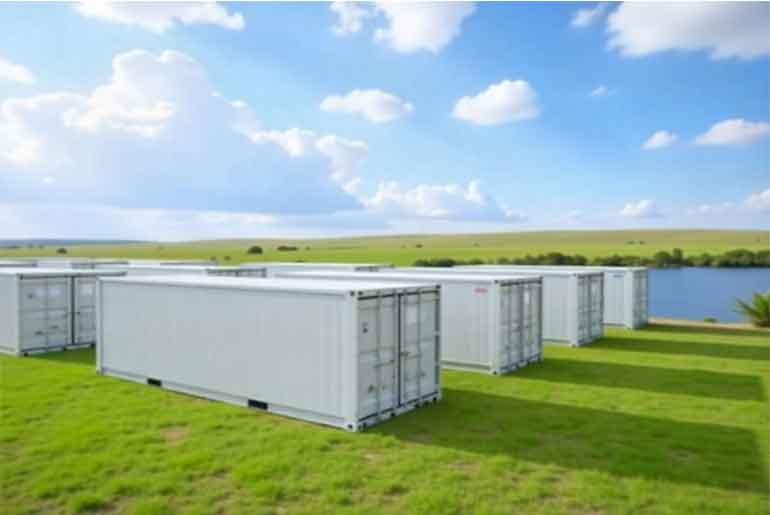
Imagine standing out in the middle of a massive, modern clean energy site. Rows of heavy, industrial steel containers stretch across the horizon. Nearby, Power Conversion Systems (PCS) hum quietly, acting like the brain and nervous system regulating massive flows of electricity. Cooling units pump chilled liquid or air to keep the interior sweet spots at the perfect temperature, while digital control rooms track every single cell, rack, and megawatt flowing into the grid. At first glance, you might think the batteries themselves are the absolute star of the show. It makes sense—they hold the power. But if you look a little closer, there’s a much bigger story happening. Behind every successful storage facility is an engineering team that had to figure out how to source, assemble, protect, and connect thousands of individual high-tech parts so they work together as a single, living asset. This is exactly where top BESS EPC Companies in India come into the picture. They are the executioners turning raw hardware into a functioning reality.
The Massive Scale of India’s Storage Boom
As India pushes faster into renewable energy, battery storage isn’t just a luxury anymore—it is becoming the backbone of our national power grid. Think about the classic clean energy dilemma: solar power peaks gloriously in the middle of the day, but our actual electricity demand spikes right after sunset when everyone turns on their lights and appliances. Wind power is just as unpredictable, blowing hard one hour and dying down the next.
To bridge these gaps, we need massive energy storehouses that can catch this power and let it loose exactly when the grid screams for it.
The numbers heading towards the next decade are staggering. Industry projections from the India Energy Storage Alliance (IESA) show that front-of-the-meter storage deployments in India are on track to hit anywhere between 346 GWh and 544 GWh by 2033. To put that in perspective, India doesn’t just need to buy batteries; it needs the industrial muscle to deploy battery infrastructure at a scale we have never seen before.
Sourcing elite hardware from the Leading BESS Manufacturers in India is a great starting foundation, but actually getting a multi-megawatt project up and running smoothly falls squarely on the shoulders of specialized Engineering, Procurement, and Construction (EPC) contractors. Furthermore, as aggressive developers rush to bid on the massive utility contracts opening up through current BESS Tender Opportunities in India, having an experienced, battle-tested EPC partner is becoming the ultimate competitive advantage.
What Does a BESS EPC Company Actually Do?
If you talk to someone outside the industry, they might think an EPC company just acts as a general contractor who hires laborers and watches a site get built. In the world of utility-scale battery storage, however, the job is immensely technical and highly volatile.
A modern BESS site is a complex web of batteries, high-power electronics, heavy transformers, communication networks, fire-suppression systems, and structural enclosures. The EPC company has to act as the master coordinator for all of it, taking the project through four distinct, high-pressure phases.
1. Detailed Engineering & Sizing
Long before a single shovel hits the dirt, engineers have to run complex simulations. They study how hard the battery will be cycled (is it doing daily power arbitrage, or is it fixing split-second grid frequency fluctuations?), local weather extremes, and how the local grid behaves.
A major part of this design phase involves mapping out heat loads. Because battery cells are incredibly sensitive to temperature spikes, EPC firms must integrate advanced Thermal Management Systems for BESS to ensure the racks stay cool and never risk hitting a dangerous thermal runaway threshold.
2. Strategic Procurement
Once the blueprints are locked in, the logistics puzzle begins. The EPC firm has to orchestrate orders from dozens of specialized global and domestic suppliers. A delay on a single shipment of high-voltage switchgear or control software can stall a multi-crore project and trigger massive delay penalties.
3. Civil & Electrical Construction
This is where the physical heavy lifting happens. Teams prepare foundations that can support the immense weight of dense battery enclosures, route miles of specialized DC and AC cabling, and build out localized substations.
4. Commissioning & Grid Interconnection
This is arguably the hardest step. The EPC team conducts rigorous testing across thousands of digital checkpoints to ensure the facility can synchronize with the utility grid without causing power trips, voltage sags, or safety risks.
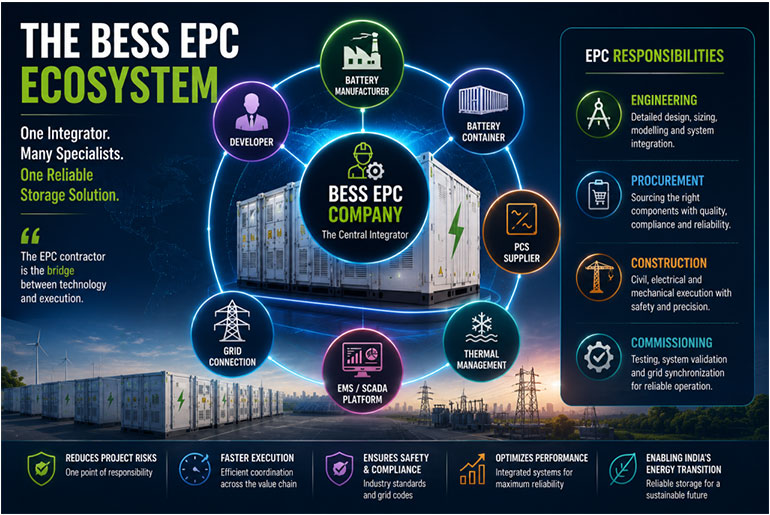
To see how all these pieces fit together, look at how a project is structured from the ground up:
At the very top of the hierarchy sits the Project Developer—this is the asset owner or investor who finances the project and secures the land and grid allocation.
Directly underneath them is the BESS EPC Company, acting as the absolute central coordinator. They bridge the gap between the developer’s high-level vision and the complex technical execution on the ground. The EPC company manages three core, parallel engineering streams:
- The Power Storage Stream: The EPC coordinates with Battery Manufacturers to source the physical cells and racks that will actually hold the energy.
- The Protection & Housing Stream: The EPC collaborates with Battery Enclosure specialists to supply the structural units housing the batteries, which include the critical cooling and automated fire safety systems.
- The Power Conversion Stream: The EPC interfaces with PCS (Power Conversion System) Suppliers to integrate the heavy-duty inverters and transformers required to convert and step up the electricity for the grid.
By tying these three specialized supply chains together, the EPC company ensures every single component communicates perfectly to deliver a unified, operational energy asset.
The Market Leaders Driving the Industry
Because executing these projects requires deep electrical engineering expertise, a distinct group of heavyweights and fast-rising players are dominating the Indian BESS market right now.
Tata Power Solar Systems
A true legacy giant in India’s clean energy space. They have a massive history of handling complex solar-plus-storage hybrids. One of their crown jewels is a 100 MW solar plant integrated with a 120 MWh battery system in Chhattisgarh. They are also actively working on bringing 100 MW of BESS directly into Mumbai’s crowded urban network to keep the city’s power completely resilient.
Sterling and Wilson Renewable Energy
Known worldwide for executing massive utility-scale infrastructure, Sterling and Wilson has transitioned beautifully into energy storage. Their strength lies in managing huge project footprints and working seamlessly across multiple types of cell chemistries and hybrid configurations.
Larsen & Toubro (L&T)
When a project requires serious high-voltage grid substations, heavy transmission lines, and world-class civil engineering, L&T is usually the top choice. They treat BESS installations like the massive infrastructure assets they are, bringing unmatched structural and grid-connectivity expertise to the table.
Ganesh Green Bharat
If you want to look at the fastest-rising star in the industry, this is it. They completely shocked the market by securing a massive 1,000 MWh BESS EPC contract from NTPC Renewable Energy Limited. This win highlights a fascinating evolution in the Indian market: the rise of highly agile, domestic players who can combine traditional engineering with rapid technology integration.
Fluence & Wärtsilä
These are the global technology and software specialists. They bring decades of international deployment experience to Indian shores. While they often act as technology integrators rather than pure civil builders, their advanced energy management software platforms are vital for EPCs who need to maximize how efficiently a battery charges and discharges into the grid.
Sungrow & Amara Raja
While Sungrow dominates the power electronics side by partnering with contractors to supply robust inverters, legacy names like Amara Raja are aggressively building out local manufacturing and supply chains. EPC contractors frequently collaborate with certified PCS Suppliers for BESS in India like these to guarantee that the bi-directional power flow between DC battery power and AC grid power happens with near-zero efficiency losses.
Real-World Lessons from India’s Megawatt Milestones
We don’t have to look at hypothetical plans to see these companies in action—the proof is already live across the country.
- The Khavda Mega Project (Gujarat): Out in the salt flats of Gujarat, Adani Green Energy commissioned a staggering 3.37 GWh BESS facility. The sheer scale of coordinating thousands of moving parts in an incredibly harsh, hot environment is a masterclass in modern procurement and logistics. It stands proud as one of the Largest BESS Projects in India, showing the world exactly what our domestic supply chain can handle.
- The Rajnandgaon Project (Chhattisgarh): This Tata Power Solar project proved to the commercial market that combining large-scale solar arrays with a 120 MWh battery could successfully deliver smooth, reliable, round-the-clock clean energy to the regional grid.
- The Kilokari Substation (Delhi): Proving that storage isn’t just for open deserts, this urban pilot project in the heart of Delhi showed how localized battery containers can step in during peak summer afternoons to stop local distribution transformers from overloading.
The Hard Realities of Building BESS
Despite all the excitement, building a utility-scale battery facility is not a walk in the park. BESS EPC companies run into intense technical bottlenecks every day.
The biggest hurdle isn’t placing the battery racks—it’s the grid interconnection. Getting power utilities to approve connection points, matching protection relays so a minor grid glitch doesn’t fry or trip the entire battery bank, and managing transmission line losses requires top-tier electrical engineering.
Then there is the logistical shift toward modular design. The industry is rapidly abandoning the old method of assembling individual battery components inside a building on-site. Instead, everyone is moving toward factory-assembled, pre-tested container blocks.
To pull this off, EPCs must source their enclosures from an approved Battery Container Manufacturer in India to guarantee that structural integrity, liquid-cooling loops, and automated fire suppression systems are flawlessly built-in long before the asset ever arrives at the project site.
Turning Ambitions into Reality
At the end of the day, it is easy to get caught up in the raw science of energy storage—debating cell chemistries, lithium pricing, and degradation curves. But a battery sitting in a warehouse helps absolutely no one.
It takes a dedicated BESS EPC company to take those cells, house them securely, wire them safely, cool them efficiently, and plug them securely into the Indian power grid. As hundreds of gigawatt-hours of new storage tenders continue to flood the market, these engineering firms are the ones truly building the foundation for India’s clean energy future. The batteries might hold the power, but the EPC companies are the ones making sure it actually lights up our homes.
 Electrify your feed! Click here to join our Whatsapp group and to get the latest updates, expert insights, and innovations driving India’s energy storage revolution.