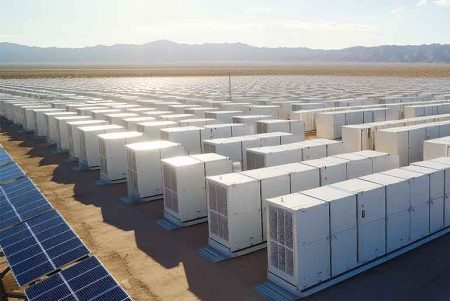
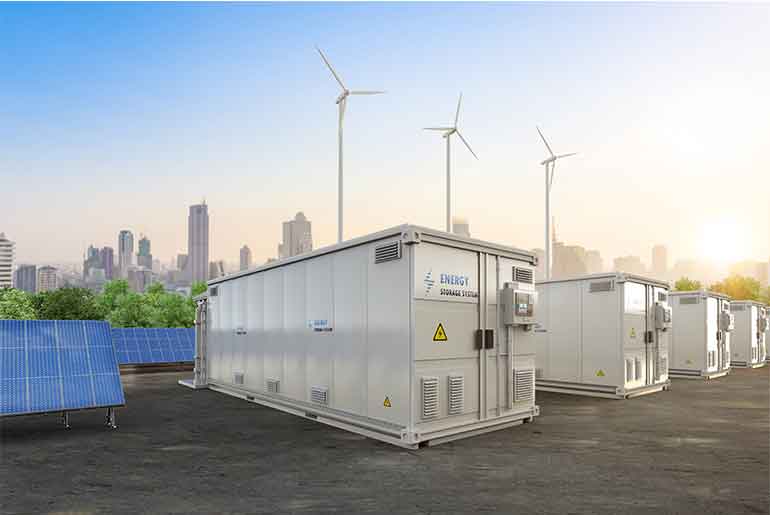
Have you ever wondered what happens to solar power after sunset? For years, India’s renewable energy journey looked fairly simple. Build more solar parks. Install more wind turbines. Add more renewable capacity to the grid. And to be fair, that strategy worked. India today stands among the world’s fastest-growing renewable energy markets and is steadily moving towards its ambitious target of 500 GW of non-fossil fuel capacity. But as renewable energy expanded across the country, a new challenge quietly emerged. What happens when the sun goes down? What happens when the wind slows down? And what happens when electricity demand suddenly rises but renewable energy generation doesn’t? Generating clean energy was only half the challenge. Storing it has become the other half. This is where Battery Energy Storage Systems (BESS) are beginning to change the entire conversation. A few years ago, battery storage was mostly discussed in policy papers, conference halls, and pilot projects. Today, it is becoming one of the most important pillars of India’s energy transition. In fact, India has already crossed the 1 GWh milestone in operational battery storage capacity, while another 35.8 GWh is currently under construction. Since 2021, approximately 83 GWh of battery storage projects have been tendered across the country. Those numbers tell us something important. Battery storage is no longer an experiment. It is becoming infrastructure. And as this transformation gathers momentum, a new group of companies is stepping into the spotlight. These are the leading BESS manufacturers in India.
Some are building gigafactories capable of producing millions of battery cells. Some are developing utility-scale storage systems. Others are integrating advanced software, thermal management solutions, and energy management platforms to help stabilize the grid. Together, they are helping build the backbone of India’s future energy system. The question is no longer whether battery storage will become essential. The question is: which leading BESS manufacturers in India are best positioned to shape this rapidly growing market?
India’s BESS Market Has Finally Moved Beyond the Pilot Stage
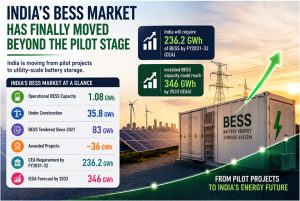
Think back five years. Whenever battery storage was discussed, the conversation almost always revolved around future possibilities. People spoke about potential. They spoke about opportunities. They spoke about what might happen one day. Today, that day has arrived. India ended 2025 with approximately 1.08 GWh of operational battery storage capacity. At the same time, another 35.8 GWh of projects are under construction. That difference alone tells an incredible story. The industry is moving from pilot projects to utility-scale deployment. And this is only the beginning.
According to the Central Electricity Authority (CEA), India will require approximately 236.2 GWh of Battery Energy Storage Systems by FY2031-32.
The India Energy Storage Alliance (IESA) believes installed BESS capacity could reach 346 GWh by 2033. Under an accelerated adoption scenario, that figure could climb as high as 544 GWh.
In simple words, the market we see today is only a fraction of the market that is likely to exist by the next decade.
India’s BESS Market at a Glance
- Operational BESS Capacity: 1.08 GWh
- Under Construction: 35.8 GWh
- BESS Tendered Since 2021: 83 GWh
- Awarded Projects: ~36 GWh
- CEA Requirement by FY2031-32: 236.2 GWh
- IESA Forecast by 2033: 346 GWh
Now here’s where things become really interesting. Behind every storage project, every battery container, every utility-scale installation, and every gigafactory announcement, there is an increasingly competitive ecosystem of manufacturers. Some are established battery giants. Some are ambitious newcomers. And some are companies that many people outside the energy industry have barely heard of. Yet all of them are helping shape India’s storage future.
What’s Fueling India’s Battery Storage Boom?
If someone had asked this question a few years ago, the answer would have been straightforward. Government policy. Today, the answer is much bigger.
- The first driver is renewable energy growth itself. As solar and wind installations continue to increase, the grid requires flexibility. Renewable energy generates electricity according to weather conditions, not according to consumer demand. Battery storage helps bridge that gap.
- The second driver is grid stability. Utilities increasingly need resources capable of responding within seconds to fluctuations in generation and demand. BESS is becoming one of the fastest and most effective solutions available.
- The third driver is government support. The Ministry of Power has already approved Viability Gap Funding (VGF) support for 13.2 GWh of standalone BESS projects. At the same time, the government is working on a much larger ₹15,000 crore storage support programme that could support 50 GWh of battery storage, 60 GWh of pumped storage and 2 GWh of emerging storage technologies.
- Then there is the manufacturing push. Through the ACC Production Linked Incentive (PLI) scheme, India is encouraging domestic battery manufacturing and reducing dependence on imported cells.
- And finally, there is the project pipeline. SECI has emerged as India’s primary market-maker for utility-scale battery storage. The agency has already launched some of the country’s largest storage tenders, including standalone battery projects and renewable energy projects coupled with storage.
NTPC, meanwhile, is targeting 22 GWh of BESS capacity by 2032 and has already awarded approximately 5 GWh of projects under VGF-supported schemes.
For manufacturers, developers, and system integrators, this growing project pipeline represents one of the biggest BESS Tender Opportunity in India today.
Naturally, where there is opportunity, competition follows. The race among the leading BESS manufacturers in India has officially begun. How We Identified the Leading BESS Manufacturers in India
Before discussing the companies themselves, it is important to understand one thing. Not all BESS companies play the same role. Some manufacture battery cells. Some manufacture battery packs. Some focus on utility-scale deployments. Others specialize in software, thermal management, and system integration.
That is why we evaluated companies across six key parameters:
- Cell Manufacturing Capability
- BESS Manufacturing Capability
- Utility-Scale Deployment Experience
- Technology Position
- Financial Strength Medium
- Expansion Plans
Rather than simply ranking companies based on revenue or announced investments, we looked at their ability to influence India’s future storage ecosystem. After extensive research, seven companies emerged as the most significant players shaping India’s battery storage landscape today. Now comes the most interesting part of the story. When people talk about battery storage, they often imagine a single industry moving in one direction. But that’s not really what’s happening. India’s storage ecosystem is being built by three different types of players.
The first group consists of established battery manufacturers that are expanding into lithium-ion technology and utility-scale storage. The second group includes companies building giant battery manufacturing ecosystems that could dominate the market later in the decade. And the third group consists of pure-play BESS specialists focused entirely on energy storage systems. Together, these companies represent the leading BESS manufacturers in India today.
The Integrated Battery & BESS Leaders
Amara Raja Energy & Mobility
Let’s start with a company most Indians already know. For decades, Amara Raja has been associated with automotive batteries. Chances are, if you’ve owned a vehicle, you’ve come across the brand at some point.
But here’s what makes the company interesting today. Amara Raja doesn’t want to remain just a battery company. It wants to become a major player in India’s energy storage future. Through its ambitious Giga Corridor project in Telangana, the company is developing a 16 GWh lithium-ion cell manufacturing ecosystem alongside a 5 GWh battery pack manufacturing facility. And unlike some companies that are still building future roadmaps, Amara Raja already has meaningful deployment experience. The company has crossed the 1 GWh milestone in lithium battery storage deployments, particularly in the telecom sector.
Exide Industries
If Amara Raja represents one side of India’s battery story, Exide represents the other. For generations, Exide has been one of India’s most trusted battery brands. But just like the rest of the industry, the company understands that the future belongs to lithium-ion technology and energy storage systems. Through Exide Energy Solutions, the company is developing a 12 GWh lithium-ion cell manufacturing facility in Bengaluru.
What’s particularly impressive about Exide is not just the scale of its investment. It’s the financial strength behind it. Building battery manufacturing facilities requires enormous capital, long-term commitment, and patience. Few companies possess the balance sheet strength needed to make such investments. Exide does.
The company may still be building its utility-scale storage track record, but its manufacturing capabilities and financial resources ensure that it remains one of the leading BESS manufacturers in India.
Waaree Energy Storage Solutions
Now here’s a company that surprises many people. Ask most industry professionals about Waaree and the first thing they’ll mention is solar. And understandably so. Waaree has built one of India’s largest solar manufacturing businesses. But over the past few years, the company has quietly begun expanding into battery storage. And not in a small way. Waaree Energy Storage Solutions is pursuing a battery manufacturing platform that could eventually reach 20 GWh.
The company is also developing a major integrated battery manufacturing project in Andhra Pradesh while strengthening its utility-scale storage capabilities. What really caught our attention, however, was the scale of some of the projects linked to Waaree’s storage business.
The company has been associated with a 350 MW / 1,400 MWh BESS EPC contract—one of the largest publicly disclosed storage contracts involving an Indian company. This highlights another important trend.
As the storage market grows, the role of BESS EPC Companies in India will become increasingly important. Manufacturing batteries is one thing. Delivering utility-scale projects is another. Waaree appears to be positioning itself for both.
The Emerging Gigafactory Giants
Reliance New Energy
Whenever Reliance enters an industry, people pay attention. Battery storage is no exception. But here’s an important distinction. Reliance is not simply trying to build a battery factory. It is attempting to build an entire energy ecosystem. At Jamnagar, the company is developing a massive clean-energy platform that includes battery materials, cell manufacturing, battery packs, storage systems, renewable energy infrastructure, and more. Its long-term ambitions are enormous. While some competitors are talking about a few gigawatt-hours of manufacturing capacity, Reliance has discussed plans that could eventually scale towards 100 GWh.
Of course, much of this story is still unfolding. Reliance is currently stronger in future potential than present deployment. But if its vision materialises, the company could become one of the most influential names among the leading BESS manufacturers in India.
Agratas
Every industry has a company that feels like a long-term bet. In India’s battery sector, that company is Agratas.
Backed by the Tata Group, Agratas is building a battery manufacturing platform that spans both India and the United Kingdom. Its planned facility in Gujarat is expected to reach 20 GWh, while its UK project targets 40 GWh. Together, that represents a 60 GWh manufacturing vision. What’s particularly interesting about Agratas is the ecosystem surrounding it. Think about it. The company sits within a group that already includes automotive manufacturing, engineering expertise, infrastructure capabilities, and energy businesses.
That creates opportunities that very few competitors can match. Today, Agratas remains a future-focused story rather than a deployment-focused one. But tomorrow could be very different.
The Pure-Play BESS Specialists
GoodEnough Energy
Now let’s talk about one of the most talked-about names in India’s storage sector. GoodEnough Energy is different from most companies on this list. It isn’t trying to become another automotive battery manufacturer. It isn’t trying to build a massive industrial conglomerate. Its focus is much more specific- Battery Energy Storage Systems.
The company commissioned a 7 GWh BESS manufacturing facility in Noida and has announced plans to expand that capacity to 25 GWh over the coming years.
That alone makes it one of the most significant pure-play storage companies in the country. GoodEnough’s strength lies in complete storage systems rather than cell manufacturing. Its expertise includes energy storage integration, battery packs, thermal management, and utility-scale storage solutions. As larger projects emerge across the country, the importance of every Battery Container Manufacturer in India is likely to increase significantly. And companies like GoodEnough are positioning themselves right at the centre of that opportunity.
RePlus Engitech
If GoodEnough represents manufacturing scale, RePlus represents execution. And that’s an important distinction. Because in the storage business, capacity announcements are only part of the story. Projects matter. Deployments matter. Execution matters. RePlus has built a strong reputation by focusing on exactly those areas. The company has delivered more than 100 MWh of storage projects, completed dozens of deployments, and secured major contracts including a 250 MWh storage agreement with Hero Future Energies.
But what makes RePlus particularly interesting is its technology focus. The company has invested heavily in liquid-cooled storage systems, advanced energy management platforms, battery analytics, and intelligent controls. In many ways, RePlus reflects where the industry is heading. As storage projects become larger and more sophisticated, technologies such as Thermal Management Systems for BESS, advanced software platforms, and intelligent controls will become increasingly important. The future of storage will not be determined by batteries alone. It will also be shaped by the systems that make those batteries smarter, safer, and more efficient. And that is exactly where RePlus is focusing its efforts.
Looking across these seven companies, one thing becomes clear. India’s storage revolution is not being built by a single type of player. It is being built by battery giants, gigafactory developers, project integrators, technology specialists, and system manufacturers working together to create an entirely new industry.
And the race is only just beginning.
What Will Separate the Winners from Everyone Else?
Now that we’ve looked at the leading BESS manufacturers in India, let’s ask a bigger question. What will actually determine who leads the market over the next decade? Because here’s the reality. The battery storage industry is still in its early stages. Yes, factories are being announced. Yes, projects are being awarded. Yes, investments are flowing into the sector. But the companies that dominate the market in 2035 may not necessarily be the ones leading it today. So what will separate the winners from everyone else?
Manufacturing Scale Will Matter
Let’s start with the obvious one.
Scale
India’s storage requirements are expected to increase dramatically over the next decade. The Central Electricity Authority estimates the country could require 236.2 GWh of battery energy storage by FY2031-32.
That is a massive number. Meeting that demand will require more than project announcements. It will require manufacturing capacity. Lots of it.
This is where companies such as Amara Raja, Exide, Reliance, Agratas, and Waaree have a significant advantage. They are investing billions of rupees into battery manufacturing ecosystems that could support India’s long-term storage ambitions.
As demand rises, manufacturing scale may become one of the biggest competitive advantages in the industry.
Cell Manufacturing Could Become a Game Changer
For many years, India’s battery industry relied heavily on imported cells. That model is slowly beginning to change. Today, some of the leading BESS manufacturers in India are investing aggressively in domestic cell manufacturing through gigafactories and integrated battery ecosystems.
Why is that important?
Because whoever controls the cell often controls the economics of the battery. Domestic manufacturing can help reduce import dependence, strengthen supply chains, improve energy security, and create long-term cost advantages. This is one reason why companies such as Amara Raja, Exide, Reliance, Agratas, and Waaree are attracting so much attention. They are not simply assembling batteries. They are trying to build the foundations of a domestic battery manufacturing ecosystem.
Execution May Be More Important Than Announcements
Here’s something that often gets overlooked. Building a factory is one challenge. Delivering a large battery storage project is another. The industry is entering a phase where execution will matter more than announcements. This is especially true as India moves towards some of the Largest BESS Projects in India. Utility-scale storage projects require engineering expertise, system integration capabilities, project management experience, and long-term operational reliability. This is where companies such as RePlus and GoodEnough have created strong positions for themselves. Their experience in storage integration and project execution could become increasingly valuable as project sizes continue to grow.
The Future Isn’t Just About Batteries
This may sound surprising, but the future of battery storage isn’t only about batteries. Think about a modern Battery Energy Storage System. A battery is just one part of the solution.
You also need:
- Energy Management Systems (EMS)
- Fire protection systems
- Thermal management solutions
- Battery containers
- Power Conversion Systems (PCS)
- Monitoring and analytics platforms
In many cases, these supporting technologies determine whether a project succeeds or fails.
This is why conversations around Thermal Management Systems for BESS are becoming increasingly important. As projects become larger and more energy-dense, effective thermal management will play a critical role in safety, performance, and battery life. Similarly, discussions around PCS Suppliers for BESS in India are becoming more prominent because power conversion systems serve as the bridge between batteries and the electricity grid.
The companies that successfully integrate all these technologies may ultimately gain an edge over competitors focused solely on battery manufacturing.
The Rise of the BESS Ecosystem
One of the most fascinating aspects of India’s storage industry is that no single company can do everything alone.
Every utility-scale storage project depends on a wider ecosystem. Battery manufacturers need component suppliers. System integrators need software providers. Developers need EPC contractors. Utilities need technology partners. This is creating opportunities across the value chain.
In fact, the rise of BESS EPC Companies in India, Battery Container Manufacturers in India, software providers, thermal management specialists, and PCS suppliers is becoming one of the most interesting stories in the sector.
The battery storage revolution is not being built by manufacturers alone. It is being built by an entire ecosystem.
The Next Decade Belongs to the Leading BESS Manufacturers in India
Let’s go back to the question we asked at the beginning. What happens to solar power after sunset?
A decade ago, very few people were thinking about that question. Today, some of India’s largest companies are investing billions of rupees to answer it. And that’s what makes this moment so important. Battery storage is no longer a niche technology.
It is becoming a critical part of India’s energy infrastructure. The numbers make that clear. India has already crossed 1 GWh of operational battery storage capacity. Another 35.8 GWh is under construction. Around 83 GWh of projects have already been tendered. The country could require more than 236 GWh of battery storage by FY2031-32. That is not a small market. That is the foundation of an entirely new industry. And at the centre of that industry are the leading BESS manufacturers in India. Some are building gigafactories. Some are deploying utility-scale storage systems. Some are developing advanced software platforms. Others are creating the technologies that make battery storage safer, smarter, and more efficient. Together, they are helping transform battery storage from an emerging technology into a critical piece of national infrastructure.
The race has only just begun. The factories are still being built. The projects are still being awarded. The technology is still evolving. But one thing is already becoming clear. The companies that combine manufacturing scale, technological innovation, execution capability, and long-term vision will be the ones that define India’s storage future. And as India’s renewable energy journey continues, the role of the leading BESS manufacturers in India will only become more important. Because in the end, the future of clean energy isn’t just about generating power. It’s about making sure that power is available exactly when we need it.
 Electrify your feed! Click here to join our Whatsapp group and to get the latest updates, expert insights, and innovations driving India’s energy storage revolution.