For decades, electricity was viewed as a fixed operating expense—an unavoidable cost of running a factory, warehouse, office, or commercial facility. Today, that mindset is rapidly changing. Soaring electricity rates, skyrocketing peak demand charges, worries about grid reliability and aggressive corporate sustainability goals are prompting businesses to reconsider not only how they consume power, but how they manage it.
India’s industrial sector is at the heart of this transformation. The International Energy Agency (IEA) has reported that 36% of India’s electricity demand growth from 2021 to 2025 is due to the industrial sectors. The demand pro is going to rise by an average of 6.4% annually until 2030.As manufacturing expands under initiatives like Make in India and energy-intensive sectors continue to grow, electricity is becoming one of the most significant operational costs for businesses rather than just another utility bill.
India’s commercial and industrial sector is expected to be one of the fastest growing battery storage markets as businesses increasingly adopt behind-the-meter energy storage to reduce electricity costs, improve energy resilience and maximise renewable energy consumption, says the India Energy Storage Alliance (IESA). The increasing demand of industry for power, Time-of-Day tariffs and corporate decarbonisation commitments are accelerating this shift.
The pressure is compounded by India’s rapidly increasing power demand. The country’s peak electricity requirement has already exceeded 270 GW and is expected to reach 300 GW in the coming years, driven by industrial expansion, electric mobility, air-conditioner demand and explosive growth in data centres. As the grid becomes more heavily loaded during peak hours, businesses face higher electricity costs, voltage fluctuations and supply constraints.
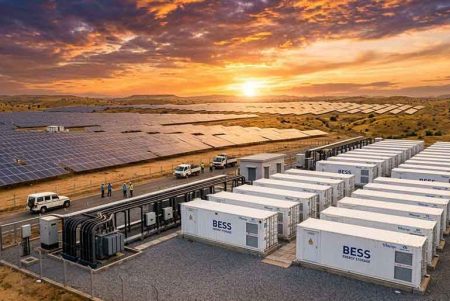
Meanwhile, businesses are making huge investments in green energy through rooftop solar panels and open-access power purchase contracts to reduce their costs and meet their ESG commitments. But solar power only works during the day, and production plants, hospitals, IT campuses and logistics centers often operate well into the night. Without energy storage, a big part of the benefits of renewable energy is wasted when the sun sets.
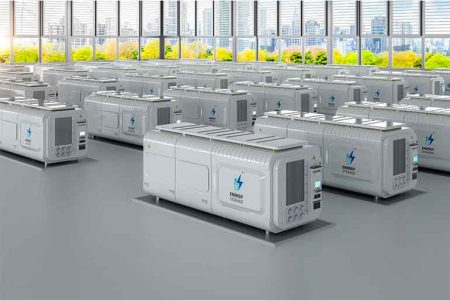
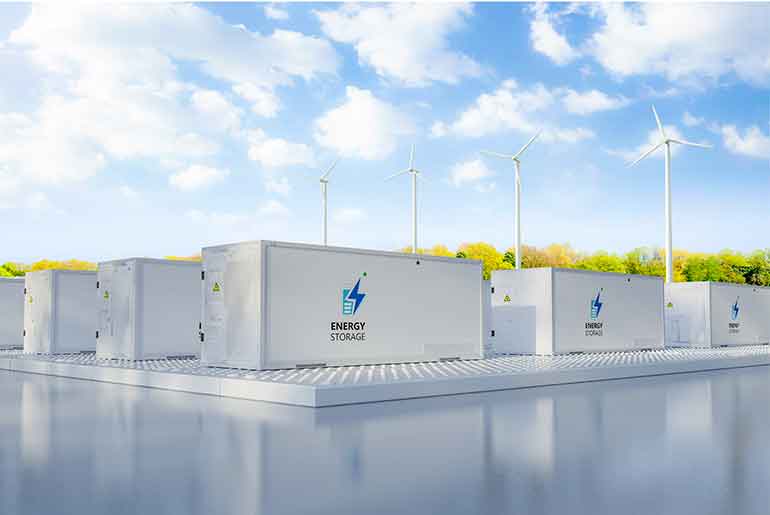
That’s where Commercial & Industrial Battery Energy Storage Systems (C&I BESS) come in and change the equation. Modern battery systems do more than just provide emergency backup during outages – they enable businesses to store cheap solar or off-peak electricity and use it when electricity prices are highest. That means lower peak demand charges, better power reliability, more use of renewable energy and more control over one of the fastest growing costs of doing business.
The shift is about far more than batteries. It’s part of a bigger change in how companies think about energy itself. Companies aren’t just looking for uninterrupted power anymore, they’re looking for predictable costs, operational resilience and more control of their energy infrastructure. Over the next decade, companies that get smart about electricity are likely to have a competitive advantage that is as significant as investments in automation, digitalisation or advanced manufacturing. This is why Commercial & Industrial Battery Energy Storage Systems are fast becoming one of the most important growth opportunities in India’s changing energy landscape.
From Backup Power to Profit Centre
For decades, businesses thought of batteries as an emergency backup system that would sit idle until the grid went down. That role is rapidly changing today. Today’s Commercial & Industrial Battery Energy Storage Systems are designed to deliver value every day by helping businesses reduce electricity costs, improve operational efficiency and optimise the use of renewable energy.
Peak shaving is one of the biggest opportunities. Demand charges for many industrial customers are based on not only total units of electricity consumed in a billing period but also on the highest usage in that billing period. During these short peaks in demand, battery systems discharge stored energy and reduce the maximum load drawn from the grid, helping businesses cut monthly electricity bills without impacting operations.
The economics only improve with the roll-out of( Time of Day) ToD tariffs across India. Rather than paying for expensive electricity during the evening peak, businesses can charge batteries with cheap electricity – or when rooftop solar generation is high – and then use that stored energy when tariffs increase. This is called energy arbitrage , and it is what makes battery storage a financial asset that can yield measurable cost savings .
For facilities with rooftop solar, the benefits extend even further. Without storage, surplus solar power generated during the day is often underutilised once production declines in the evening. Battery systems bridge this gap by storing excess renewable energy for later use, increasing solar self-consumption while reducing dependence on expensive grid electricity and diesel generators.
Maybe the biggest change is that one battery system doesn’t just do one thing anymore. It can reduce peak demand charges, enable renewable energy integration, provide backup power, allow load shifting, and prepare businesses for future grid services such as demand response. Commercial & Industrial Battery Energy Storage Systems are shifting from insurance policies against outages to multi-purpose energy assets that improve both operational resilience and financial performance.
Battery storage is no longer purchased for the rare moments when power fails. Increasingly, it is being deployed for the everyday opportunities to save money, optimise energy use, and create long-term business value.
Which Industries Will Lead India’s C&I Battery Boom?
The possibilities for Commercial & Industrial Battery Energy Storage Systems are limitless beyond one industry. The advent of electricity as a strategic business resource has already led to the emergence of applications for battery energy storage in various industries where efficiency and cost savings have a direct effect on corporate productivity and profits.
Manufacturing is likely to be the largest adopter. Automotive assembly plants, steel mills, cement factories, pharmaceutical facilities, textile units and electronics manufacturers all use energy intensive processes that can be disrupted by even short power outages, which increase operating costs. For industrial facilities, battery storage is an investment that is becoming more attractive because it reduces peak demand charges, supports rooftop solar and ensures uninterrupted operations.
Data centres comprise another fast-growing sector. The Ministry of Power reports that the energy needs of data centres in India could reach 26 GW in 2032 and 35.7 GW by 2040. Data centres need a constant supply of quality electricity for their operations, creating a market for efficient alternatives to diesel generators, including energy storage systems, which harness renewable energy sources.
Besides heavy industry, logistics parks, cold storage facilities, hospitals, airports, IT campuses, hotels, shopping malls are beginning to see battery storage as a business enabler, rather than just a backup solution. These facilities rely on reliable electricity to run their critical operations, but also look to minimise operating costs and meet corporate sustainability goals.
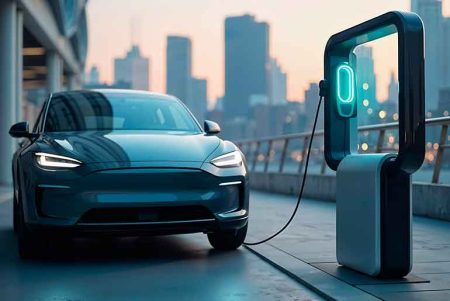
Another new opportunity is electric vehicle charging infrastructure. Battery storage can relieve pressure on the local grid as high-power charging stations proliferate, control peak loads, and allow faster charging without costly network upgrades.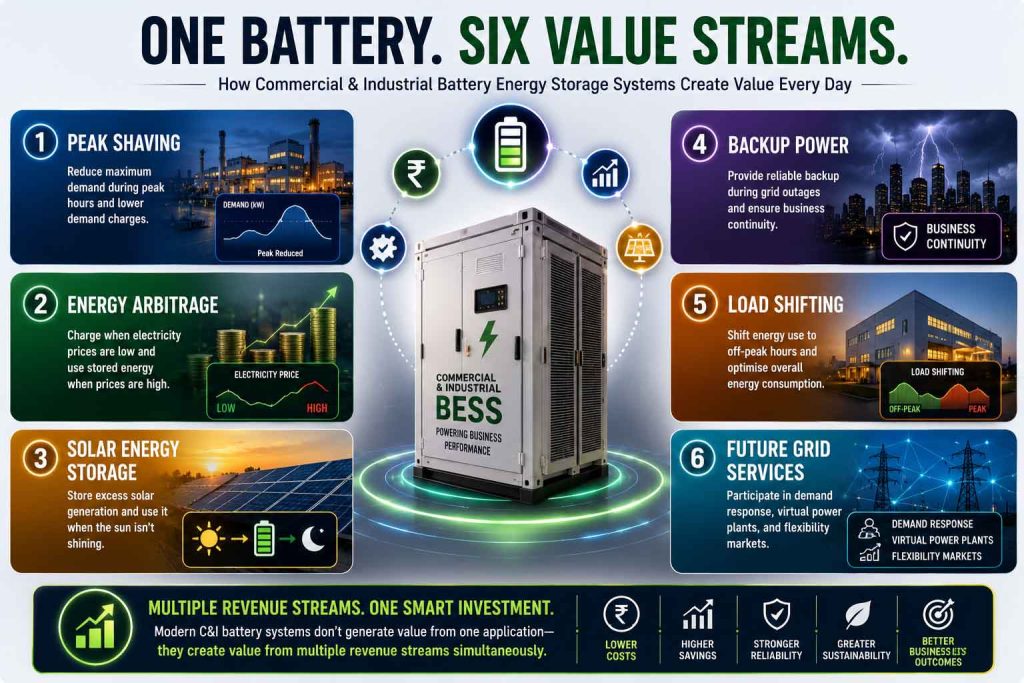
The common thread between these industries is obvious: they aren’t flushing money into batteries just to keep the lights on. They are investing to build operational resilience, cut energy costs, integrate renewable power and create more intelligent energy systems.
| Industry | Primary Energy Challenge | How C&I BESS Creates Value |
| Manufacturing | High demand charges | Peak shaving & uninterrupted production |
| Data Centres | 24×7 uptime | Instant backup & renewable integration |
| Warehouses | Variable electricity demand | Load shifting & cost optimisation |
| Hospitals | Critical power reliability | Silent, instant backup |
| Airports & IT Parks | High peak loads | Demand management & energy resilience |
| EV Charging Hubs | Grid constraints | Peak load support & faster charging |
The Smart Technologies Powering Commercial Battery Storage
The true value of Commercial & Industrial Battery Energy Storage Systems lies not only in the batteries themselves, but in the intelligence that controls them. As businesses become more data-driven, battery storage is evolving into a software-enabled energy platform capable of making thousands of operational decisions every day.
The Energy Management System (EMS) is at the core of all this. The EMS is the brain of the entire system, forever calculating electricity prices, how much electricity is being demanded, how much solar energy is being produced by the solar panels and how charged the battery is, among other variables. Because of this, it is able to help businesses to save on energy costs without having to be manually operated.
Supporting the EMS is the Battery Management System (BMS), which safeguards the battery’s performance and longevity. By monitoring cell temperatures, voltage, charging cycles, and overall battery health, the BMS ensures safe operation while extending the lifespan of one of the facility’s most valuable assets.
Artificial Intelligence is expanding this intelligence even more so. AI analytics can provide prediction for electricity requirement, forecasting solar energy production, optimize battery charging, and signify failures before they begin happening. In a combination with cloud monitoring, IoT sensors, and technology of digital twins, companies can watch numerous battery installations remotely, plan maintenance responsibly, and ensure good operational efficiency.
As the industry evolves, competitive advantage will no longer depend solely on battery capacity. How well that capacity will be managed will become increasingly important. This process gives rise to opportunities for new startups engaged in Energy storage technologies. Numerous companies are developing modern software, AI platforms, and digital energy management solutions that are playing just as important a role as batteries.
The future of battery storage will not be defined only by better batteries—it will be defined by better software. Businesses that combine intelligent energy management with battery storage will gain the greatest operational and financial advantage.
Why Commercial Battery Storage Is Becoming a Multi-Billion-Dollar Opportunity
Commercial battery storage is fast transitioning from a niche technology to one of India’s most promising clean energy markets. Headlines continue to spotlight utility-scale Battery Energy Storage Systems, but a parallel opportunity is emerging behind the gates of factories, office campuses, warehouses and commercial facilities, where businesses are seeking greater control over their energy costs.
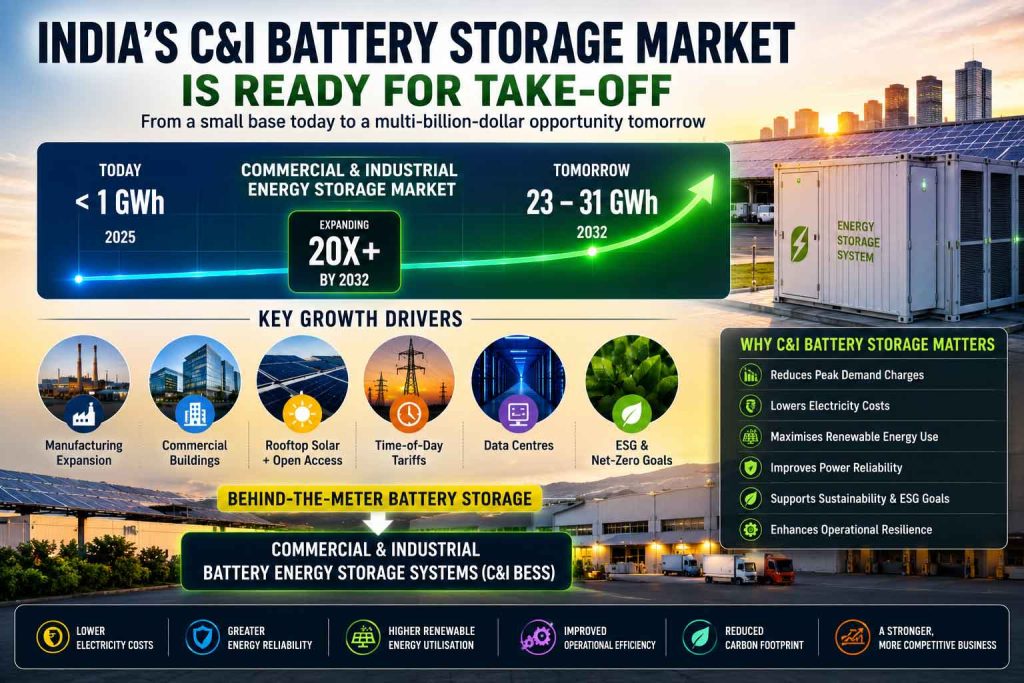
The commercial opportunity is already becoming visible in market forecasts. A joint study by India’s Energy Storage Alliance (IESA) and Customised Energy Solutions (CES) forecasts that the energy storage market for commercial and industrial sectors will grow from less than 1 GWh in 2025 to 23 GWh to 31 GWh by 2032. Manufacturing, commercial buildings, data centers and behind-the-meter renewable energy systems are the key drivers of this growth.
The scale of this opportunity is reflected in India’s long-term storage requirements. According to the Central Electricity Authority (CEA), the country is expected to require 34.72 GWh of Battery Energy Storage Systems by FY2026–27, rising sharply to 236.22 GWh by FY2031–32 and nearly 1,840 GWh by 2047. Meeting this demand will require not only large grid-scale projects but also widespread adoption of Commercial & Industrial Battery Energy Storage Systems across the private sector.
The economic case for battery storage is becoming increasingly attractive. Falling battery prices, improved Energy Management Systems, and better financing options are shortening project payback periods and making battery storage accessible to more businesses. Furthermore, companies are investing in technology which cuts electricity costs and carbon emissions as companies are increasingly focusing on sustainability and net-zero targets.
The opportunity is way bigger than just the battery manufacturers. EPC Contractors, Software Developers, System Integrators, Renewable Energy Companies, Financial Institutions and Battery Energy Storage System Companies in India are all getting ready to serve this growing market. Innovative business models like Battery-as-a-Service and Energy-as-a-Service are lowering barriers to adoption, enabling businesses to take advantage of battery storage without the need for a significant upfront capital investment.
As commercial energy users become more focused on resilience, operational efficiency, and sustainability, battery storage is no longer just creating a new technology market—it is creating an entirely new energy economy.
India’s next battery boom may not be built solely through massive renewable energy parks. It could be powered by thousands of factories, warehouses, hospitals, and commercial buildings quietly transforming the way they buy, store, and consume electricity.
What Still Holds the Market Back?
Although considerable progress has been made, there are still some significant challenges that must be overcome before Commercial & Industrial Battery Energy Storage Systems become a regular part of Indian companies. As battery price trends downward, the large initial investment needed for these systems remains worrisome, especially for small and medium enterprises. Also, access to affordable financing is limited with many businesses still seeing battery storage as a capital expense rather than a long term investment.
Another issue is the transparency of policy. Government efforts are speeding battery deployment but as the market grows more standardisation in safety regulations, fire protection, interconnection standards and recycling frameworks will be required. At the same time, India will need to continue building its domestic battery manufacturing ecosystem to reduce dependence on imported cells and critical minerals.
Conclusion
The evolution of Commercial & Industrial Battery Energy Storage Systems reflects a broader shift in how Indian businesses view energy. What was once considered a backup solution is rapidly becoming a strategic asset that reduces electricity costs, improves operational resilience, supports renewable energy integration, and advances corporate sustainability goals.
As demand for electricity continues to rise and businesses look to become more efficient, battery storage will play an ever more central role in the industrial and commercial world. Batteries, with intelligent software, rooftop solar and digital energy management, are enabling organisations to move from simply consuming electricity to actively managing it.
This presents an important clean energy opportunity in India for Battery Energy Storage System Companies in India, EPC contractors, technology suppliers and investors. It marks the beginning of the next phase for the country’s transitions in the energy sector as it will not be driven only by large utility renewable energy projects but by thousands of businesses using smarter and cleaner energy solutions as well.
The factories, data centres, hospitals, warehouses, and commercial campuses of the future will not compete solely on productivity or automation—they will compete on how intelligently they generate, store, and manage energy. In that future, Commercial & Industrial Battery Energy Storage Systems will be a competitive advantage, not just an energy solution.
 Electrify your feed! Click here to join our Whatsapp group and to get the latest updates, expert insights, and innovations driving India’s energy storage revolution.