Imagine a 100 MW/400 MWh BESS where every battery container has reached the project site. Hundreds of megawatt-hours of storage capacity are sitting on the ground, ready to charge and discharge.
But can you connect those containers directly to the grid?
No.
The batteries still need an electrical pathway to move power, foundations to stand on, transformers and switchgear to connect with the wider electrical system, cables to carry electricity, protection and metering, auxiliary power, communications, safety infrastructure and, depending on the project, a substation and power-evacuation system leading to the grid. Much of this supporting infrastructure sits within what the industry refers to as Balance of Plant for Battery Storage or, in some project documents, Balance of System (BoS).
And its importance is growing with the size of India’s BESS projects.
NTPC Renewable Energy Limited’s 2026 tender pipeline alone has included projects such as 800 MW/3,200 MWh at Khavda, 550 MW/2,200 MWh at Shimboo Ka Burj, 300 MW/1,200 MWh at Nokhra and 240 MW/960 MWh at Devikot. At this scale, building the battery is only one part of the challenge. Thousands of electrical, civil, digital and safety interfaces have to come together before those stored megawatt-hours become a functioning grid-connected power asset.
This is where understanding Balance of Plant for Battery Storage becomes critical for developers, EPC contractors, utilities and project owners.
But there is an important catch: there is no single equipment list that defines the BoP boundary for every BESS project.
A PCS may sit inside the core BESS package in one procurement and outside it in another. EMS may be supplied with the battery package. Civil works may be divided between contractors. Grid responsibility may stop at the BESS terminals in one project but continue through a substation or power-evacuation infrastructure in another.
SECI’s 600 MW/1,200 MWh standalone BESS project at Nandiyal, Andhra Pradesh, makes this distinction particularly clear. Its procurement was divided into separate packages, including a BESS DC Package and a Balance of System AC Package. Within the BoS package definition, specified BESS containers, PCS, EMS and associated cables up to the PCS were excluded from that contractor’s supply/work boundary, while substantial engineering, procurement, civil, installation, testing, commissioning, performance-demonstration and O&M responsibilities remained.
That example changes the question this article needs to answer.
Instead of simply asking “What equipment is included in BoP?”, you need to ask:
Where does the battery package end, what infrastructure begins after it, and who is responsible for every interface in between?
This guide follows that infrastructure from the battery terminals towards the grid—through electrical and civil systems, auxiliaries, controls and communications, safety infrastructure and finally the Point of Interconnection—to explain what Balance of Plant for Battery Storage actually means in a real BESS project.
What Is Balance of Plant in a Battery Storage Project?
The easiest way to understand BoP is to separate the storage technology from the infrastructure that turns it into a power plant. At the centre sits the battery system: cells assembled into modules and racks and ultimately integrated into enclosures or containers along with associated battery-level systems. But stored energy still needs a route outward.
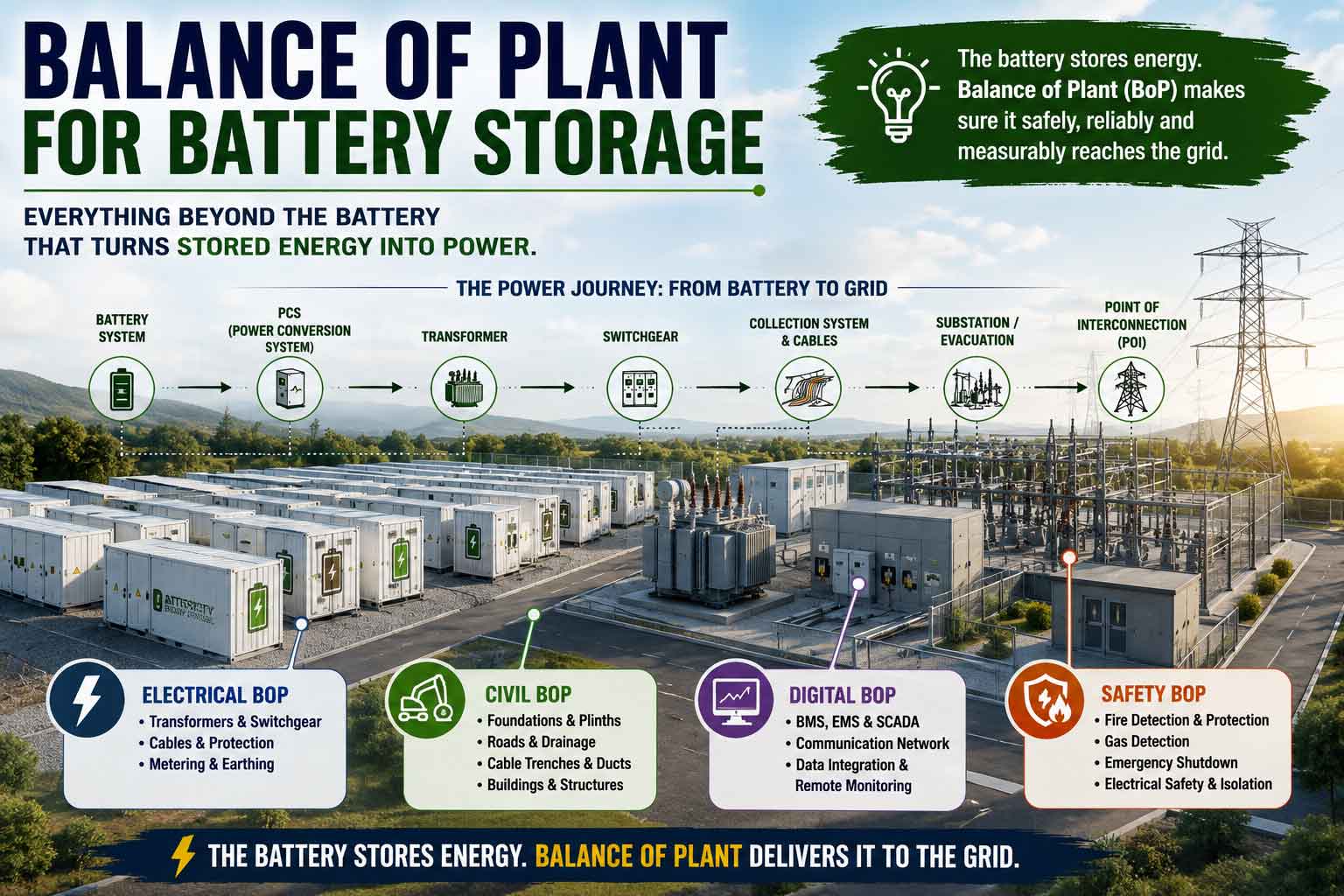
Conceptually, that journey can look like:
Battery → PCS → Transformer → Switchgear → Collection/Evacuation System → Point of Interconnection*
Around that power path sits another layer:
Civil Infrastructure + Auxiliary Power + Protection & Metering + Earthing + Controls & Communications + Safety Systems
Together, these supporting systems can form significant parts of the Balance of Plant for Battery Storage, depending on how the particular project contract defines its scope.
The asterisk beside PCS is deliberate.
SECI’s Nandiyal project demonstrates why. Its specified PCS sits outside the BoS AC contractor’s supply/work boundary. In another turnkey BESS procurement, PCS may sit within the contractor’s overall responsibility. The same caution can apply to EMS, communications, civil packages and even grid-connection infrastructure.
This is also why BoP and EPC should not be treated as interchangeable terms.
- BoP asks: What supporting plant and infrastructure are required around the core storage equipment?
- EPC asks: Who engineers, procures, constructs, integrates, tests and commissions the systems allocated to that contractor?
Our guide to EPC Scope in Battery Storage Projects examines those contractor responsibilities in detail. Here, we are looking inside the physical and system infrastructure itself.
For anyone learning How to Bid for BESS EPC Projects, that distinction has a direct commercial consequence. If the tender says the battery is supplied separately, you still need to determine who receives it, who installs it, who provides its foundations, who terminates the cables, who integrates communications, who performs combined testing and who carries responsibility when two separately supplied packages fail to work together.
Because “excluded from supply” does not automatically mean “excluded from responsibility.”
That is the real starting point for understanding Balance of Plant.
The battery may store the electricity. The BoP is what gives that electricity somewhere to go.
Follow One MWh: The Electrical Balance of Plant
Imagine one MWh sitting inside a charged battery container. For that energy to become useful to the power system, it has to travel through several layers of electrical infrastructure. This journey provides one of the clearest ways to understand Balance of Plant for Battery Storage.
Conceptually, the route can be:
Battery → PCS → Transformer → Switchgear → Collection System → Substation/Evacuation → Grid*
Whether the PCS belongs to the battery package or wider BoP/EPC scope depends on the contract.
PCS: Start by Checking the Boundary
The Power Conversion System provides the bidirectional conversion interface between the battery’s DC side and the AC electrical system. But before putting PCS into your BoP cost sheet, check the tender.
SECI’s Nandiyal project is the perfect warning: specified PCS is excluded from its BoS AC contractor’s supply/work package. In other projects, PCS may form part of the wider turnkey BESS responsibility.
Even when separately supplied, however, its interfaces still matter. Battery operating voltage, PCS characteristics, communications, protection and the connection towards the transformer have to work together.
Who supplies the equipment and who integrates it are two different questions.
Transformers, Switchgear and Cables: Building the Power Path
Once power moves towards the AC network, transformers provide the required voltage transformation according to the project architecture. Switchgear then provides switching, isolation and protection functions across the electrical system.
Connecting all of this are cables—and cable scope is more significant than it sounds.
Actual Indian BESS specifications separately address AC and DC cabling, installation and terminal points because every cable needs two clearly defined ends. If the battery vendor’s responsibility stops at one terminal while the BoP contractor’s begins somewhere else, even a small undefined gap can become a project problem.
The wider Electrical Scope in Battery Storage can therefore include transformers, switchgear, AC/DC cables, protection, metering, auxiliary electrical systems, earthing and lightning protection, subject to the project’s defined battery limits.
Protection makes these interfaces particularly visible. A transformer may come from one vendor and switchgear from another, but a transformer fault may need to initiate the correct breaker action. The individual packages cannot merely work independently; their protection philosophy has to work together.
The Small Meter With a Big Job
Metering deserves special attention because this is where electricity can become a contractual number.
Depending on the project, meters may measure energy exchange, auxiliary consumption and other required parameters at specified locations. The contractual measurement point can also matter when performance such as deliverable energy or efficiency is demonstrated.
Put simply:
The battery tells you how much energy exists inside the storage system. The contractual meter helps establish what the project actually delivered at the defined point.
This is why Balance of Plant for Battery Storage cannot be treated as a collection of secondary equipment. Transformers, cables, switchgear, protection and metering collectively determine whether stored electricity can travel safely and measurably towards the grid.
Civil BoP: Building the Ground Beneath the Megawatts
Now look underneath that electrical system.
Battery containers, transformers and switchgear cannot simply be placed wherever there is empty land. They need foundations, access, cable routes, drainage and supporting site infrastructure.
Depending on project scope, Civil Works in BESS Projects can include site development, equipment foundations, roads, cable trenches and ducts, drainage, control/electrical buildings and other associated infrastructure.
And civil engineering begins interacting with electrical engineering almost immediately.
Take one cable.
The electrical engineer decides its size, terminals and route. The civil team may have to provide the trench, duct or crossing through which it travels. The equipment vendor determines where the terminal physically sits.
A late change by one party can therefore affect all three.
The same applies to foundations. Equipment dimensions, weight, anchoring arrangements, cable entries and maintenance clearances need to reach the civil team before designs are frozen.
Can the Equipment Actually Reach Its Foundation?
Site access is another easily underestimated part of Balance of Plant for Battery Storage.
Battery containers and heavy transformers must be transported, unloaded and positioned. SECI’s Nandiyal BoS package, for example, places responsibilities including receipt, unloading and storage within its defined contractor scope.
Roads and equipment access therefore have to work with the construction and lifting strategy—not merely look correct on a site layout.
And the question may need to be asked again years later:
If this equipment fails, can you get it out?
Future augmentation creates a similar challenge. Where the project’s lifecycle strategy anticipates additional battery capacity, today’s BoP may need to consider future space, access, cable routes, electrical headroom and other infrastructure.
That gives civil BoP a surprisingly important job.
It must make room not only for the BESS you are building today, but—where the contract requires it—for the BESS that may need to exist tomorrow.
The electrical diagram tells you where the power needs to travel. Civil BoP makes sure there is a physical plant through which it actually can.
The Infrastructure You Cannot See: Auxiliary and Digital BoP
A BESS does not only deliver electricity. It also consumes electricity to keep itself operating.
Depending on the project architecture, auxiliary power may support controls, protection systems, SCADA, communications, lighting, fire and safety equipment, cooling systems and other plant loads. This creates a second electrical pathway alongside the main battery-to-grid route:
Main Power: Battery ↔ PCS ↔ Transformer ↔ Grid
Auxiliary Power: Auxiliary Source → Distribution/UPS → Plant Loads
This matters because auxiliary consumption may influence plant-level performance depending on where contractual efficiency is measured. Actual Indian BESS specifications therefore treat auxiliary transformers, AC/DC distribution and backup power as engineered systems rather than leftover electrical loads.
Thermal management needs similar care. Cooling may be integrated within the battery container supplied by the OEM, while HVAC for control or electrical buildings may fall elsewhere. So, like PCS, thermal management should not automatically be placed inside Balance of Plant for Battery Storage without checking the contract.
Digital BoP: Making Separate Packages Speak
A modern BESS also contains an infrastructure you cannot see on the single-line power diagram: data.
At its simplest:
BMS ↔ PCS ↔ EMS ↔ SCADA ↔ Plant/Grid Interface
The Battery Management System monitors and protects the battery at battery level. The EMS coordinates how stored energy is operated, while SCADA provides wider plant monitoring, alarms and control.
But the BoP question is not simply what these systems do.
It is: who makes them communicate?
SECI’s Nandiyal project again demonstrates why boundaries matter. Its specified EMS is excluded from the BoS AC contractor’s supply/work package. Yet the complete project still has to function as one integrated facility.
Communication protocols, data points, alarms, commands and control interfaces therefore need clear ownership. This is why SCADA Requirements in BESS should be addressed during engineering rather than left until the final days of commissioning.
Remote monitoring introduces another consideration: cybersecurity. Where plant systems communicate across wider networks, access control, communication security, remote access and post-handover responsibilities need to follow applicable requirements and owner specifications.
A useful rule emerges:
Supply boundary does not necessarily equal integration boundary.
One vendor may supply the battery, another the PCS and another the controls. The operating BESS cannot behave like three separate contracts.
Safety BoP: Infrastructure Built for the Bad Day
Most of the Balance of Plant for Battery Storage is designed to make the facility operate correctly. Safety infrastructure must also prepare it for the moment normal operation stops.
Depending on battery technology, project design and applicable requirements, this can involve hazard detection, alarms, thermal management, electrical isolation, emergency shutdown, fire detection and protection, emergency access and other safety measures.
And again, these systems cannot operate in isolation.
A battery fault detected by the BMS may require coordinated action across the PCS, switchgear, controls, alarms and emergency systems. The contractor therefore needs to understand not only individual equipment protection but the complete safety interface.
India’s BESS safety framework also requires careful reading. Contractors must work against FsecFapplicable CEA safety regulations, relevant standards and the specific tender requirements while tracking evolving guidance and audit provisions. A fire-protection arrangement specified for one BESS project should never automatically be treated as a universal design requirement for every project.
That is why our dedicated guide to Fire Protection Requirements in BESS needs to go deeper into the regulatory and technology-specific details.
The lesson is simpler:
Electrical BoP moves the energy. Civil BoP gives the plant somewhere to exist. Digital BoP makes it communicate. Safety BoP makes sure the entire system knows what to do when something goes wrong.
Grid BoP: Where the Battery Becomes a Power-System Asset
By this stage, the battery can store energy, the PCS can convert it, the transformer can change voltage and the plant’s controls can communicate. But one critical journey remains:
How does that electricity reach the grid?
Depending on the project, the electrical infrastructure can continue through:
BESS → MV Collection → Switchgear → Substation → Power Evacuation → Point of Interconnection (POI)
This is where Balance of Plant for Battery Storage can expand dramatically.
A contractor whose responsibility ends at the BESS MV terminals is bidding for a very different project from one responsible for developing the substation, evacuation infrastructure and connection up to the specified POI.
The POI is particularly important because it is more than a location on a single-line diagram. Under India’s grid-code framework, specified Energy Storage System performance tests—including power-output capability, energy-output capacity, frequency response and ramping capability—are considered at the point of interconnection.
That creates a practical question for every EPC team:
How much infrastructure sits between the battery and the point where the project has to prove its performance?
Transformers have losses. Cables have losses. Auxiliary systems consume electricity. The contractual measurement and performance boundary therefore needs to be understood before equipment is sized and guarantees are accepted.
For contractors studying How to Bid for BESS EPC Projects, this is why the POI should never be treated as a small technical note buried inside the tender.
It can help define the end of your electrical journey—and the extent of your responsibility.
The Most Important BoP Question: Who Supplies What?
Now imagine the tender says:
Battery containers: supplied separately.
At first glance, that sounds simple. Remove the battery price from your BoP quotation and continue.
But what happens when the containers arrive?
Who receives them? Who unloads them? Who provides the foundations? Who positions them? Who connects their cables? Who integrates their communication systems? Who participates in testing? And if the battery package works independently and the BoP works independently—but the complete plant does not work—who fixes the interface?
This is why a serious Balance of Plant for Battery Storage review needs an interface matrix, not merely an equipment list.
| Package | First Question the Contractor Should Ask |
| Battery containers | Who supplies, receives, installs and connects them? |
| PCS | Battery package, owner supply or contractor supply? |
| Transformer | Who supplies it and where are its terminal boundaries? |
| Switchgear | Which voltage levels and connections are included? |
| Cables | Exactly where does one contractor’s cable scope end? |
| EMS/SCADA | Who supplies the system and who integrates it? |
| Civil works | Who provides foundations, trenches, roads and associated works? |
| Safety systems | Who owns complete plant-level integration? |
| Substation | Inside or outside the BoP/EPC boundary? |
| Evacuation | Where does contractor responsibility terminate? |
| Testing | Who proves that separately supplied packages work together? |
| O&M | Does responsibility continue after commissioning? |
The dangerous part of this table is not always what appears inside each box.
It is the white space between the boxes.
The White Space Where EPC Risk Lives
Suppose the battery OEM supplies Package A and the BoP contractor supplies Package B.
Both meet their individual specifications. But A cannot communicate correctly with B. Or the OEM changes a cable-entry location after civil drawings are frozen. Or the PCS protection philosophy does not coordinate properly with downstream switchgear. Or owner-supplied equipment arrives late and affects the construction sequence.
These are interface problems—and they can become schedule, cost and performance problems.
The same issue reaches warranties. A BESS assembled from individually warrantied components can still create an unwarrantied argument when the failure occurs between two packages.
That is why “excluded from supply” should never automatically be read as “excluded from responsibility.” The contract needs to establish responsibility for installation, interface engineering, integration, testing, documentation, warranties and handover.
SECI Nandiyal: A Real BoS Boundary in Action
SECI’s 600 MW/1,200 MWh standalone BESS at Nandiyal, Andhra Pradesh, gives us one of the clearest Indian examples of why this distinction matters.
Instead of procuring the complete facility as one undivided equipment package, SECI structured separate procurements including a BESS DC Package and a Balance of System AC Package.
Under the defined BoS AC scope, specified BESS containers, PCS, EMS and associated cables up to PCS are excluded from the contractor’s supply/work boundary, subject to the detailed project allocations.
You might assume that leaves the BoS contractor with a small supporting role.
It does not.
The package covers substantial responsibilities including design and engineering, procurement and supply within the defined scope, manufacturer testing and inspections, logistics, receipt and storage, associated civil works, erection, testing, commissioning and performance demonstration.
And the responsibility does not necessarily disappear when the project starts operating.
The Nandiyal BoS package also includes five years of comprehensive O&M.
That makes this project an excellent demonstration of what BoP/BoS actually means in practice:
The size of the contractor’s responsibility cannot be judged simply by counting which major pieces of equipment it supplies.
A contractor may not supply the battery itself and can still carry enormous responsibility for turning that battery into an operating plant.
Compare that with other Indian BESS procurements where the battery, PCS, management systems and associated BoS have been brought together within a wider turnkey contractor scope. The terminology may look similar, but the commercial and technical responsibility can be completely different.
This is why Battery Storage EPC Companies in India need capabilities extending beyond equipment procurement. They must understand package boundaries, civil-electrical coordination, control interfaces, protection, grid integration, commissioning and long-term responsibilities.
Because ultimately the grid does not see a battery contract, a PCS contract, a civil contract and a SCADA contract.
It sees one power plant.
And somebody has to make all those contracts behave like one.
Before You Price the BoP, Find the Missing Scope
By the time a contractor reaches the commercial schedule, the Balance of Plant for Battery Storage may look reasonably clear. There are transformers, switchgear, cables, civil works, auxiliaries, controls and perhaps a substation.
But the most expensive mistake may be the item that is not clearly written anywhere.
Before pricing a BESS BoP package, trace the complete project from the battery to the Point of Interconnection and ask:
- Where exactly does the battery supplier’s scope end?
- Is the PCS included, excluded or owner-supplied?
- Who supplies and installs transformers and switchgear?
- Where do cable responsibilities start and terminate?
- Who provides foundations for separately supplied equipment?
- Who handles unloading, storage and installation?
- Are auxiliary power and backup supplies included?
- Who integrates BMS, EMS, PCS and SCADA?
- Who provides plant-level safety and fire-protection infrastructure?
- Does the scope include a substation or power-evacuation system?
- Where is the contractual metering point?
- Where must capacity and performance be demonstrated?
- Who conducts integrated testing across different OEM packages?
- Are spares and warranty-management obligations included?
- Is future augmentation expected and does today’s infrastructure need to accommodate it?
- Does the contract include O&M after commissioning?
This is where How to Bid for BESS EPC Projects and BoP engineering meet.
You are not pricing a list of equipment. You are pricing a chain of responsibilities.
If even one link in that chain belongs to nobody, it can eventually belong to the contractor who needs the project to work.
BoP Does Not Necessarily End at Construction
There is one final boundary worth checking: time.
A contractor’s responsibility may continue well beyond equipment installation.
Depending on the contract, the scope can extend through factory inspections and testing, erection, pre-commissioning checks, system integration, testing, commissioning, performance demonstration, documentation, training, spares, warranty support and eventually O&M.
This is why Commissioning of Battery Storage Systems deserves attention of its own. Commissioning is the moment when separately engineered packages finally have to behave as one plant.
The battery must communicate with the controls. The PCS must respond correctly. Protection must operate as intended. Metering must capture the required parameters. Alarms and safety systems must respond correctly. And the complete facility must demonstrate the performance required by its contract.
SECI’s Nandiyal procurement illustrates how far the responsibility can continue: its BoS AC package includes five years of comprehensive O&M.
So a BoP contractor may not simply be building infrastructure for commissioning day. It may be inheriting responsibility for keeping parts of that infrastructure operational for years afterwards.
That makes maintainability, equipment access, spare-parts planning, documentation, OEM coordination and warranty management relevant during engineering—not after handover.
Where long-term responsibilities are included, our guide to O&M Contracts for BESS becomes the next part of that lifecycle conversation.
Balance of Plant Is Where the Battery Becomes a Power Plant
A battery container can arrive at site fully assembled, tested and capable of storing electricity.
It still does not make a BESS power plant on its own.
It needs a pathway for electricity. It needs foundations beneath the equipment and cables between it. It needs transformers, switchgear, protection and metering. It needs auxiliary power to keep essential systems running, digital infrastructure to make different packages communicate and safety systems capable of responding when normal operation stops.
And eventually, it needs a defined route to the grid.
That is why Balance of Plant for Battery Storage should never be dismissed as everything “around” the battery.
As India’s BESS projects move into hundreds of megawatts and multiple gigawatt-hours, the challenge is increasingly about making large numbers of separately engineered components operate as one reliable power-system asset.
For developers, that makes the BoP boundary important.
For EPC contractors, it makes the boundary commercially critical.
And for anyone evaluating Battery Storage EPC Companies in India, it explains why the strongest contractor is not necessarily the company that can procure the longest equipment list. It is the one that understands where every package begins, where it ends and what must happen in the space between them.
Because the battery stores the energy.
Balance of Plant is what turns that stored energy into a functioning power plant.
 Electrify your feed! Click here to join our Whatsapp group and to get the latest updates, expert insights, and innovations driving India’s energy storage revolution.