If you take a road trip out to the sun-baked edges of Rajasthan or the windy plains of Gujarat, you will see a jaw-dropping sight. Thousands of solar panels stretch out like shimmering blue oceans across the desert, catching gigawatts of clean, green electricity. It is an amazing testament to how fast India is racing toward its renewable energy targets. But if you talk to the grid engineers working behind the scenes, they will tell you about a quiet, invisible headache: the sun doesn’t shine at night, and the wind doesn’t blow on command
To keep this massive clean energy revolution from hitting a wall, India is building giant, utility-scale power banks. These are known as Battery Energy Storage Systems (BESS). But there is a massive technical catch. While companies source millions of high-tech cells from the Leading BESS Manufacturers in India, those battery cells are effectively mute. They store electricity as Direct Current (DC). Meanwhile, the high-voltage national grid that keeps our cities running speaks an entirely different language: Alternating Current (AC).
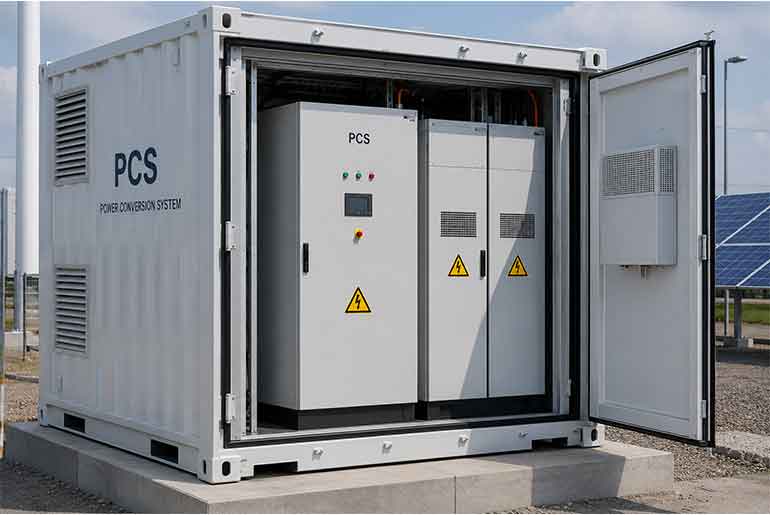
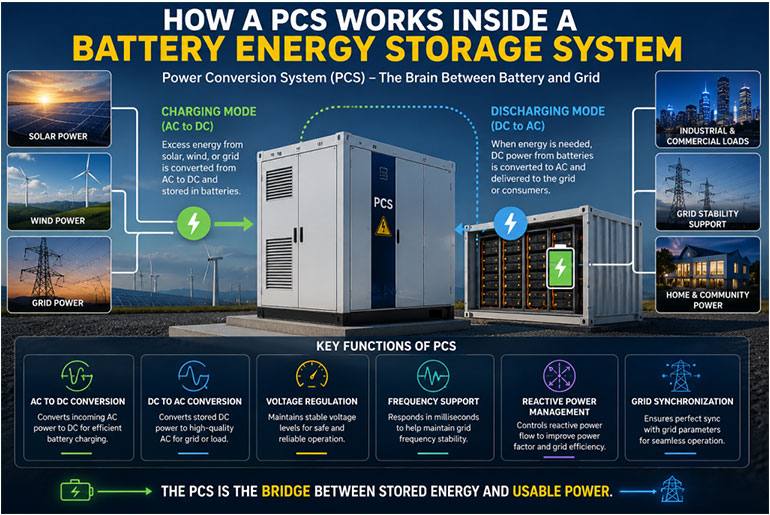
To bridge this gap, you need a high-power, incredibly smart translator. You need a Power Conversion System (PCS)—the bidirectional brain and muscle that converts DC to AC and back again in the blink of an eye. As our country prepares to hook up hundreds of gigawatt-hours of storage to the grid, picking a specialized, top-tier PCS Supplier for BESS in India has suddenly become the single most critical engineering decision of a project’s lifecycle. It is the core technology that decides whether a multi-crore energy asset runs flawlessly or suffers from devastating blackouts.
The Translation Challenge: Handling Megawatts in Microseconds
To understand why the search for a reliable PCS Supplier for BESS in India is causing so many long meetings for project developers, you have to look at the crazy balancing act happening on the wires. A grid-scale PCS isn’t just a simple wall inverter like the one you might have at home for power cuts. It is an industrial-strength powerhouse running a continuous, high-stakes translation job.
When thousands of solar parks are pumping out excess power at 1 PM, the PCS intercepts that high-voltage AC electricity, cleans it up, and turns it into smooth DC to charge up the massive battery banks. Then, at 8 PM, when millions of households turn on their lights, fans, and air conditioners, the system reverses instantly. It sucks DC out of the batteries, flashes it into grid-synchronized AC, and shoots it out to the transmission lines.
Doing this smoothly when you are dealing with megawatts of electricity is like trying to change the tires on a race car while it’s flying down the track at 200 kilometers per hour. Every single time power passes through these conversion systems, a tiny fraction of it is lost as heat. For BESS EPC Companies in India who are aggressively bidding on razor-thin margins for government contracts, these tiny losses are a massive deal.
If your conversion system is inefficient, your Round-Trip Efficiency drops. Over a 20-year project timeline, a loss of even half a percent of electricity can mean burning through crores of rupees in wasted energy. That is why developers look at power electronics with a magnifying glass—it is the direct link to the project’s financial survival.
Central vs. String Topologies: Where Do You Put the Inverter Muscle?
When setting up a mega-scale battery farm, developers face a major fork in the road regarding how they want to arrange their conversion hardware. The industry is currently split into two very different design styles, and this choice fundamentally changes how a Battery Container Manufacturer in India has to build the protective steel housing for the project.
The Centralized Approach
This is the traditional, heavy-duty path. Instead of scattering small parts everywhere, you use massive, centralized inverter blocks—frequently packaged on concrete-reinforced outdoor skids that look like mini-substations handling 3 MW to 6 MW at a time. These giant blocks handle the pooled power of multiple battery enclosures all at once.
The big benefit here is cost and simplicity. By using fewer, larger machines, you save on initial setup costs, have fewer communication lines to track, and give your maintenance teams a single, obvious place to work when making repairs. The downside? It puts all your eggs in one basket. If a massive central inverter suffers a component failure or trips due to a cooling issue, a huge chunk of your battery farm goes completely offline.
The Decentralized String Approach
Borrowing a trick from the rooftop solar revolution, string architecture breaks the inverter down into small, modular, rack-ready slices (usually around 125 kW to 250 kW each). These compact units are mapped directly to individual battery racks inside the enclosures.
This setup offers incredible peace of mind. If one small string inverter breaks down or needs a part replaced, it only pauses the single battery rack it is attached to. The remaining 95% of the giant container keeps trading power with the grid without skipping a beat. However, this means you are managing thousands of individual data streams, dealing with highly complex internal wiring, and requiring an incredibly smart software system to keep everything in sync.
Because of this architectural split, choosing your PCS Supplier for BESS in India directly impacts your physical enclosure design. For a centralized setup, a Battery Container Manufacturer in India must route thick, heavy copper busbars to high-capacity terminal boxes at the end of the container.
For a string layout, the container must instead be built with specialized internal mounting brackets, unique wiring cutouts, and localized cooling pathways to handle the heat of multiple smaller inverters humming right alongside the battery bays.
The Grid-Forming Revolution: The New Rules of Virtual Inertia
For a long time, standard solar and battery inverters operated in a passive “grid-following” mode. They essentially acted like polite passengers on a train—they sensed the existing voltage and frequency wave of the utility grid, matched it, and went along for the ride. If the main grid wave fluctuated wildly or went dark, these inverters would immediately shut themselves off to prevent damage.
But as India rapidly shuts down older, coal-fired thermal plants to make room for all those new solar parks, a quiet engineering crisis has emerged: the loss of mechanical inertia. Traditional coal and hydro plants use massive, spinning steel turbines that weigh hundreds of tons. When something goes wrong on the grid—like a major transmission line getting knocked out by a storm—those heavy spinning masses act like physical shock absorbers, naturally resisting sudden drops in grid frequency and giving automated safety systems time to react. Solar panels and battery cells have no moving parts. They have zero natural inertia.
To prevent sudden, widespread grid collapses, India’s Central Electricity Authority (CEA) stepped in with tough new technical guidelines. The mandate is clear: a fixed portion—aiming for 10% to 15%—of all future utility-scale storage systems must have active Grid-Forming capabilities.
This means that a modern PCS Supplier for BESS in India can no longer just provide a passive machine. The inverter must be equipped with incredibly fast, brilliant software algorithms that allow it to mimic a physical, spinning steel turbine.
Instead of looking for a grid signal to follow, a grid-forming system actively creates and stabilizes the voltage wave right at the substation. If a regional line suddenly snaps, a grid-forming conversion system detects the drop in microseconds and injects a massive burst of power to steady the entire network. It also adds “black-start” capabilities, meaning it can jump-start a completely dark regional grid without needing an external power feed from a faraway hydro or thermal plant. For anyone aiming to build the Largest BESS Projects in India, this isn’t a luxury feature anymore—it’s a mandatory requirement to connect to the grid.
Real-World Power: Electronics in India’s Landmark Energy Projects
The true test of these power electronics is happening right now in the field, changing how the Largest BESS Projects in India are designed from the ground up. As these mega-scale storage systems roll out, the choice of conversion hardware dictates the entire engineering playbook.
The Thermal Co-Location Model: NTPC’s Mega Projects
Look at India’s largest power producer, NTPC. They are actively integrating massive battery storage systems directly into their existing thermal power stations. These hybrid sites are designed to provide rapid frequency response and smooth out the sharp spikes of renewable energy integration.
For projects of this magnitude, engineers rely heavily on high-capacity, centralized power conversion platforms packed with advanced grid-forming software. Because these systems are directly connected to critical national transmission hubs, the conversion units are built with extreme low-voltage ride-through features, ensuring the battery asset stays online and protects the grid even during intense, transient electrical storms.
The Hybrid Solar-Wind Model: ReNew’s Peak Power Assets
In the renewable-heavy regions of Karnataka and Rajasthan, developers like ReNew have deployed massive hybrid projects designed to guarantee steady power to state utilities even during peak evening hours when solar is zero.
On these sites, developers often use a clever combination of central and string options. By deploying highly responsive, rack-level string units on the most active segments of the battery bank, they can manage the state-of-charge with incredible accuracy. This ensures that a single underperforming rack never slows down the rest of the facility, maximizing every ounce of energy the system can hold.
Who is Powering the Conversion Layer? A Look at the Top PCS Supplier for BESS in India
The exploding demand for high-reliability grid hardware has turned India into a massive competitive arena, where global engineering giants and native Indian innovators are constantly pushing boundaries.
Hitachi Energy India
Hitachi Energy is widely considered a top-tier benchmark for heavy utility grid integration. Their bidirectional conversion systems are custom-engineered for modern 1500 VDC high-density setups. Instead of relying on traditional air cooling—which can quickly choke in the dusty, scorching desert heat of western India—Hitachi relies on highly advanced liquid-cooled platforms. This keeps the internal electronics running at safe temperatures without de-rating their power output, even in extreme coastal or high-altitude environments.
Delta Electronics India
Delta has captured a massive chunk of both the heavy utility and industrial commercial sectors through sheer modular flexibility. Their product range is vast, scaling from compact 100 kW cabinet systems up to massive, pre-fabricated 6 MW outdoor medium-voltage skids that arrive ready to plug straight into high-voltage transformers. A massive edge for Delta is their unified software ecosystem; their conversion hardware connects directly into their proprietary energy management layer (DeltaGrid), completely eliminating communication lag for system integrators.
Global Turnkey Integrators (Sungrow)
International heavyweights continue to secure massive wins across central government tenders by providing fully integrated, pre-assembled power blocks. Companies like Sungrow have pioneered unified architectures where the liquid-cooled battery banks and the central conversion units are built onto a single physical chassis. This layout completely removes the need for complex, long-distance DC cabling in the field, ensuring the entire system acts as a single, perfectly coordinated machine.
Local Engineering Houses (Statcon Energiaa)
On the domestic front, companies like Noida-based Statcon Energiaa are doing vital, deeply localized work. Statcon Energiaa’s bidirectional conversion platforms are specifically designed to handle the rugged, everyday realities of regional Indian distribution grids, which often deal with sudden voltage swings and phase imbalances.
By manufacturing highly versatile systems that play nice with classic lithium iron phosphate chemistry as well as emerging, low-cost alternatives like Sodium-Ion, these domestic players offer fast component turnarounds and local engineering support that massive global conglomerates can’t easily match.
The Integration Matrix: The Ultimate Balancing Act
To pull off a truly successful utility-scale storage plant, an asset owner cannot look at parts in isolation. Long-term operational success requires a seamless, real-time handshake between three completely different industrial layers:
- The Chemistry Layer: Delivered by the Leading BESS Manufacturers in India, providing the raw cells, internal module wiring, and localized rack safety.
- The Armor Layer: Fabricated by a specialized Battery Container Manufacturer in India, establishing the rugged, weatherproof, climate-controlled physical shell.
- The Conversion Layer: Supplied by the chosen PCS Supplier for BESS in India, acting as the high-speed bilingual translator between the chemical cells and the high-voltage grid.
If these three layers operate in corporate silos, the project can quickly turn into an expensive nightmare. For example, a cell manufacturer can deliver a top-tier battery rack, but if the conversion supplier’s firmware doesn’t have native, microsecond communication protocols to talk to the battery’s localized Management System, the facility will suffer from constant false alarms, erratic charging limits, and unexpected safety trips.
Physical and thermal design must also be perfectly aligned. A multi-megawatt inverter generates intense localized heat through its rapid switching actions. If this thermal footprint isn’t accurately factored into the container manufacturer’s liquid-cooling loops, it can create localized hot zones that accelerate cell degradation in nearby battery racks, quietly destroying the asset’s lifespan.
The Next Frontier: Silicon Carbide Semiconductors
As we look toward the future of grid management, the technology inside these power electronics is moving incredibly fast. The most exciting leap currently moving from engineering labs into actual field deployments is the switch to Wide-Bandgap semiconductors, specifically Silicon Carbide (SiC).
For decades, the power conversion industry relied on traditional silicon-based components. While reliable, silicon has physical limits on how fast it can switch and creates noticeable energy losses in the form of waste heat. By moving to advanced Silicon Carbide architectures, a next-generation PCS Supplier for BESS in India can design systems that handle incredibly high switching frequencies while cutting internal energy losses by up to 50%.
This semiconductor upgrade allows new string and central inverters to achieve peak conversion efficiencies well over 99%. Even better, because SiC components can run safely at much higher temperatures, the physical size and weight of the inverter’s cooling systems can be dramatically scaled down. This results in ultra-dense, compact power skids that free up highly valuable land within crowded city substations.
Conclusion
When people talk about the clean energy transition, the conversation almost always focuses on mining logistics, raw lithium processing, and gigafactory production targets. While those things are incredibly important, they only cover how we store energy statically. A raw battery cell cannot stabilize a collapsing regional grid during a sudden evening peak storm, nor can it clean up electrical noise at a high-voltage substation.
The actual, daily viability of India’s green grid depends entirely on the power electronics layer. By engineering the fast, smart, grid-forming conversion systems that translate, clean, and actively guide megawatts of electricity in fractions of a second, India’s top power conversion specialists are building the vital digital muscle needed to make our clean energy future stable, profitable, and completely self-reliant.
 Electrify your feed! Click here to join our Whatsapp group and to get the latest updates, expert insights, and innovations driving India’s energy storage revolution.