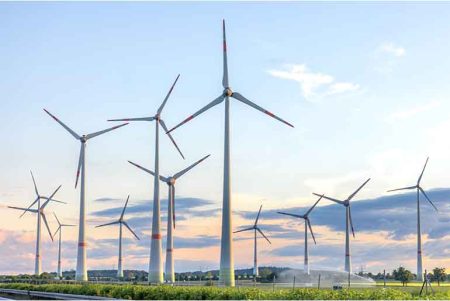
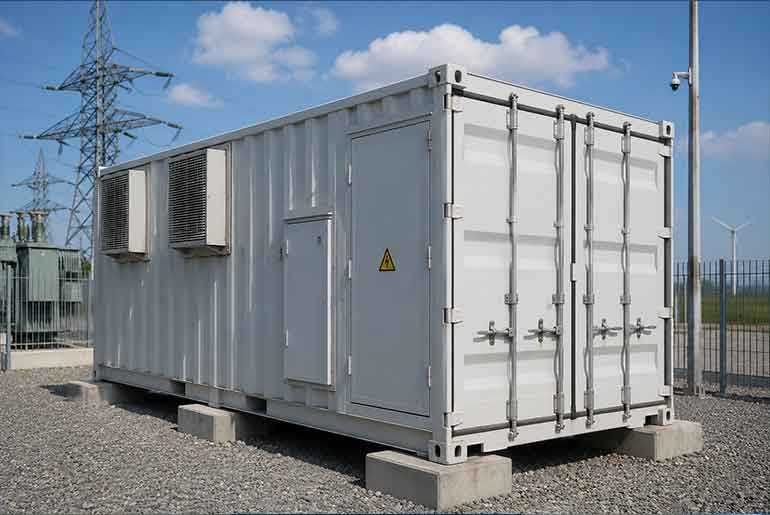
If you travel out to the fringes of India’s most ambitious clean energy zones, you will see a fascinating shift happening. The old architectural approach—where grid-scale storage meant erecting massive, air-conditioned concrete buildings to house battery banks—is effectively obsolete. Instead, the landscape is being redefined by rows of heavy, industrial, weatherproof steel blocks that arrive on flatbed trucks, get dropped onto concrete foundation pads, and plug straight into high-voltage transformers. These are not standard shipping containers. They are self-contained, highly engineered thermal cocoons protecting billions of rupees worth of ultra-sensitive electrochemical hardware. As India sprints toward its aggressive renewable goals, Battery Container Manufacturers in India are emerging as the essential architects providing the physical armor for the country’s clean energy transition.
India’s 200+ GWh Storage Ambition and the Rise of Enclosure Engineering
To understand why Battery Container Manufacturers in India has suddenly become a multi-billion rupee industrial priority, we only need to look at the macro projections established by the Central Electricity Authority (CEA). According to national power planning estimates, India’s grid will require more than 200 GWh of battery energy storage capacity by 2030, a figure scaling up to 236 GWh by 2032 to balance the massive influx of solar and wind installations.
This presents a staggering physical manufacturing puzzle. If you break this down into digestible infrastructure units, a standard, state-of-the-art utility-scale enclosure holds roughly 5 MWh of storage capacity.
To meet the CEA’s baseline targets, India will need more than 40,000 highly specialized battery containers fabricated, outfitted, and synchronized across its substations over the next several years.
When project developers design utility-scale facilities, they focus intensely on sourcing individual lithium-ion or sodium-ion cells from the Leading BESS Manufacturers in India. However, an individual battery cell is inherently vulnerable; it cannot withstand a torrential Indian monsoon, desert dust storms, or extreme ambient temperature swings on its own.
The container is the physical insurance policy that keeps those cells alive. Without highly advanced structural enclosures, the vision of a stable, renewable-powered national grid cannot materialize.
Why Traditional Battery Buildings Are Giving Way to Modular Energy Blocks
The transition from brick-and-mortar battery rooms to modular container blocks is driven by an uncompromising mix of speed, economics, and civil engineering realities. Building an industrial-grade concrete structure on-site requires months of civil construction, extensive local permitting, and complex architectural overhead. More importantly, it creates a high-risk installation environment where individual battery cells must be unboxed, stacked, wired, and tested in the field, exposing them to ambient humidity and dust.
Modular containerization flips this execution model completely. By shifting the entire integration process to a controlled factory floor, the structural shell, thermal controls, power electronics, and battery racks are assembled and tested under pristine conditions before shipment.
For project developers actively bidding on competitive utility contracts found in BESS Tender Opportunities in India, this approach cuts field construction timelines by up to 60%. This shift is creating unprecedented demand for Battery Container Manufacturers in India capable of delivering fully integrated, factory-tested energy storage enclosures.
Anatomy of a Modern 5 MWh Battery Container
To appreciate the sheer complexity of what Battery Container Manufacturers in India are producing today, it helps to strip away the outer steel skin and examine the dense, multi-layered engineering packed into a standard 20-foot or 40-foot modular enclosure. locaA modern 5 MWh battery container is an intricate, self-contained ecosystem where mechanical, thermal, electrical, and digital systems work in perfect synchronization.
The outermost layer consists of a high-tensile structural steel shell, typically built from Corten or marine-grade alloy, capable of supporting immense physical weight. While a standard cargo container is framed to transport distributed, hollow freight, a utility-scale battery rack is incredibly dense—often scaling the total container payload up to 35 to 40 metric tons. The floor frames must be structurally reinforced using rigorous finite element analysis (FEA) to prevent micro-deflections that can warp internal busbars and cause catastrophic electrical shorts.
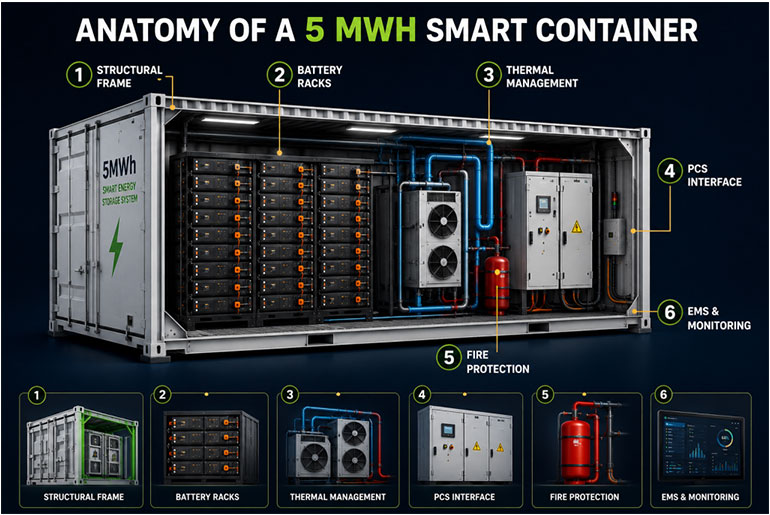
Moving inward, the container houses high-density battery racks equipped with localized Battery Management Systems (BMS). Container design should provide clean and modular mounts that connect properly to standard, high-power inverters located in India for the BESS, routing bi-directional DC/AC through tight, safe, bulkheads.
Finally, the entire container is interwoven with industrial communication cables, digital control panels, and Energy Management System (EMS) edge devices that continuously monitor cell health, balancing internal operations in real time.
From Shipping Containers to Intelligent Energy Enclosures
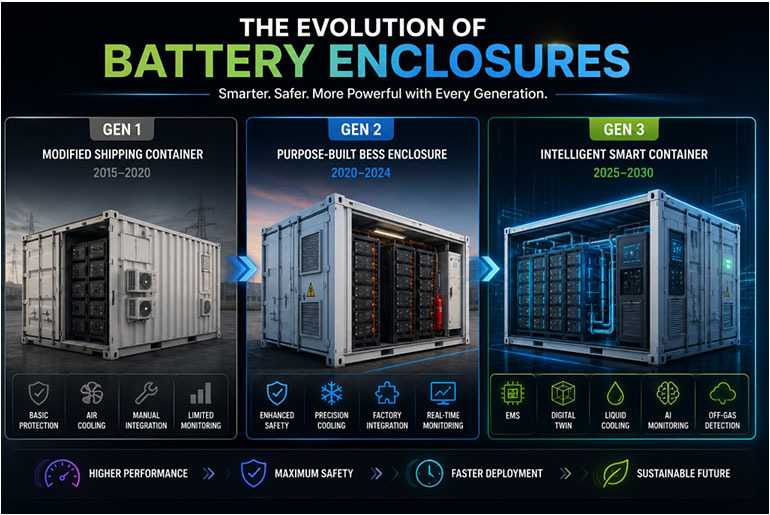
The technology driving Battery Container Manufacturers in India has evolved rapidly through three distinct structural generations:
- Generation 1 (The Modified Box): Pilot projects for initial storage of energy were done using standard ISO shipping containers. Holes were cut in the containers for basic HVAC units, Industrial racks were bolted to the floor from stock. Internal power wiring was installed in the container by hand. The physical layout of the system resulted in poor thermal distribution because of the way they were designed, manufactured and installed. Additionally, these systems experienced issues with inadequate weather sealing and had no internal structural optimization.
- Generation 2 (Purpose-Built Shells): As demand for electrical storage increases, OEMs are no longer using shipping containers as the basic building block for stationary energy storage. Instead, they are implementing custom-built structural enclosures designed specifically for stationary battery architecture, which have additional heavy-duty floor reinforcement and integrated air ducts or channels for better distributing conditioned air over the battery racks.
- Generation 3 (Intelligent Energy Enclosures): The current benchmark in mid-2026 centers on smart, adaptive enclosures. These units are highly integrated thermal and digital structures featuring built-in liquid-cooling loops, automated safety systems, and digital twin compatibility. They continuously communicate internal atmospheric data back to central utility control rooms, actively predicting maintenance needs before hardware components can degrade.
Safety, Thermal Runaway, and the New Engineering Imperative
In utility-scale storage, safety is not an afterthought—it dictates the entire structural architecture of the enclosure. When dense lithium-ion cells experience internal shorts or mechanical damage, they can face thermal runaway, an uncontrolled self-heating state that releases highly flammable toxic gases. If these gases are left to accumulate inside a sealed steel container, they can trigger explosive pressure spikes.
To prevent this, modern container manufacturers engineer robust multi-tier mitigation systems directly into the physical frame of the box:
When thermal overheating occurs inside a battery cell, it triggers a critical sequence of safety mechanisms engineered directly into the container. The primary defense begins with pre-emptive gas detection sensors that catch trace chemical emissions long before any open flame appears. If ignition occurs, the system splits its defense: automated clean-agent systems immediately flood the compartment to suppress the fire, while structural deflagration vents pop open to safely relieve extreme internal pressure spikes.
Simultaneously, the roof of the container features heavy-duty deflagration vents. These explosion relief panels are engineered to release safely upward at precise pressure thresholds, venting gases safely away from surrounding equipment and protecting the structural integrity of the overall substation site.
Thermal Management: The Key to System Performance
Even if a battery manufacturer produces the highest quality and most energy-dense Lithium Iron Phosphate (LFP) batteries possible, if the enclosure holding those cells does not have perfect thermal uniformity, there will be significant operational penalties associated with that entire system. If only one rack within that entire bank of batteries is just a few degrees warmer than all of the other racks, the LFP batteries in the poorly cooled rack will degrade at a faster rate than those in the correctly cooled racks and negatively affect the overall performance of the enclosure, as well as shorten the lifespan of the enclosure compared to an all-cool battery bank.
This is why container architecture is fundamentally designed around the physics of heat removal. Manufacturers work hand-in-hand with engineering teams focused on specialized Thermal Management Systems for BESS to integrate liquid-cooled chilling plates directly into the flooring and rack framing.
By running closed-loop glycol channels directly past the cell modules, smart containers can maintain a uniform temperature variance of less than 2°C across thousands of individual cells, maximizing energy throughput and extending the operating life of the asset for decades.
Leading Battery Container Manufacturers in India
The domestic manufacturing landscape is divided into two distinct, highly capable categories of industrial providers:
A. Integrated BESS Technology Providers
These are comprehensive engineering giants that design, build, and completely integrate the internal technology systems directly inside their own proprietary container enclosures.
- Tata AutoComp Systems (TACO): Utilizing its extensive industrial assembly lines in Pune and Sanand, TACO stands at the absolute vanguard of integrated domestic container assembly. Through high-profile ventures like TACO Gotion, they specialize in producing completely integrated, liquid-cooled smart containers optimized for high-density stationary storage, serving as a primary manufacturing engine for major utility rollouts.
- Statcon Energiaa: Operating out of their primary production facilities in Noida, Statcon Energiaa manufactures the highly regarded “GAJX” containerized BESS product series. These are highly versatile, export-ready all-in-one container enclosures (available up to 40-foot configurations) that arrive fully equipped with integrated AC/DC distribution boxes, built-in power electronics bays, and complete environmental safety protection.
- Exicom Tele-Systems: Long recognized for their deep expertise in power electronics, Exicom has expanded its industrial focus into grid-scale storage, producing rugged, high-capacity modular outdoor enclosures designed to maintain strict thermal protection within harsh, decentralized field environments.
- Replus Engitech: Backed by the heavy industrial muscle of the LNJ Bhilwara Group, Pune-based Replus Engitech manufactures fully integrated containerized storage solutions. Their platforms showcase exceptional domestic hardware-to-software orchestration, featuring homegrown Battery Management Systems and intelligent energy management control layers built directly into pre-tested container blocks.
B. Industrial Fabrication Specialists
These are heavy-duty engineering and sheet metal fabrication specialists that focus on producing the highly precise structural steel hulls, blast-rated partition panels, and weatherproof outer skins used by tier-1 system integrators.
Sahyadri Industries & Specialized Metal Fabricators: These major industrial sheet metal houses utilize advanced computer numerical control (CNC) laser cutting, automated robotic welding, and precision finite element testing to turn out high-tensile, seismic-resistant, anti-corrosive steel enclosures capable of protecting 40-ton payloads in the most demanding outdoor environments.
Vertical Stacking: Solving the Urban Footprint Crisis
As energy storage moves closer to major urban load centers like Mumbai, Delhi, and Bengaluru to support localized substations and massive data centers, space becomes an expensive premium. You cannot easily spread ten or twenty sprawling battery containers across flat acreage when urban land costs are prohibitively high.
To solve this spatial bottleneck, container manufacturers are engineering rugged, stackable structural frames.
To solve the urban land crisis, manufacturers have engineered a vertical stacking system where a liquid-cooled upper container sits securely atop a heavy-duty lower unit. This is made possible by reinforced corner castings and internal structural steel pillars that create a heavy-duty interlock, allowing developers to double energy density on the same physical footprint.
By utilizing high-strength structural pillars and heavy-duty corner castings reminiscent of maritime cargo transport, these next-generation enclosures can be stacked vertically. This design allows developers to double or triple total site energy density on the exact same physical land footprint, ensuring urban power grids can expand their storage reserves within tight municipal boundary constraints.
Localization, Supply Chains, and India’s Manufacturing Opportunity
Sourcing battery containers from Battery Container Manufacturers in India isn’t just an intelligent way to optimize project economics—it is becoming a strategic requirement for energy security, supply chain resilience, and project execution certainty. Historically, the energy storage sector relied heavily on importing completed, pre-integrated container blocks from overseas supply chains, leaving local developers highly vulnerable to volatile international freight costs, customs bottlenecks, and shipping delays.
By developing a robust domestic container fabrication and integration ecosystem under the “Make in India” initiative, the domestic industry insulates itself from global disruptions.
Furthermore, localizing this manufacturing base gives project developers an exceptional logistical advantage. Moving a massive, 40-ton steel enclosure across oceans is a logistical nightmare prone to transit vibration damage; fabricating and outfitting those same units natively ensures shorter transport timelines, rapid quality control turnarounds, and smoother execution schedules for the Largest BESS Projects in India.
Future Outlook: Building the Physical Backbone of a Storage Economy
As the country moves toward the end of the decade, the demand for specialized battery containers will only intensify. The industry is already experimenting with next-generation structural advancements, including ultra-lightweight composite insulating walls to cut dead-weight transport overhead, and specialized fire-resistant coatings capable of withstanding extreme thermal loads for hours without compromising structural integrity.
Ultimately, the conversation around the clean energy transition must extend beyond raw cell chemistry, lithium processing, and digital market trading software. A battery cell cannot stabilize a national power grid if it is exposed to ambient dust, overheating, or moisture damage.
By engineering the advanced, climate-controlled, blast-protected steel shells that shield these immense financial and infrastructure assets, India’s battery container manufacturers are building the literal, physical foundation upon which the country’s clean energy economy will confidently stand.
 Electrify your feed! Click here to join our Whatsapp group and to get the latest updates, expert insights, and innovations driving India’s energy storage revolution.