Have you ever stopped to look out over a city skyline just as the sun begins to slip beneath the horizon? It is a fascinating, quiet moment. For most of us, it is a signal to head home, switch on the air conditioning, turn on the lights, and prepare for the evening. But inside the state load dispatch centers across our country, this exact hour triggers an intense, high-stakes balancing act. For years, our national conversation around green energy focused almost exclusively on a single objective: installing more solar modules and erecting taller wind masts. We treated clean energy generation as the ultimate prize. Yet, as our renewable capacity climbs toward historic highs, we are collectively confronting a raw, inescapable engineering reality. What happens when the sun goes down, the wind stills, and millions of homes simultaneously demand power? This is the exact turning point where the Largest BESS Projects in India stop being an experimental luxury and become an absolute necessity. Battery Energy Storage Systems (BESS) are no longer just speculative lines inside corporate policy brochures or minor installations running inside isolated rural microgrids. Today, we are witnessing a massive transition.
We are actively constructing some of the most ambitious, utility-scale infrastructure assets on Earth. Together, let us explore how the Largest BESS Projects in India are stepping into the spotlight, stabilizing our national grid, and completely reshaping our energy economy.
India’s Storage Boom by the Numbers
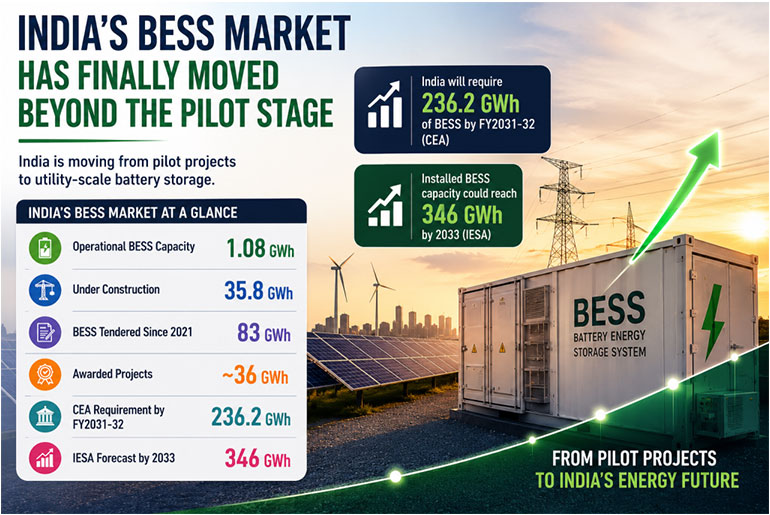
To truly appreciate the sheer velocity of this shift, we need to look closely at the numbers tracking our current grid transformation. The pace at which grid-tied storage is moving from blueprint to reality is staggering. India’s 2026 storage market is exploding, anchored by a 1.08 GWh operational base, 35.8 GWh actively under construction, and a massive 83 GWh tendered since 2021.
Consider what this trajectory represents. We are no longer simply testing the waters or running cautious pilot operations. Our energy sector has crossed the threshold into full-scale industrial maturity. According to long-term projections by the Central Electricity Authority (CEA), our grid will require a staggering 236.2 GWh of battery capacity by the end of the next decade.
Furthermore, independent data from the India Energy Storage Alliance (IESA) suggests the total footprint could skyrocket to 346 GWh by 2033. This insatiable grid appetite is opening up an unprecedented BESS Tender Opportunity in India, sparking highly competitive domestic bidding rounds and drawing global infrastructure capital directly into our local energy markets.
The Scale Shift: When Did Battery Storage Become So Massive?
If we look back just half a decade, an installation capable of delivering 10 or 20 megawatt-hours of electricity was treated as a major corporate milestone. A 50 MWh asset was viewed as an exceptionally bold gamble. In that era, utility managers looked at large-scale batteries primarily as precision tools—designed to trim peak spikes for less than an hour or smooth out sudden, localized frequency drops.
Today, that old paradigm has been completely shattered. As our massive regional solar parks cross multi-gigawatt thresholds, deploying tiny, short-duration batteries is like trying to hold back a monsoon with an umbrella. We need massive infrastructure capable of absorbing enormous waves of power during midday periods of overproduction and discharging that energy smoothly over four to six consecutive hours.
Consequently, the individual capacities of the Largest BESS Projects in India have evolved rapidly, jumping from megawatt-hour experiments directly into massive, multi-gigawatt-hour grid assets.
The New Giants: Rajasthan and Gujarat Redefine the Horizon
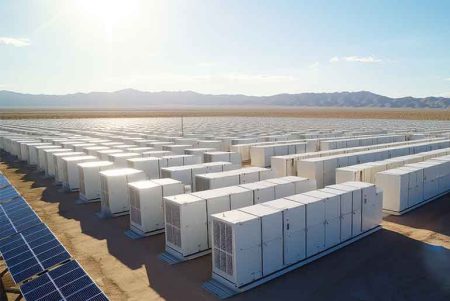
When we map out where the Largest BESS Projects in India are taking root, our attention is drawn straight to the vast, sun-drenched expanses of Rajasthan and Gujarat. These states are no longer just leading in terms of raw solar generation; they are pioneering the integration of mega-scale storage.
The NGEL Bikaner Project (7,800 MWh)
Let us start with a project that fundamentally redefines our collective understanding of energy storage scale. In Rajasthan, NTPC Green Energy Limited (NGEL) has stepped forward with an epic development at the NTPC REL Bikaner Solar Park. This facility features an absolute behemoth of an installation: a planned 1,950 MW / 7,800 MWh battery storage system.
To visualize what a 7,800 MWh installation means, look at how the architecture is organized. The entire development is broken down into five distinct, specialized storage blocks. The single largest sub-block alone—Block-2—delivers an astonishing 2,200 MWh of storage capacity.
This project isn’t designed to simply sit back and wait for emergency frequency deviations. It is built to act as a massive, dispatchable baseload asset. By soaking up the enormous mid-day solar surges from the Bikaner solar fields, it converts erratic, weather-dependent electrons into predictable, reliable power that can be fed into the national grid whenever consumer demand peaks.
The Khavda BESS Complex (3.37 GWh)
Simultaneously, if we shift our focus across the state border into the salt flats of Gujarat, Adani Green Energy is busy executing the Khavda renewable complex. This development integrates a massive 3.37 GWh storage setup directly into the heart of one of the largest clean energy installations on the planet.
What makes the Khavda installation so unique is the sheer speed of its physical deployment and its close proximity to massive wind and solar generation plants. It stands as a brilliant example of how the Largest BESS Projects in India are shifting away from standalone, isolated assets and evolving into fully integrated clean energy platforms.
Solar Plus Storage: Making Clean Energy Round-the-Clock
For a long time, clean generation and grid storage were managed as entirely separate conversations. A developer would build a solar plant, and a completely different utility company would handle grid transmission issues down the line. Today, that operational barrier is fading away completely.
The industry is rapidly embracing co-located “Solar-Plus-Storage” systems, ensuring that our green energy infrastructure is built with intelligent storage capabilities right from the start.
During the day, solar panels feed the grid directly to cover daytime loads while diverting the excess midday surge into battery storage. When the sun sets and power demand spikes, these batteries step in, discharging their stored energy to smoothly manage the critical evening peak.
Look at the NGEL Fatehgarh BESS Project in Rajasthan. This installation adds a substantial 800 MW / 3,200 MWh of storage capacity directly across three dedicated battery blocks, connected straight to the state’s existing solar infrastructure. Rather than treating storage as a late addition, the project designs it right into the system from day one.
Similarly, Avaada’s Pugal Solar Plus Storage Project integrates 1,560 MWp of solar capacity with a 2,500 MWh battery installation. These massive hybrid configurations solve the grid’s biggest headache: they ensure that our clean energy generation matches our actual, real-world consumption patterns, making renewable energy reliable enough to power our lives around the clock.
Avaada Group
The Thermal Paradox: Why Our Coal Fleet is Adopting Mega Batteries
Now, let us explore an unexpected development that catches many casual energy observers completely by surprise. When we think about major battery installations, our minds naturally drift to high-tech solar fields out in the desert. Yet, some of the most innovative, strategically vital storage deployments are happening inside our traditional coal-fired thermal power stations.
This might seem strange at first glance. Why would a steady, coal-fired station require a giant battery system? The answer boils down to grid flexibility and asset protection. Coal boilers are massive, heavy systems. They are built to run steadily, and forcing them to ramp up or slam down to chase sudden drops in solar generation causes severe mechanical wear, shortens equipment lifespans, and burns fuel inefficiently.
By installing massive battery systems right next to these thermal units, utilities can use the fast-acting batteries to handle sudden grid swings, allowing the coal plants to run smoothly and efficiently. NTPC’s multi-station storage program is a fantastic example of this smart approach, deploying 2.67 GWh of battery capacity across nine historic thermal facilities, including:
- Barauni
- Gadarwara
- Khargone
- Dadri
- Tanda
Among these, the newly awarded 1,000 MWh Barauni BESS Project in Bihar stands out as a major milestone. Developed in partnership with SPML Infra and Energy Vault, this project integrates a 250 MW / 1,000 MWh battery storage setup directly into a major thermal station.
Instead of building all our storage in one single location, we are scattering these smart assets across key points in our network—improving grid resilience exactly where the power is consumed.
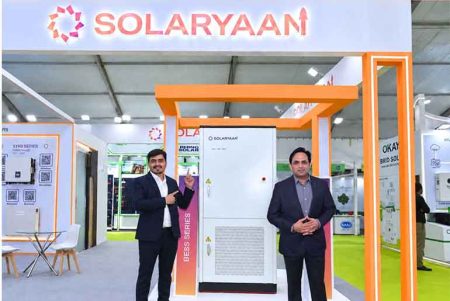
Behind the massive grid deployments stands a powerful domestic industrial ecosystem. The Leading BESS Manufacturers in India—including heritage heavyweights like Exide, Amara Raja, and Tata Power Solar, alongside specialized giants like Waaree and GoodEnough Energy—are investing heavily in gigafactory-scale production. Together, we are building the advanced gigawatt-hour manufacturing foundation necessary to keep our future grid completely self-reliant.
Beyond Lithium: The Long-Duration Flow Battery Revolution
When we discuss energy storage, we often focus on conventional Lithium-ion chemistry. After all, lithium dominates our consumer electronics and electric vehicles. But as we look toward long-duration storage needs, we are seeing alternative chemistries step up to handle heavy, continuous grid work.
A perfect example is the GIPCL Vanadium Flow Battery Project at its Vadodara facility in Gujarat. Compared to the massive gigawatt-hour projects we’ve discussed, this 20 MW / 120 MWh system might seem small, but its technology is incredibly significant. This project is India’s very first utility-scale demonstration of Vanadium Redox Flow Battery (VRFB) technology.
Lithium-ion systems store energy in solid electrodes, degrading gradually over time and requiring intense cooling to manage fire risks during typical two-to-four-hour discharges. Conversely, water-based Vanadium Flow batteries store energy safely in liquid tanks, offering near-zero degradation for over twenty years and dominating long-duration needs exceeding six to ten hours.
Unlike lithium systems, where the energy is stored inside solid electrodes, a flow battery keeps its energy in massive tanks of liquid electrolyte. If you want to expand your storage capacity, you don’t need to buy expensive new battery cells; you simply build larger fluid tanks.
Furthermore, these systems can endure tens of thousands of continuous charge cycles over 25 years with almost zero degradation, and they carry no risk of thermal runaway. As we aim for true round-the-clock clean energy, these flow systems will play a vital role alongside lithium to keep our grid steady.
The Industrial Anatomy of a Mega-Scale BESS Facility
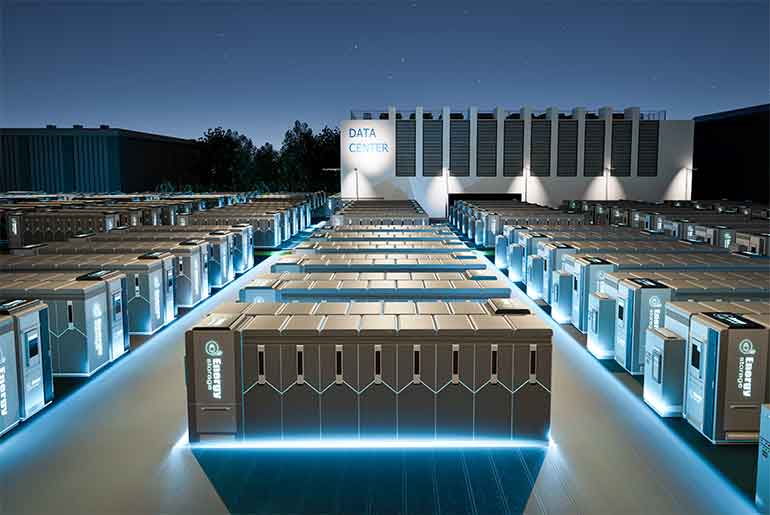
What does one of these Largest BESS projects in India massive installations actually look like up close? It is helpful to picture it not as a simple warehouse filled with batteries, but as an incredibly complex, finely tuned industrial ecosystem where multiple advanced systems work together in perfect harmony.
When project developers design these mega-scale sites, they rely on specialized BESS EPC Companies in India to manage the complex engineering, procurement, and construction work required to bring these plants to life. Every component matters:
Renewable Watch
- The Protective Shell: The outer layer relies on a specialized Battery Container Manufacturer in India to construct heavy-duty, weather-proof enclosures. These structures protect the dense rows of battery cells from intense outdoor heat, dust, and moisture.
- The Grid Bridge: Inside the installation, advanced PCS Suppliers for BESS in India provide the bi-directional Power Conversion Systems. These smart inverters act as the bridge between the batteries and the grid, smoothly turning high-voltage alternating current (AC) into direct current (DC) for storage, and vice versa.
- The Climate Loop: Finally, keeping the entire system running safely requires highly efficient Thermal Management Systems for BESS. Because large batteries generate significant heat when charging and discharging, these liquid-chilled climate loops maintain perfect operating temperatures—preventing dangerous overheating and ensuring the entire plant runs reliably for decades.
Looking Ahead: The Storage-Powered Grid
As we step back and look at the big picture, the lesson is clear: our clean energy journey has entered an entirely new era. Just a few years ago, we measured our green energy progress simply by how much power we could generate. The next decade, however, will be defined by how intelligently we can save and move that power.
The Largest BESS Projects in India are changing from ambitious trials into the literal backbone of our modern electrical grid. From the massive 7,800 MWh Bikaner project in the desert to the innovative flow batteries in Gujarat and the smart thermal integrations at Barauni, we are building a world-class energy network.
We are creating a highly reliable, flexible system built to serve our communities every single hour of the day. The energy transition is no longer a distant goal for tomorrow—it is actively charging up right before our eyes.
Series Navigation
To dive deeper into the technical components and market opportunities driving India’s energy storage revolution, explore our comprehensive deep-dives:
- Market Opportunities: Discover the shifting policy landscape and upcoming project pipelines in our analysis of the BESS Tender Opportunity in India.
- Engineering & Turnkey Delivery: Learn how India’s leading engineering firms build utility-scale storage assets in our breakdown of BESS EPC Companies in India.
- Enclosure Engineering: Explore the structural, weather-proofing, and structural safety standards required for grid-scale batteries with our guide on choosing a Battery Container Manufacturer in India.
- Grid Integration Technology: Unpack the bi-directional inverters and smart switchgear stabilizing our power lines in our technical review of PCS Suppliers for BESS in India.
- Climate Control & Safety: Examine the liquid cooling loops and thermal runaway prevention systems protecting our grid assets in our look at Thermal Management Systems for BESS.
 Electrify your feed! Click here to join our Whatsapp group and to get the latest updates, expert insights, and innovations driving India’s energy storage revolution.