Ark Energy has taken a final investment decision (FID) on its Richmond Valley Solar-Storage Hybrid Project in New South Wales (NSW), Australia, paving the way for an investment of approximately AUD 1.3 billion (USD 907.3 million) in the renewable energy and storage development.
The FID was approved during an extraordinary board meeting of Ark Energy’s parent company, Korea Zinc. The decision enables the Australian renewable energy developer to move ahead with a financing package comprising AUD 586 million in equity and AUD 716 million in debt. The funding will support the initial stage of the large-scale hybrid project, which is planned to combine solar generation with a lithium iron phosphate (LFP) battery energy storage system (BESS).
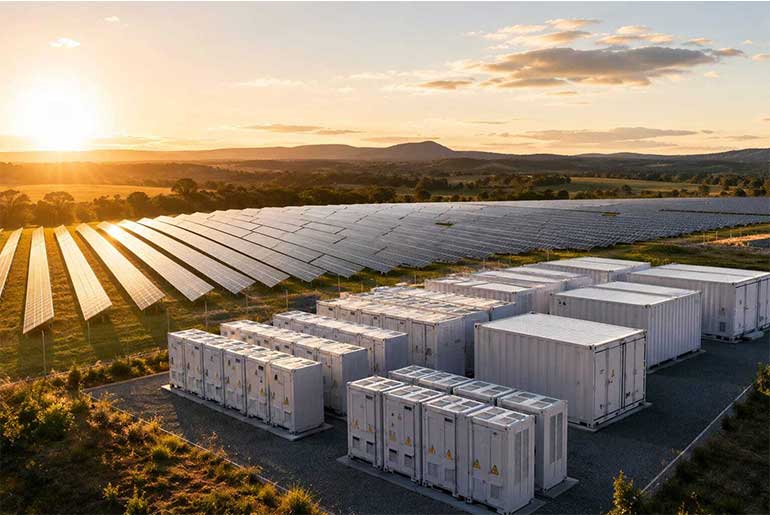
The full Richmond Valley project is planned to feature a 435 MW solar photovoltaic (PV) facility alongside a 475 MW/3,148 MWh BESS. The development is expected to provide a significant source of renewable electricity while using large-scale energy storage to improve the flexibility and reliability of power supply.
The first stage of the project will include 200 MW of solar generation capacity and up to 275 MW/2,200 MWh of battery storage. Ark Energy expects to reach financial close for the project in September, with construction scheduled to commence in October. The initial development is targeted to be energised in January 2029.
The Richmond Valley solar-storage project will be located approximately 25 kilometres south of Casino in the Northern Rivers region of NSW. The location places the project within an area that is expected to play an important role in Australia’s transition toward a more renewable electricity system.
The integration of solar generation and battery storage is becoming increasingly important in Australia’s energy market as the country expands its renewable capacity. Solar projects can generate significant amounts of electricity during daylight hours, while BESS facilities can store surplus power and discharge it during periods of higher demand or when renewable generation declines.
For the Richmond Valley project, the planned 2,200 MWh of storage in the first stage could provide substantial flexibility to the electricity system. The use of LFP battery technology also reflects the growing adoption of the chemistry for utility-scale energy storage projects, supported by its established safety characteristics, long cycle life and suitability for large stationary applications.
Once fully developed, the 435 MW solar and 475 MW/3,148 MWh storage complex is expected to become a major renewable energy and energy storage asset in NSW. The project also highlights the increasing trend of co-locating large-scale renewable generation with BESS infrastructure, allowing developers to better manage renewable output and respond to changing electricity demand.
Ark Energy’s investment decision comes amid growing demand for firm and flexible clean energy capacity across Australia’s electricity market. As more variable renewable generation is connected to the grid, large-scale battery systems are expected to play a greater role in balancing supply and demand, supporting grid stability and shifting renewable electricity to periods when it is most needed.
With financing arrangements progressing and construction targeted to begin later this year, the Richmond Valley project represents a significant step forward for Ark Energy’s renewable energy portfolio and Australia’s broader clean energy transition.
 Electrify your feed! Click here to join our Whatsapp group and to get the latest updates, expert insights, and innovations driving India’s energy storage revolution.