




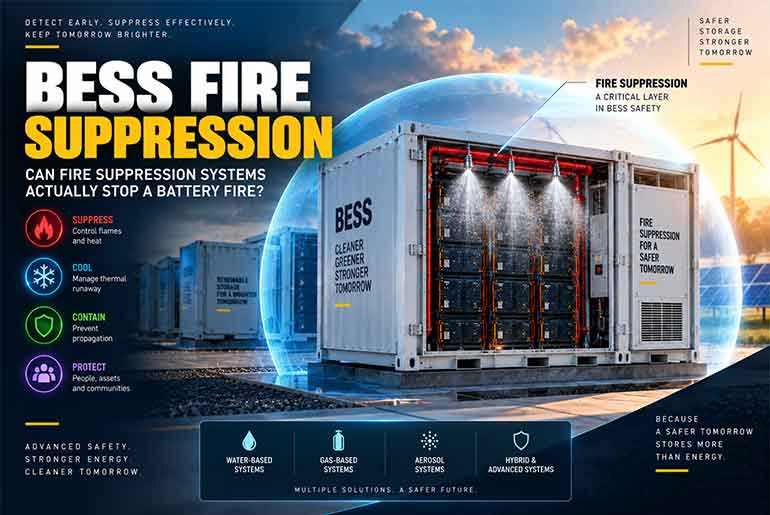
A fire-suppression system can discharge within seconds. But a battery can continue generating heat long after the flames disappear. That uncomfortable distinction sits at the centre of BESS Fire Suppression.
For conventional electrical equipment, extinguishing the visible fire can often mean the immediate emergency is largely over. A lithium-ion Battery Energy Storage System is different. When a cell enters thermal runaway, the underlying electrochemical reaction can continue to generate heat, release gases and potentially trigger neighbouring cells. A suppression system may control flames and heat, but that does not automatically mean the damaged battery has become safe.
That is why the industry’s question is evolving.
It is no longer enough to ask:
“Does the BESS have fire suppression?”
The more important questions are:
What is the suppression system designed to achieve? How quickly can it act? Can it control heat? Can it limit propagation? What happens after discharge? And what evidence proves that the system works with the actual battery configuration being installed?
Recent BESS incidents have made those questions impossible to ignore. At the Victorian Big Battery in Australia, investigators found that water used by firefighters was directed primarily toward protecting neighbouring exposures rather than extinguishing the burning Megapack, while the fire nevertheless remained contained to the affected area. At Moss Landing in California, the January 2025 fire continued despite the facility’s existing suppression arrangements, ultimately requiring a prolonged emergency response and extensive post-fire battery removal.
For India, where the Central Electricity Authority’s new BESS-specific safety framework will take effect on 1 April 2027, the lesson is clear: BESS Fire Suppression cannot be treated as a standalone piece of firefighting hardware. It has to be part of a complete safety architecture.
What Is BESS Fire Suppression Actually Supposed to Do?
The first problem is the word “suppression.”
It can imply that a fire starts, the system activates and the fire disappears.
That is an oversimplification for battery energy storage.
The objective of BESS Fire Suppression can involve several different functions:
- controlling visible flames;
- removing or controlling heat;
- protecting neighbouring cells and modules;
- limiting thermal-runaway propagation;
- protecting the enclosure;
- reducing exposure to surrounding equipment;
- supporting emergency response; and
- preventing a small event from becoming a larger fire.
These objectives are related but not identical.
A system may be effective at controlling flames without stopping thermal runaway inside every affected cell.
Conversely, a system that cannot immediately “extinguish” the battery may still be highly valuable if it keeps surrounding equipment below critical temperatures and prevents propagation.
This distinction is becoming increasingly important in BESS engineering.
The National Fire Protection Association notes that testing has shown water to be the most effective agent for cooling a battery ESS, while its research also emphasises the specific challenges of lithium-ion battery fires and thermal runaway.
So the right question is not simply:
“Which extinguishing agent puts out the flame?”
It is:
“Which protection strategy best manages the actual failure mechanism?”
A Battery Fire Is Not the Same as a Conventional Electrical Fire
A BESS contains electrical equipment, but the battery introduces an additional failure pathway.
Consider a conventional electrical fault.
A conductor fails.
Protection operates.
The circuit is isolated.
The energy source is disconnected.
The fire may then be extinguished.
A lithium-ion battery can behave differently.
A cell can develop an internal fault, enter thermal runaway and begin releasing heat and gases. Electrically disconnecting the system can remove external power, but it does not necessarily reverse the electrochemical process already occurring inside a damaged cell.
That creates a difficult problem for BESS Fire Suppression.
The suppression system may be fighting the consequences of a battery failure rather than the original failure itself.
This is why suppression has to be integrated with:
BMS → detection → isolation → cooling → suppression → containment → emergency response
rather than operating independently.
Thermal Runaway Changes the Fire-Suppression Equation
Our earlier article, Thermal Runaway in BESS: What Actually Starts a Battery Fire?, examined the process that can precede a battery fire.
Thermal Runaway in BESS: What Actually Starts a Battery Fire?
The key issue is that thermal runaway can generate enough heat to trigger further reactions.
That creates the possibility of:
Cell failure
↓
Thermal runaway
↓
Heat and gas generation
↓
Neighbouring-cell heating
↓
Propagation
↓
Fire
A BESS Fire Suppression system therefore enters this chain at a particular point.
The earlier layers of protection are trying to prevent or isolate the event.
Suppression is part of the response when those earlier layers have not prevented escalation.
That makes suppression essential—but also explains why it cannot carry the entire burden of BESS safety.
Water: The Most Important Suppression Agent—and the Most Misunderstood
Water creates an unusual debate around lithium-ion BESS.
There is a widespread assumption that putting water near a battery automatically creates an electrical hazard.
But modern BESS fire-safety research takes a more nuanced position.
The principal value of water in lithium-ion battery fires is cooling.
NFPA states that testing has shown water to be the most effective cooling agent for battery ESS fires. Its research also notes that water can help cool batteries and stop the spread of thermal runaway.
That does not mean that every BESS should simply be flooded.
The actual system design depends on:
- battery architecture;
- enclosure;
- electrical configuration;
- detection;
- suppression system;
- drainage;
- water availability;
- fire-service strategy;
- environmental controls;
- site layout; and
- applicable codes and standards.
The objective is not simply to “put water on batteries.”
It is to deliver cooling where it matters while managing the electrical, thermal, structural and environmental consequences of the incident.
Cooling May Matter More Than Extinguishing
This is perhaps the most important concept in BESS Fire Suppression.
Imagine that flames are visible inside a container. A suppression system knocks down those flames. But several cells are still at dangerously high temperatures. If those cells remain hot enough, the event can continue.
This means:
No visible flame ≠ no thermal hazard
The suppression system may therefore need to manage heat even after the visible fire has been controlled.
This is one reason water is valuable: its high heat capacity makes it particularly effective for cooling.
The question then becomes how the system delivers that cooling.
Does the agent reach the affected area?
Can it cool the battery sufficiently?
Can it prevent adjacent cells from reaching runaway conditions?
Can it protect surrounding equipment?
Those are much more meaningful performance questions than simply asking whether the agent is “effective against fire.”
Can Gas Suppression Stop a Battery Fire?
Gas-based systems can have applications in fire protection, particularly where protecting sensitive electrical equipment from water damage is important.
But a BESS presents a different challenge.
The fundamental hazard is not simply combustion in the surrounding air.
A cell undergoing thermal runaway can continue generating heat internally.
Therefore, an agent that removes oxygen from an enclosure may not necessarily stop the underlying electrochemical reaction inside the battery.
This is why a generic clean-agent strategy should not automatically be assumed to be equivalent to a battery-specific thermal-management strategy.
The system designer needs to establish:
- what fire scenario is being addressed;
- what stage of failure the system is designed for;
- whether cooling is required;
- whether propagation is possible;
- whether the enclosure can safely contain gases;
- and what happens after the agent discharges.
BESS Fire Suppression has to be designed around the battery failure mode—not simply the electrical equipment inside the container.
Aerosol Suppression: Where Does It Fit?
Aerosol systems have also attracted attention in energy-storage applications because they can provide compact fire protection without the same water infrastructure requirements.
But again, the critical distinction is between:
extinguishing combustion
and
controlling battery thermal runaway.
If an aerosol system extinguishes external flames but does not adequately control the temperature of damaged cells, the possibility of continued internal heating or reignition needs to be considered.
That does not automatically make aerosol technology unsuitable.
It means its performance needs to be established for the specific BESS configuration and fire scenario.
This is exactly where system-level testing becomes important.
Why Reignition Is Such a Serious Problem
A BESS fire can create a dangerous assumption:
“The flames are gone, so the incident is over.”
That assumption can be wrong.
Damaged cells may retain significant thermal energy.
Some cells may be physically compromised but not yet visibly burning.
A system can therefore require continued monitoring after the initial suppression event.
The issue is especially important during:
- firefighting;
- post-fire inspection;
- battery removal;
- transportation;
- dismantling; and
- disposal.
The EPA’s continuing response at Moss Landing demonstrates just how long the safety challenge can persist after the initial fire.
As of June 2026, EPA reported that 33,943 intact batteries had been de-energised, with roughly 5,000 more remaining in difficult or unsafe areas of the fire-impacted building. EPA also noted that batteries can re-ignite in wet conditions and that thermal imaging and infrared cameras were being used during the cleanup process.
That is an extraordinary illustration of the difference between:
fire suppression
and
making a damaged battery system safe.
Case Study: Victorian Big Battery Shows Why “Extinguish” Is Not Always the Objective
The Victorian Big Battery fire in Australia in July 2021 is particularly useful because the response illustrates the importance of containment.
The 300 MW/450 MWh project used Tesla Megapacks. The independent technical investigation found that the fire originated in one Megapack and spread to a neighbouring unit.
The investigation identified a likely sequence involving a cooling-system leak, electrical arcing/heating and subsequent thermal runaway.
But the firefighting response is what matters for this article.
The report states that water was not aimed at suppressing the fire, but rather at protecting exposures. It also concluded that water had limited effectiveness in reducing or stopping propagation from one Megapack to another, while the passive protection and separation strategy helped contain the event.
That leads to a crucial lesson:
A successful BESS fire strategy does not necessarily mean extinguishing the originating battery immediately.
Sometimes the safety objective is:
Let the affected unit fail in a controlled manner while preventing the failure from spreading.
That is a very different philosophy from conventional firefighting.
Case Study: Moss Landing Raises a Harder Question
The January 2025 fire at Vistra’s Moss Landing facility provides an even more uncomfortable lesson.
The fire began on 16 January 2025 in the Vistra energy-storage facility. The EPA records that the site contained about 100,000 battery modules at the time. Local agencies requested EPA assistance with air monitoring, and EPA established nine monitoring locations around the site.
The fire went out on January 18, but the incident did not simply end there.
A flare-up occurred on February 18.
The subsequent cleanup required extensive stabilisation, battery delinking, de-energisation and removal.
By June 2026, more than 33,000 intact batteries had already been sent off-site for recycling, while approximately 5,000 remained in difficult or unsafe areas of the affected building.
The cause of the January 2025 fire remains under investigation according to the EPA’s response timeline.
The lesson for BESS Fire Suppression is not that suppression “doesn’t work.”
That conclusion would be too simplistic.
The lesson is that suppression performance must be evaluated against the full incident lifecycle:
Detection → fire development → suppression → cooling → containment → reignition monitoring → recovery
A system can perform one part of that chain successfully while another part remains challenging.
McMicken: When Suppression Became Part of the Problem
The 2019 APS McMicken incident in Arizona provides another important lesson.
The facility experienced a battery failure that progressed into thermal runaway and eventually produced an explosive event.
The APS technical investigation became one of the industry’s important sources of lessons on BESS fire response. NFPA reported that the suppression system activated about a minute after the initial failure.
The incident demonstrated why fire suppression, gas accumulation and firefighter response cannot be considered independently.
A battery enclosure can accumulate flammable gases during a thermal event.
If those gases are not adequately managed, introducing an ignition source or changing the enclosure conditions can create an explosion hazard.
That means:
Fire suppression ≠ explosion protection
A BESS needs both hazards considered separately.
This is increasingly reflected in the evolution of international testing.
UL 9540A’s updated methodology separates fire-hazard evaluation from explosion-hazard evaluation, while the latest edition includes large-scale testing intended to examine realistic fire and post-deflagration conditions.
India’s New CEA Rules Put Suppression Inside a Larger Safety Architecture
India’s regulatory position has now moved considerably beyond the earlier draft framework.
The CEA notified the Central Electricity Authority (Measures relating to Safety and Electric Supply) Amendment Regulations, 2026 on 27 March 2026, with the new BESS-specific Chapter XA coming into force on 1 April 2027.
For applicable BESS installations connected above 650 V, the chapter addresses:
- two-fault-tolerant design;
- BMS monitoring;
- battery-container design;
- explosion protection;
- forced ventilation;
- thermal management;
- equipment separation;
- hazard detection;
- automatic fire suppression;
- emergency shutdown;
- security;
- earthing; and
- independent third-party fire-safety audits.
Regulation 122(F) specifically requires hazard detection for smoke, gas, heat and flame, with monitoring, and requires every battery container to have an automatic fire-suppression system according to the relevant standard.
And this is where an important distinction must be made.
The final CEA rule does not say every BESS must use water.
The earlier 2025 draft had specified water-based automatic suppression for battery containers of 200 kWh and above. The final notified regulation changed this wording to require automatic fire suppression as per the relevant standard.
That change matters.
It leaves the suppression technology tied to the applicable technical standards and the engineered hazard rather than declaring one extinguishing medium universally appropriate.
For developers, this makes the question of which suppression technology is appropriate even more important.
What Does UL 9540A Tell Us About Suppression?
UL 9540A is not a fire-suppression product certification.
It is a test method for evaluating thermal-runaway fire propagation behaviour in energy-storage systems.
Its importance lies in testing progressively larger system configurations.
The methodology examines:
- cell-level behaviour;
- module-level propagation;
- unit/system behaviour; and
- installation-level fire behaviour.
UL Solutions says the installation-level assessment evaluates fire-protection-system effectiveness alongside heat and gas release and risks such as deflagration and re-ignition.
The sixth edition of UL 9540A, published in March 2026, strengthens the large-scale fire-testing approach and introduces an installation-level scenario involving ignition of vent gases. UL Solutions says the revised approach is intended to provide more realistic data on fire spread, separation distances, enclosure performance and suppression effectiveness.
This is highly relevant to BESS procurement.
A suppression system should not be evaluated in isolation.
It should be evaluated as part of the actual battery system and installation configuration.
Why Container-Level Testing Matters
Suppose a suppression manufacturer demonstrates that its system works in a laboratory enclosure.
That is useful.
But what if the project uses:
- a different battery chemistry;
- a different cell format;
- different module density;
- different rack configuration;
- different HVAC;
- different enclosure dimensions;
- different state of charge;
- different ventilation;
- different detection thresholds?
The outcome may not be identical.
That is why system-level fire testing matters.
UL Solutions explains that installation-level large-scale testing evaluates the effectiveness of the fire-protection system as well as heat and gas release, including potential re-ignition and deflagration hazards.
The industry’s question therefore needs to move from:
“Is the suppression system tested?”
to:
“Is this suppression system validated for this BESS configuration?”
The Three Jobs of BESS Fire Suppression
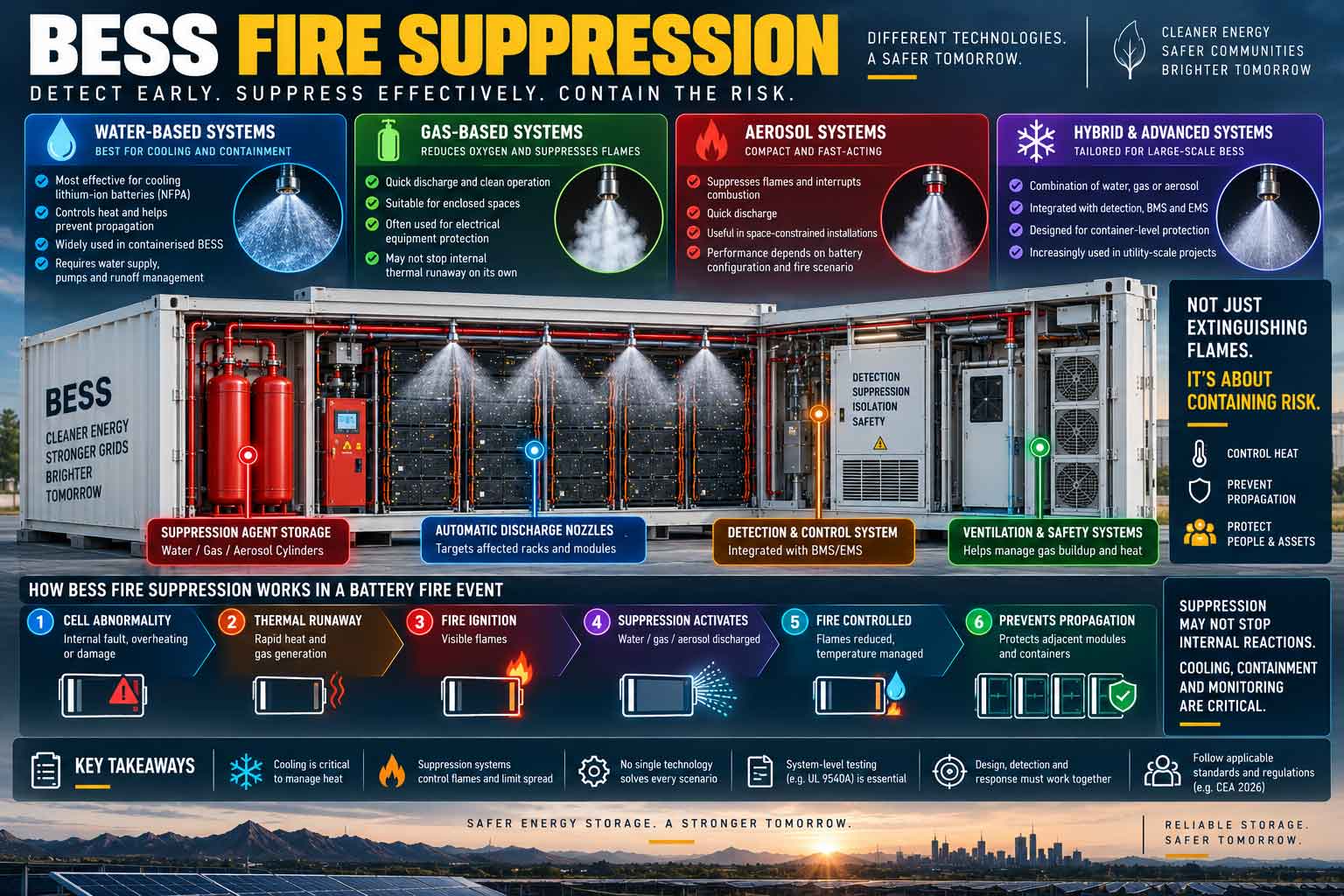
A useful way to evaluate suppression is to separate its objectives into three categories.
1. Extinguish
Can the system control visible combustion?
This is the most obvious question.
But it is not the only one.
2. Cool
Can it remove enough heat to prevent surrounding cells from reaching thermal runaway?
This may be even more important.
3. Contain
Can it prevent the event from spreading beyond the affected module, rack or container?
This is where passive fire protection, spacing and enclosure design become critical.
A system may therefore be highly valuable even if its role is primarily cooling and containment rather than instantaneous extinguishment.
That is why evaluating BESS Fire Suppression using a simple “fire/no fire” test can be misleading.
Suppression Cannot Replace Detection
Our previous article examined the growing role of early BESS Fire Detection.
BESS Fire Detection: How Early Can a Battery Fire Be Detected?
The relationship between the two articles is straightforward.
Detection buys time.
Suppression uses that time.
If a system detects a developing hazard early, it may have more opportunity to:
- stop charging;
- stop discharging;
- isolate the affected section;
- activate ventilation controls;
- initiate suppression;
- alert operators;
- notify emergency responders.
A suppression system that activates only after the entire container is involved has a fundamentally different task from one triggered during an earlier stage.
This is why detection and suppression need to be engineered as one safety chain.
Suppression Cannot Replace Thermal Management
The same principle applies to cooling.
A BESS should not rely on the emergency suppression system to compensate for inadequate normal thermal management.
The normal HVAC or liquid-cooling system is intended to keep batteries within their operating conditions.
The emergency fire-protection system is intended to respond to an abnormal hazard.
Confusing these roles creates a dangerous design philosophy:
“The suppression system will protect us if the battery gets too hot.”
That is not a substitute for proper thermal management.
India’s CEA framework reflects this separation by addressing HVAC/cooling and thermal management in one provision and hazard detection/suppression in another.
That is the right conceptual approach:
- Prevent abnormal heating first.
- Detect abnormality early.
- Suppress and contain if prevention fails.
The Hidden Requirement: Water Supply and Firewater Management
If a project relies on water-based BESS Fire Suppression, another question immediately follows:
Where does the water come from?
And:
How much is actually available when the system needs it?
A suppression design is only as credible as its supporting infrastructure.
That can include:
- water storage;
- pumps;
- pressure;
- pipework;
- valves;
- detection controls;
- backup power;
- maintenance;
- drainage;
- runoff containment.
The environmental side also matters.
The EPA reported that water used during the January 2025 Moss Landing fire was collected and stored on site, sampled and determined to be non-hazardous before disposal. It also reported that approximately 586,300 gallons of water stored on the property were removed during subsequent response work.
This illustrates an often-overlooked point:
Firewater becomes part of the incident-management problem.
The suppression system may save equipment or limit fire spread while simultaneously creating contaminated or potentially contaminated runoff that must be captured and managed.
What Should Indian BESS Developers Actually Specify?
For developers, the procurement document should go beyond:
“Provide an automatic fire-suppression system.”
That is too vague.
The specification should establish the intended safety function.
Ask what the system is designed to control
Fire?
Heat?
Propagation?
All three?
Ask when it activates
What detection signal triggers it?
Smoke?
Gas?
Temperature?
Flame?
BMS abnormality?
Ask what happens after activation
Does the battery isolate?
Does HVAC shut down?
Does ventilation change?
Does the system continue cooling?
Ask about re-ignition
How is the battery monitored after suppression?
Ask about testing
What test evidence exists?
Was the actual battery configuration tested?
Ask about failure modes
What happens if:
the detector fails?
the suppression system loses power?
the pump fails?
HVAC fails?
communications fail?
a valve fails?
one container loses protection?
Ask about emergency response
What information reaches the fire service?
Ask about water and runoff
If water is used, what is the supply and containment strategy?
These questions are more useful than simply comparing suppression-system price quotes.
The Real Cost of Choosing the Wrong Suppression Strategy
There is a tendency in BESS procurement to treat fire protection as an additional CAPEX item.
That can be misleading.
The real economic question is:
What is the cost of inadequate fire protection?
A BESS fire can create:
- equipment loss;
- project downtime;
- lost contracted revenue;
- replacement costs;
- insurance complications;
- investigation costs;
- environmental remediation;
- emergency-response costs;
- reputational damage;
- regulatory scrutiny.
The cost of the suppression system therefore needs to be evaluated against the risk it is designed to control, not simply against the cheapest competing equipment.
This becomes particularly important as BESS projects become larger.
A suppression system protecting a 5 MWh installation and one protecting a 500 MWh site cannot be evaluated purely through a per-container equipment price.
The consequence of failure is different.
Does More Suppression Mean More Safety?
Not necessarily.
More equipment does not automatically equal better engineering.
A poorly integrated suppression system can create new challenges.
For example:
Detection without response is weak.
Suppression without cooling may be incomplete.
Cooling without containment may leave propagation risk.
Containment without emergency access can complicate response.
Suppression without post-fire monitoring can leave reignition risk.
The strongest design is therefore not necessarily the one with the most technology.
It is the one where every safety layer has a clearly defined purpose.
The New Standard: Prove the System, Not Just the Product
This is where the global standards landscape is moving.
UL Solutions says the latest UL 9540A approach places greater emphasis on installation-level large-scale fire testing, including the behaviour of fire-protection systems under severe conditions.
The significance is bigger than one standard.
It reflects an industry-wide realisation:
BESS fire behaviour is a system problem.
The battery.
The rack.
The container.
The HVAC.
The detection.
The suppression.
The ventilation.
The spacing.
The neighbouring units.
The emergency response.
All interact.
Testing one component cannot automatically validate the entire chain.
So, Can BESS Fire Suppression Actually Stop a Battery Fire?
The honest answer is:
Sometimes it can control or extinguish the visible fire—but that is not the same as stopping every underlying battery failure.
A strong BESS Fire Suppression system can play several critical roles:
- control flames;
- remove heat;
- slow propagation;
- protect adjacent equipment;
- support containment;
- give emergency responders more options.
But it should not be expected to solve:
- poor cell quality;
- inadequate BMS protection;
- poor thermal management;
- insufficient separation;
- uncontrolled gas accumulation;
- weak emergency planning;
- inadequate testing.
Those risks have to be addressed elsewhere in the architecture.
And that is precisely what the industry’s recent experience is teaching.
The Victorian Big Battery demonstrated the value of containment even where water was not being used primarily to extinguish the originating fire. Moss Landing demonstrated that a major BESS incident can remain a complex safety and recovery operation long after the visible flames have diminished. McMicken demonstrated how battery fire, suppression, gas accumulation and firefighter response can interact in dangerous ways.
India’s BESS Industry Has a Bigger Question to Answer
India’s new CEA framework is an important step because it makes automatic fire suppression part of a dedicated BESS safety architecture for applicable installations.
But the regulation is only the baseline.
The industry still has to answer the engineering questions underneath it:
- What should the suppression system accomplish?
- Which technology is appropriate for the battery chemistry and enclosure?
- How quickly does it activate?
- How effectively does it cool?
- Can it prevent propagation?
- What happens after the flames disappear?
- How is reignition monitored?
- What happens to firewater?
- What evidence proves that the installed configuration is safe?
These questions matter because BESS safety is moving from generic fire protection toward battery-specific hazard management.
India’s CEA rules recognise this by combining fire suppression with BMS monitoring, ventilation, thermal management, explosion protection, hazard detection, emergency shutdown and independent fire-safety auditing.
The Real Purpose of BESS Fire Suppression
Perhaps the industry’s biggest mistake would be to judge a suppression system only by whether it can make flames disappear.
A safer way to think about it is:
- Prevent the failure.
- Detect it early.
- Isolate the affected equipment.
- Control the heat.
- Suppress the fire where appropriate.
- Prevent propagation.
- Manage the gases.
- Protect surrounding assets.
- Monitor for reignition.
- Support emergency response.
That is a much more realistic definition of BESS Fire Suppression.
The ultimate objective is not necessarily to make every battery fire disappear instantly.
It is to keep a cell-level failure from becoming a rack-level event, a rack-level event from becoming a container fire, and a container fire from becoming a site-wide emergency.
For India’s rapidly expanding storage market, that distinction could become one of the most important safety lessons of the decade.
Because the best suppression system is not the one that looks most impressive when the fire starts.
It is the one that has already been engineered into the system before the fire ever begins.
 Electrify your feed! Click here to join our Whatsapp group and to get the latest updates, expert insights, and innovations driving India’s energy storage revolution.

1 Comment
Well articulated writeup. Fire once starts in BESS is very difficult to suppress or control, if the precursor that lead to fire are monitored then the chances of fire reduce considerably. This point is missing.