
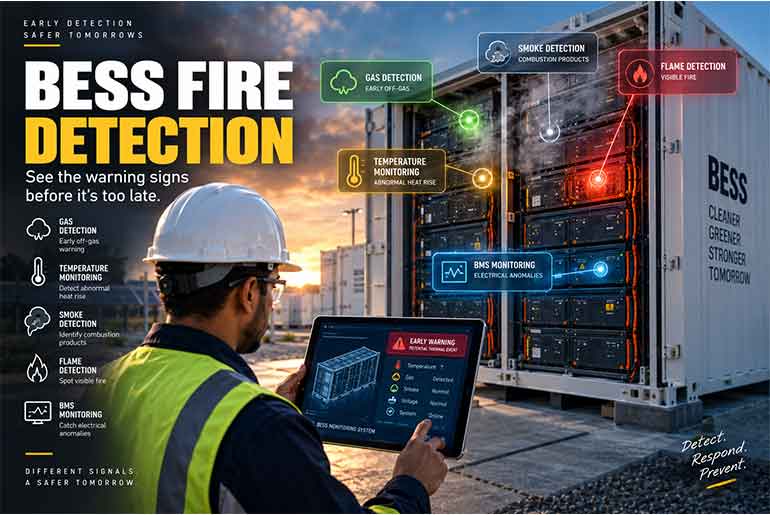
A BESS fire may become visible only after the most important safety window has already begun to close. BESS Fire Detection is therefore moving beyond conventional smoke and heat alarms toward systems designed to identify abnormal battery behaviour before a visible fire develops.
For India’s rapidly expanding Battery Energy Storage System fleet, that distinction could become critical.
A failing lithium-ion cell can release gases during an early venting stage before progressing to thermal runaway. If that warning is detected, communicated and connected to an effective response, operators may have an opportunity to isolate the affected equipment before the event escalates.
But there is an important caveat.
Earlier detection is useful only when the system knows what to detect and what to do with the warning.
A sensor that raises an alarm five minutes earlier is not necessarily a safety solution if there is no effective response pathway behind it.
That makes BESS Fire Detection a systems-engineering problem—not simply a sensor-selection exercise.
Why BESS Fire Detection Is Different From Conventional Fire Detection
A conventional fire alarm generally looks for the products of combustion.
- Smoke.
- Heat.
- Flame.
But a lithium-ion battery failure can develop through several stages before those signals become strong enough to trigger conventional detectors.
The broad sequence can look like:
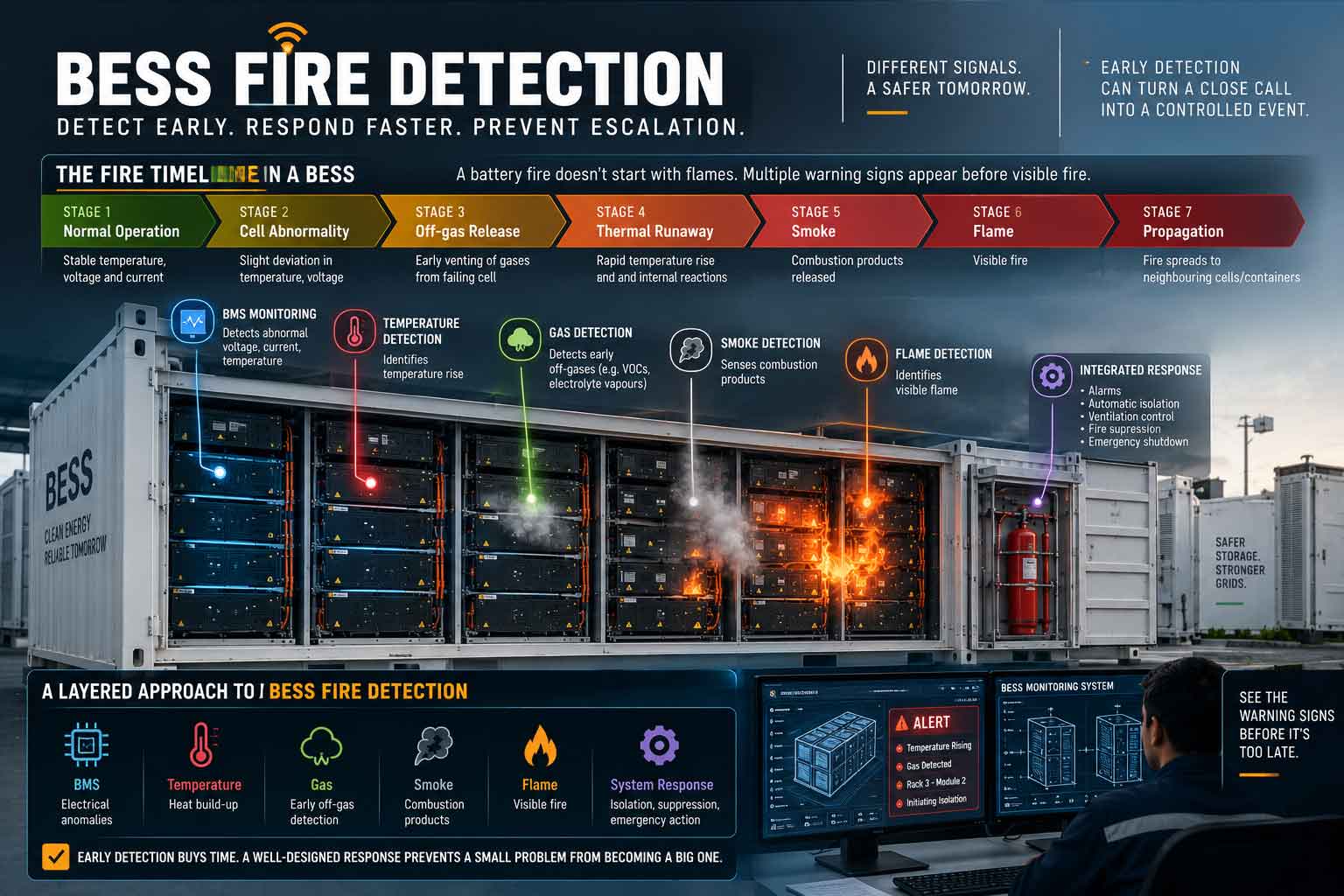
Cell abnormality → heating → venting/off-gas → thermal runaway → smoke/flame → propagation
This means different detection technologies operate at different points along the timeline.
The National Fire Protection Association’s BESS research has distinguished early off-gas detection from detection of flaming conditions through smoke or heat. It also notes that detection systems need to be connected to alarms and, where appropriate, monitoring stations and wider BMS/EMS systems.
The implication is straightforward:
There is no single detection signal that tells the entire story.
The Detection Race Starts Before Smoke
One of the most important developments in BESS Fire Detection is the increasing attention being given to the period before smoke or flame.
During an abnormal battery event, a cell may release gases before reaching full thermal runaway.
These are commonly referred to as off-gases.
They are not necessarily the same gases or concentrations that a conventional combustible-gas detector is designed to identify.
That distinction matters.
NFPA material specifically notes that gas detection intended to prevent explosive atmospheres should not automatically be treated as a thermal-runaway detection system. Early off-gas detection may require sensors capable of detecting much smaller concentrations of vaporised electrolyte.
So the question becomes:
Can the system detect the first chemical warning before the battery reaches the point where fire detection becomes the primary response?
That is where modern BESS Fire Detection strategies are increasingly focused.
1. BMS: The First Layer of Detection
The battery management system is already watching the battery continuously.
Depending on system architecture, it can monitor:
- cell voltage;
- temperature;
- current;
- state of charge;
- cell imbalance;
- charging behaviour; and
- other battery operating parameters.
An abnormal reading can indicate that something is wrong.
For example, an unusual temperature rise or voltage deviation may trigger an alarm or protective action.
But BMS monitoring has an inherent limitation.
It primarily sees electrical and thermal parameters.
An internal cell failure may not always present itself through a signal that the BMS can identify early enough.
Therefore, relying solely on BMS data for BESS Fire Detection can leave gaps.
The stronger approach is to combine battery-management data with independent physical detection systems.
2. Temperature Detection: Useful, But Potentially Late
Temperature sensors are an obvious safety layer.
If a battery begins heating abnormally, temperature monitoring can identify the change.
But temperature is not necessarily the earliest warning available.
By the time a large thermal rise becomes detectable at a sensor located away from the failing cell, the underlying event may already have progressed.
This creates a fundamental design challenge:
Where is the sensor?
A sensor close to the source may respond sooner.
A sensor farther away may see a slower and smaller temperature change.
And a large container may contain thousands of cells.
Therefore, BESS Fire Detection based on temperature requires consideration of:
- sensor location;
- sensor density;
- airflow;
- thermal gradients;
- enclosure geometry;
- response time;
- alarm thresholds; and
- integration with protective controls.
3. Smoke Detection: The Traditional Layer
Smoke detection remains important.
A thermal event can eventually produce smoke and combustion products, and smoke detection can provide a valuable indication of an established fire or developing event.
But smoke detection generally belongs later in the failure sequence than specialised off-gas detection.
That does not make smoke detection unnecessary.
It makes it one layer within a layered detection architecture.
This distinction is critical.
A BESS does not need to choose between smoke detection and early warning.
It may need both.
4. Flame Detection: When the Event Has Escalated
Flame detection provides another layer.
Once combustion occurs, optical flame detectors can potentially identify it rapidly.
But from a prevention perspective, flame detection is already relatively late.
The safety objective should ideally be to identify abnormal battery behaviour before the system reaches this stage.
That is why a mature BESS Fire Detection architecture should not be judged only by how quickly it identifies flames.
It should be judged by how early the overall safety system can recognise a credible failure pathway.
5. Gas Detection: Not All Gas Sensors Do the Same Job
This is where the subject becomes technically interesting.
There are at least two very different objectives:
Detecting early battery off-gassing
The objective is to identify small quantities of gases or vapours associated with early cell failure.
Detecting a dangerous accumulation of flammable gas
The objective is to determine whether an enclosure is approaching an explosive or otherwise hazardous concentration.
Those are different safety questions.
A sensor designed for the second purpose should not automatically be assumed to provide the sensitivity required for the first.
NFPA material has highlighted exactly this distinction: early off-gas detection can require specialised sensing capable of detecting trace quantities of electrolyte vapour before concentrations become high enough for conventional flammable-gas detection.
This is one of the most important points developers should understand when evaluating BESS Fire Detection systems.
The Most Valuable Signal May Come Before Thermal Runaway
The phrase “early detection” can become misleading unless we define what “early” means.
There are several possible detection points:
Abnormal BMS parameter
↓
Temperature rise
↓
Cell venting/off-gas
↓
Thermal runaway
↓
Smoke
↓
Flame
The earlier the signal, the more time the safety system potentially has to respond.
But earlier does not automatically mean better.
A system that generates frequent false alarms can cause unnecessary shutdowns, operational disruption and loss of confidence in the alarm system.
This creates the central engineering trade-off:
Detect early enough to matter—but accurately enough that operators trust the alarm.
That is one of the hardest problems in BESS Fire Detection.
Can Off-Gas Detection Catch Thermal Runaway Before It Happens?
Potentially—but the terminology needs care.
Off-gas detection can identify gases released during early cell failure or venting before the event develops into full thermal runaway.
NFPA’s BESS research literature notes that early-stage off-gas species differ from the gases associated with later thermal runaway, and that sensor selection and location need to reflect the battery chemistry, rack design, enclosure volume and airflow.
This means there is no universally correct sensor placement.
A detection system should be engineered around the actual BESS.
That includes:
- cell chemistry;
- cell format;
- rack configuration;
- enclosure volume;
- airflow pattern;
- HVAC arrangement;
- sensor response characteristics; and
- the intended safety action.
Where Should BESS Fire Detection Sensors Be Installed?
Sensor location can determine how quickly an event is identified.
A sensor mounted in the wrong location may encounter diluted gases or delayed heat movement.
A sensor positioned in the appropriate airflow path may identify an off-gas event much earlier.
This is why simply asking:
“How many sensors are installed?”
is not enough.
The better question is:
“Why are the sensors installed where they are?”
The answer should consider the physical behaviour of the enclosure.
For rack-based systems, sensor positioning may need to account for airflow from cooling systems and the likely movement of gases released by a failing cell.
This is particularly important for containerised BESS, where enclosure volume and airflow patterns can significantly influence detection.
Detection Without Response Is Not Safety
This is perhaps the biggest lesson for the industry.
Suppose an off-gas sensor detects an abnormal event.
What happens next?
Does the BESS:
- raise an alarm?
- isolate the affected rack?
- stop charging?
- disconnect the affected section?
- change ventilation?
- notify a control room?
- activate another detection layer?
- initiate an emergency shutdown?
- alert emergency personnel?
The answer needs to be defined before the incident occurs.
The NFPA research literature stresses that detection systems need to be coupled with alarms and integrated into the broader BMS/EMS and facility safety strategy where appropriate.
So the actual safety chain should look more like:
Detection → Decision → Isolation → Mitigation → Response
rather than:
Detection → Alarm → Wait
False Alarms Are a Real BESS Problem
There is another side to early detection that is often overlooked.
The more sensitive a detector becomes, the more important it becomes to understand its false-alarm behaviour.
A utility-scale BESS can be expected to operate for years.
If operators repeatedly receive alarms that do not correspond to meaningful battery events, they may begin treating alarms as operational noise.
That is dangerous.
The objective is therefore not:
Maximum sensitivity at any cost.
It is:
Useful sensitivity with a credible response strategy.
Detection technology should be evaluated not only for its theoretical response time but also for:
- false alarms;
- environmental conditions;
- sensor drift;
- maintenance requirements;
- calibration;
- communication reliability;
- redundancy;
- fault detection; and
- integration with the site’s emergency procedures.
Why Sensor Redundancy Matters
A BESS safety system should not depend on one sensor working perfectly forever.
Sensors can fail.
Communications can fail.
Power supplies can fail.
A controller can malfunction.
Environmental conditions can affect performance.
This is why the safety architecture should include fault monitoring and appropriate redundancy.
The CEA’s notified 2026 BESS safety framework requires hazard detection systems for smoke, gas, heat and flame, with the systems monitored according to relevant standards. It also requires an affected BESS section to shut down within a preset period when a safety issue or battery anomaly is detected.
That is significant because it connects BESS Fire Detection with the action that follows detection.
The sensor is not the endpoint.
It is the trigger for a safety response.
India’s BESS Safety Framework Is Moving Toward Layered Detection
India’s regulatory direction is becoming clearer.
The CEA’s Measures Relating to Safety and Electric Supply Amendment Regulations, 2026 now provide a dedicated safety framework for BESS. The CEA’s official site lists the amendment as a notified regulation, with the page updated in September 2026.
The framework specifically addresses hazard detection covering:
Smoke + Gas + Heat + Flame
That matters because it recognises that BESS hazards can present themselves through different physical signals.
The regulations also connect detection to emergency shutdown provisions.
This represents a broader move away from thinking about fire protection as a single piece of equipment.
India’s Bigger Problem: Detection Is Only One Part of the Ecosystem
India is developing its regulatory framework, but the country’s wider BESS safety ecosystem is still evolving.
A TERI policy brief published in August 2026 identified significant gaps in system-level safety regulation, testing and certification for grid-scale BESS, including dedicated infrastructure for full-scale fire testing and thermal-runaway propagation assessment.
This matters for detection too.
Why?
Because a detection system should ultimately be validated against the failure behaviour of the complete BESS.
If the system configuration changes, the safety analysis may need to change.
Different:
- chemistry;
- cell format;
- rack arrangement;
- enclosure;
- cooling architecture;
- ventilation;
- operating conditions;
can produce different detection challenges.
There is therefore a danger in treating a detection product as universally applicable simply because it has been used elsewhere.
What Should Developers Ask Before Selecting a BESS Fire Detection System?
For project owners, the procurement conversation should go considerably deeper than:
“Is the detector certified?”
Ask:
What event is the detector designed to identify?
Smoke? Heat? Flame? Flammable gas? Early off-gas?
How early can it detect the relevant failure?
And under what test conditions?
Where will the sensors be installed?
Ask for the engineering basis for the locations.
What battery chemistry was used during validation?
Detection performance may depend on the gases produced by the battery technology.
What happens after detection?
Alarm only?
Or automatic isolation and mitigation?
How are false alarms handled?
Especially in a continuously operating grid asset.
What happens if the sensor fails?
Is the fault itself detected?
How does it communicate with BMS/EMS and fire systems?
Integration is critical.
What testing supports the claim?
Ask whether evidence relates to the actual deployed system configuration.
What happens during loss of power or communications?
A safety system should be designed around credible failure modes.
These questions make BESS Fire Detection a project-engineering decision rather than a catalogue purchase.
Can AI Improve BESS Fire Detection?
Artificial intelligence and advanced analytics may eventually add another layer.
BMS data contains enormous quantities of information.
Algorithms can potentially identify patterns associated with:
- abnormal temperature behaviour;
- unusual voltage behaviour;
- cell imbalance;
- changing resistance;
- abnormal charging/discharging patterns; and
- deviations from historical operating behaviour.
But this should be approached carefully.
An algorithmic warning is only useful if:
- the underlying data is reliable;
- the model has been validated;
- false positives are manageable;
- the system can explain or contextualise the alert; and
- there is a defined response.
AI should therefore complement—not automatically replace—physical safety systems.
The most credible future may be sensor fusion:
BMS data + temperature + gas + smoke + other physical signals
rather than dependence on one technology.
The Five-Minute Question
For every BESS project, operators should be able to answer a deceptively simple question:
What happens during the first five minutes after the system detects an abnormal battery event?
If the answer is unclear, the detection architecture is incomplete.
A mature system should have a predefined sequence covering:
Detect
↓
Verify / classify
↓
Alarm
↓
Isolate
↓
Mitigate
↓
Notify
↓
Respond
The exact sequence will depend on the system design, hazard analysis and applicable requirements.
But the principle is universal:
Detection has value only when it buys meaningful time.
So, How Early Can a BESS Fire Be Detected?
There is no single number that applies to every BESS.
That is one of the most important conclusions.
Detection time depends on:
- battery chemistry;
- cell design;
- failure mode;
- state of charge;
- enclosure;
- airflow;
- sensor type;
- sensor location;
- detection threshold;
- environmental conditions; and
- the response system connected to the detector.
Some specialised off-gas systems are designed to detect early cell venting before smoke or flame, while BMS, temperature, smoke, flame and combustible-gas detection operate at different points in the failure sequence.
The important question is therefore not:
“How many minutes of warning does this detector provide?”
It is:
“At what stage of the failure does this detector respond, and what can the BESS actually do with that warning?”
That is the more meaningful measure of BESS Fire Detection.
The Future of BESS Fire Detection Is Not One Sensor
India is entering a period in which increasingly large BESS installations will become part of critical electricity infrastructure.
That makes early warning increasingly important.
But the industry should resist the idea that one technology will solve the problem.
The safer architecture is layered:
BMS monitoring
→ Temperature detection
→ Early off-gas detection
→ Gas detection
→ Smoke detection
→ Flame detection
→ Automatic isolation
→ Fire suppression / mitigation
→ Emergency response
Different layers serve different purposes.
The objective is not to make every sensor do everything.
It is to ensure that a failure detected at one layer triggers the next layer before the event escalates beyond control.
The Real Test of BESS Fire Detection
The strongest BESS Fire Detection system is not necessarily the one with the most sensors.
It is the one that understands the failure pathway.
It detects a meaningful abnormality early.
It distinguishes a genuine hazard from noise.
It communicates the warning reliably.
It initiates an appropriate response.
And most importantly, it gives the system a realistic opportunity to prevent escalation.
India’s new BESS safety framework is moving in this direction by requiring multiple hazard-detection modes and connecting battery anomalies with emergency shutdown provisions.
But the next step is deeper system-level validation.
As TERI has highlighted, India still needs stronger domestic capabilities for system-level BESS safety testing and certification.
Because ultimately, BESS Fire Detection is not about seeing the fire faster.
It is about seeing the failure early enough to change what happens next. And for a grid-scale battery, that difference could determine whether one abnormal cell remains a maintenance event—or becomes a major fire incident.
 Electrify your feed! Click here to join our Whatsapp group and to get the latest updates, expert insights, and innovations driving India’s energy storage revolution.