India’s Battery Energy Storage System (BESS) market is moving into a different phase. The country is no longer discussing storage only as a future requirement for renewable integration. Large battery projects are being tendered, built and connected to the power system. That changes the safety question. A battery fire at a small installation is one thing. A fire inside a utility-scale BESS containing thousands of cells, modules and racks is an entirely different engineering and emergency-response challenge.
The risk is not simply that a battery can catch fire. A lithium-ion battery undergoing thermal runaway can generate intense heat, release flammable gases, propagate failure to neighbouring cells and create conditions in which fire, toxic emissions and even explosion or deflagration become concerns. The challenge therefore extends well beyond putting out visible flames.
And India is beginning to recognise that distinction.
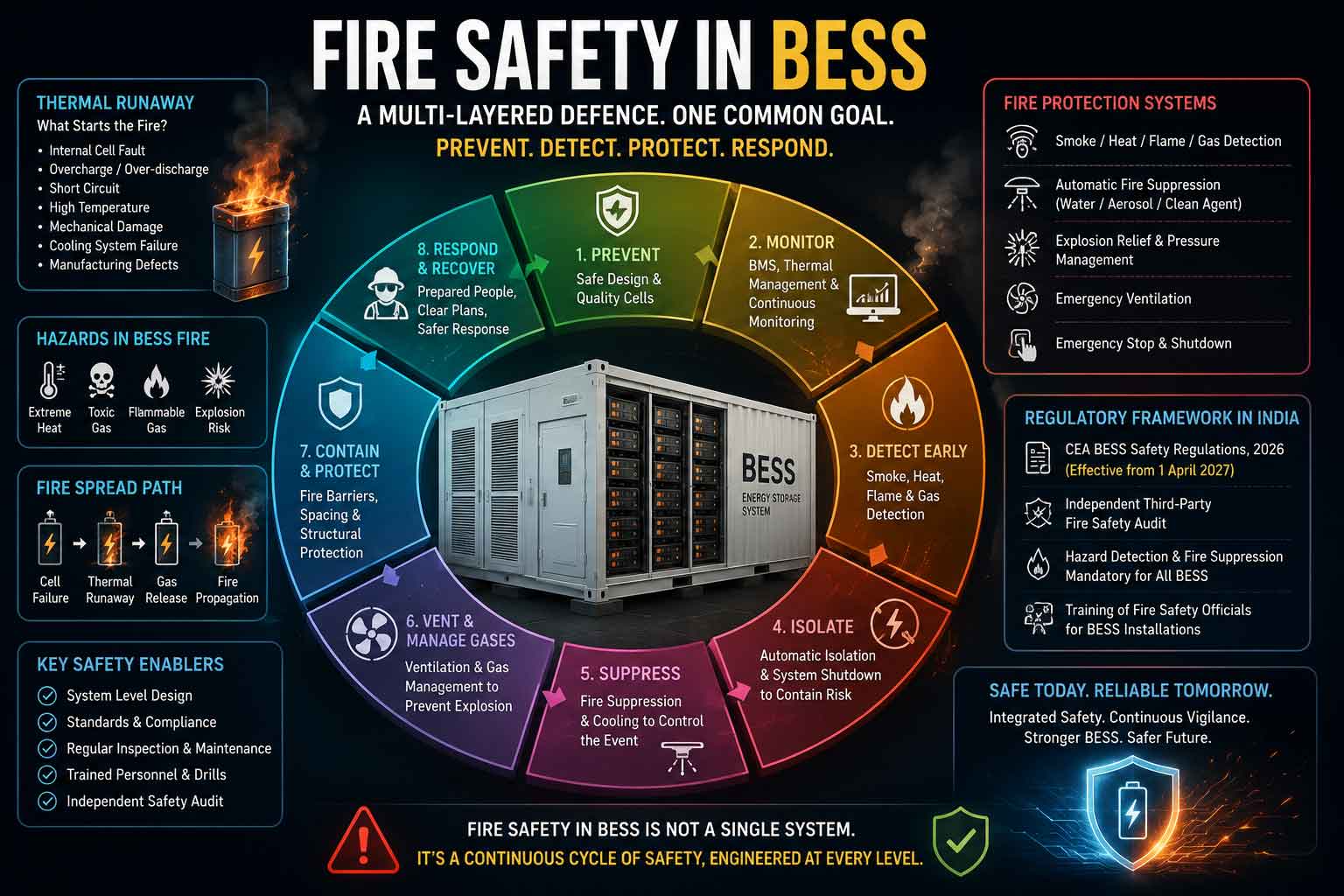
The Central Electricity Authority’s Measures relating to Safety and Electric Supply Amendment Regulations, 2026 create a dedicated Chapter XA for BESS safety. The regulations introduce requirements covering fault tolerance, BMS monitoring, fire and explosion protection, battery containers, ventilation, hazard detection and suppression, emergency shutdowns, security and independent fire-safety audits. They are scheduled to come into force on 1 April 2027.
The question now is whether India’s safety ecosystem can mature at the same speed as its storage pipeline.
A BESS Fire Is Not Just an Electrical Fire
The first mistake in discussing Fire Safety in BESS is treating a battery installation like another electrical room.
A BESS contains electrical equipment, but the battery itself introduces a different failure pathway.
A cell can experience an internal or external fault. If heat generation exceeds the cell’s ability to dissipate it, temperature can rise rapidly. Under sufficiently severe conditions, the cell can enter thermal runaway. Heat generated during the event can damage neighbouring cells, potentially creating a chain reaction.
Possible initiating conditions include:
- internal cell defects;
- short circuits;
- overcharging or abnormal electrical conditions;
- excessive temperature;
- mechanical damage;
- cooling-system failure;
- manufacturing defects;
- BMS or control-system failures; and
- faults in associated electrical equipment.
That does not mean every lithium-ion BESS is inherently unsafe.
It means safety has to be engineered across the complete system rather than added as a fire-protection product at the end of construction.
This distinction is increasingly reflected in international safety practice. IEC 62933-5-2:2025 addresses safety of grid-integrated electrochemical energy-storage systems across their lifecycle, while IEC 62933-5-4:2026 provides safety test methods for lithium-ion battery-based grid-integrated systems.
The Real Enemy Is Thermal Runaway
For Fire Safety in BESS, thermal runaway is the technical issue that sits underneath almost everything else.
It is also where a simplistic “install a suppression system and you are safe” approach begins to break down.
The objective should be to prevent thermal runaway where possible, detect abnormal conditions as early as possible, prevent propagation, manage heat and gases, isolate the affected section and protect people and surrounding assets.
This is why the new CEA framework is important.
The 2026 amendment requires BESS to be designed with two-fault tolerance to prevent catastrophic failures under conditions including overcharge, over-discharge, short circuit and operation outside specified temperature limits. It also requires BESS testing according to relevant standards and fire and explosion protection at cell, module, rack, container and site-specific installation levels.
That is a significant shift in regulatory thinking.
The emphasis is moving from:
“How do we extinguish the fire?”
to:
“How do we prevent one failure from becoming a system-level event?”
Early Detection May Matter More Than the Fire Extinguisher
A BESS can provide several opportunities to identify abnormal behaviour before visible flames appear.
The battery management system can monitor parameters such as temperature, voltage and current. Dedicated safety systems can add smoke, heat, flame and gas detection.
The CEA’s notified framework specifically requires BESS to have hazard detection systems covering smoke, gas, heat and flame, with the systems monitored according to relevant standards. It also requires automatic fire suppression systems for battery containers.
That creates several layers of defence:
Cell monitoring → BMS alarm → thermal detection → gas/smoke detection → system isolation → suppression/containment → emergency response
The earlier an abnormal event is identified, the greater the opportunity to isolate it before it becomes a larger fire.
But detection itself is not enough.
A sensor that detects a problem but does not trigger an appropriate control response is only part of a safety system.
The Gas Problem: Why Fire Can Become an Explosion Risk
This is one of the most important parts of the BESS safety conversation—and one that deserves far more attention.
Thermal runaway can produce gases. If those gases accumulate inside an enclosed battery container and reach an ignitable concentration, the hazard can change from fire to explosion or deflagration.
This is why ventilation and gas management are not optional engineering details.
The CEA framework requires BESS containers to have explosion protection, forced ventilation and automated louvers for safe release of flammable gases and maintenance of internal pressure within safe limits. It also requires mechanisms to limit the concentration of flammable materials inside the enclosure, with shutdown provisions if mechanical ventilation fails.
International standards are moving in the same direction.
The 2026 edition of NFPA 855 addresses areas including explosion control, exhaust ventilation, gas detection and thermal runaway. UL 9540A testing also examines gas generation and the potential for ignition, deflagration and re-ignition at different levels of the battery system.
That leads to a critical lesson:
A BESS fire-safety design cannot consider only flames. It has to consider what the battery releases before, during and after ignition.
Can Fire Suppression Actually Stop a BESS Fire?
This is where the industry needs to be precise.
Fire suppression is important—but suppression is not synonymous with eliminating the underlying battery failure.
Water, for example, can be highly valuable for cooling. NFPA notes that testing has shown water to be the most effective agent for cooling battery ESS fires, which is why its installation requirements incorporate water-based sprinkler protection in applicable systems.
But cooling a burning enclosure is different from reversing a cell that has already entered thermal runaway.
A properly engineered BESS safety strategy therefore needs to consider:
- cooling;
- suppression;
- thermal-runaway propagation;
- gas release;
- ventilation;
- deflagration;
- re-ignition;
- electrical isolation;
- separation between units; and
- firefighter access.
This is also why manufacturers and project developers increasingly need system-specific testing rather than relying only on component-level certificates.
India’s Biggest Gap May Be Testing
This is perhaps the most important finding for our article.
India has standards covering battery and energy-storage safety, but the country’s system-level testing infrastructure for grid-scale BESS is still developing.
A recent TERI policy brief on battery assembly and container testing found gaps in India’s system-level safety regulation, testing and certification ecosystem for grid-scale BESS, particularly around full-scale fire testing, thermal-runaway propagation assessment and integrated system-performance validation. It points to international frameworks including UL 9540, IEC 62933 and NFPA 855 as important reference points.
BIS’s current programme of work also shows India building out its electrical-energy-storage standards architecture, including Indian standards aligned with IEC 62933 and IS 17092 covering energy-storage safety.
But there is a difference between having a standard and having the domestic infrastructure to test a utility-scale BESS against the real-world failure conditions that the standard is intended to address.
That distinction matters enormously.
A cell can pass a test.
A module can pass a test.
A container can meet a specification.
But what happens when one cell enters thermal runaway inside a container containing thousands of cells?
That is the question system-level testing has to answer.
UL 9540A Shows Why Scale Matters
The international testing landscape provides a useful lesson.
UL 9540A evaluates thermal-runaway fire propagation at multiple levels:
Cell → Module → Unit → Installation
The tests examine characteristics such as thermal runaway behaviour, gas release, fire propagation, deflagration potential and, at installation level, the effectiveness of fire-protection measures. The latest sixth edition places additional emphasis on large-scale fire testing and challenging fire scenarios.
The significance is straightforward.
A battery’s safety cannot always be inferred from the safety of its smallest component.
The system itself has to demonstrate how it behaves when things go wrong.
That is a particularly important consideration as India moves toward larger containerised BESS installations.
CEA’s New Rules Change the Safety Baseline
India’s regulatory framework is now becoming much more specific.
The CEA’s 2026 amendment introduces a dedicated BESS safety chapter covering:
- general safety requirements;
- two-fault tolerance;
- BMS monitoring;
- fire and explosion protection;
- battery containers;
- equipment location and separation;
- ventilation;
- hazard detection;
- automatic fire suppression;
- electrolyte-spill management;
- emergency lighting and signage;
- security systems;
- emergency stops;
- earthing;
- new-technology provisions;
- independent third-party fire-safety audits; and
- training of fire-safety officials.
The rules apply specifically to BESS installations connected at voltage levels above 650 V; installations at 650 V and below are required to comply with relevant standards.
But there is an important timing issue.
These regulations do not come into force immediately. They take effect on 1 April 2027.
That gives the industry a window to prepare—but it also creates a period in which projects being designed today may need to think carefully about future compliance.
Fire-Safety Audits Are Becoming Part of the BESS Lifecycle
CEA had already moved toward an independent audit approach before the final 2026 amendment.
In December 2025, the authority invited comments on a draft Standard Operating Procedure for Independent Third-Party Fire Safety Audit of BESS.
The proposed audit framework looked beyond whether firefighting equipment existed.
It included areas such as:
- emergency operating plans;
- emergency contacts;
- preventive maintenance;
- inspection records;
- emergency drills;
- local fire-department consultation;
- hazard mitigation analysis;
- fire and explosion protection;
- equipment certification;
- thermal-runaway studies; and
- system-level safety compliance.
The final regulatory framework now explicitly provides for an independent third-party fire-safety audit, with the report to be submitted to the Electrical Inspector.
That is important because BESS safety cannot end when commissioning is complete.
A system can change during operation.
Cells age. Cooling equipment degrades. Sensors fail. Software is updated. Components are replaced. Operating conditions change. Physical damage can occur.
Fire safety therefore has to become part of BESS O&M and lifecycle performance, not simply project commissioning.
Are India’s Firefighters Ready?
This may become the next major question.
A utility-scale BESS is not simply another industrial building containing electrical equipment.
Firefighters may have to deal with:
- high-voltage equipment;
- stored electrical energy;
- thermal runaway;
- toxic or corrosive gases;
- re-ignition;
- damaged containers;
- unstable battery modules;
- restricted access;
- hot spots that persist after visible flames disappear; and
- the possibility that opening an enclosure changes the conditions inside it.
That makes emergency planning critical.
And CEA appears to recognise this.
In August 2026, it published Guidelines for Training of Fire Safety Officials under the 2026 BESS safety amendment, specifically addressing BESS installations.
This is a significant development because it acknowledges that regulation alone cannot make a BESS safe.
The people responding to an incident also need to understand the technology.
India Has Already Had a Warning
In July 2026, a localized fire at ACME Solar’s Suryodaya BESS facility in Pokhran affected four power-conversion-system units. ACME said the incident resulted from an IGBT-related short circuit, was brought under control by its in-house fire-safety team, and did not damage the BESS containers. The company estimated the revenue impact at around ₹20 lakh.
The incident is useful precisely because it was not a catastrophic battery-container fire. It demonstrates why BESS safety should not be discussed only after thermal runaway makes headlines.
There are multiple failure points in a storage installation.
Battery racks are not the only things that can fail.
Power-conversion equipment, cables, transformers, cooling systems, controls and auxiliary systems all form part of the overall risk picture.
Good BESS fire safety therefore has to cover the whole installation.
The Moss Landing Lesson: Containment Is Not the Same as Prevention
Globally, the industry has already seen how difficult large BESS incidents can become.
On January 16, 2025, a major fire occurred at the Moss Landing energy-storage facility in California. The US EPA says the incident led to an evacuation of around 1,200 residents; the fire remained contained to one building but included a flare-up. EPA’s subsequent response included air monitoring and management of undamaged batteries that remained at the site.
The lesson is not that BESS technology is unsafe.
The lesson is that large battery installations create consequences that extend beyond the battery enclosure itself.
A serious safety strategy therefore needs to answer questions such as:
- Can the event be detected early?
- Can the affected section be isolated?
- Can thermal propagation be stopped?
- Can gases be safely managed?
- Can neighbouring containers survive the event?
- Can firefighters approach safely?
- Can the site prevent re-ignition?
- Can the owner safely handle damaged but still energised batteries afterward?
Those questions are much more meaningful than simply asking whether a project has a fire extinguisher.
What Should a BESS FIRE Safety Look Like?
There should not be a single “magic” fire-safety technology.
A robust BESS should instead have layers of protection.
1. Safe battery design
The cell chemistry, module architecture, electrical protection and manufacturing quality establish the first safety barrier.
2. BMS and monitoring
Temperature, voltage, current and other operating parameters need continuous monitoring, with defined responses to abnormal conditions.
3. Thermal management
HVAC and cooling systems must prevent batteries from operating outside safe thermal limits.
4. Early hazard detection
Smoke, heat, flame and gas detection can provide different warning pathways.
5. Ventilation and gas management
Flammable gases need to be prevented from accumulating to dangerous concentrations.
6. Electrical isolation
The system should be capable of automatically disconnecting or shutting down affected sections when specified abnormal conditions occur.
7. Fire suppression and cooling
Suppression should be designed around the actual battery technology and tested system configuration.
8. Propagation control
Container construction, internal barriers, spacing and site layout should prevent one failure from becoming a site-wide event.
9. Emergency response
Operators and local fire services need a documented, rehearsed response plan.
10. Independent inspection and testing
Safety claims need verification rather than relying entirely on developer or supplier declarations.
This layered philosophy is consistent with the direction of the CEA framework and with international BESS safety practice.
So, Can India Prevent the Next Battery Fire?
Not completely.
No serious safety engineer should promise that a large battery installation can never experience a fire.
The more realistic objective is different:
Can India make sure that a single cell failure does not become a container fire, that a container fire does not become a site-wide event, and that a site incident does not become a public-safety crisis?
That is achievable—but only if safety is treated as a system-engineering discipline.
India now has an important regulatory foundation. The CEA’s 2026 amendment is a major step forward, and the authority has already begun building the supporting ecosystem through BESS-specific fire-official training and independent-audit mechanisms.
But regulation is only the baseline.
India still needs deeper domestic testing capability, consistent project-level interpretation of standards, trained emergency responders, transparent incident reporting, strong O&M practices and rigorous verification of what developers and equipment suppliers claim their systems can withstand.
The industry should also resist the temptation to turn fire safety into a procurement checklist.
A BESS should not be considered safe because it has a suppression system.
It should be considered safer because its battery chemistry, BMS, thermal management, electrical protection, ventilation, gas detection, fire protection, physical separation, testing, emergency procedures and maintenance regime work together as one safety architecture.
India is entering the era of gigawatt-scale storage.
The next question is not whether batteries will fail.
It is whether India’s BESS designs are ready for what happens when one does.
 Electrify your feed! Click here to join our Whatsapp group and to get the latest updates, expert insights, and innovations driving India’s energy storage revolution.