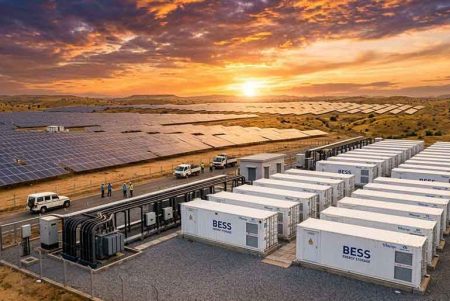

Every evening, as solar generation fades across India’s vast renewable landscape, a silent army of batteries prepares to take over. The country’s clean-energy future increasingly depends on what happens inside these containers. Once viewed as a supporting technology, BESS is now emerging as the backbone of renewable integration, grid stability, peak demand management, and round-the-clock clean power. As India pursues its target of 500 GW of non-fossil fuel capacity by 2030, storage is rapidly moving from the periphery of the power sector to its very centre.
The scale of ambition is enormous. According to the Central Electricity Authority (CEA), India will require 236.22 GWh of Battery Energy Storage System capacity by 2031-32, making it one of the world’s fastest-growing storage markets. Supported by Viability Gap Funding (VGF), Energy Storage Obligations (ESO), and a rapidly expanding pipeline of standalone and renewable-plus-storage projects, battery deployment is accelerating at an unprecedented pace.
But every additional gigawatt-hour deployed also introduces a new layer of risk.
Unlike conventional power infrastructure, utility-scale BESS facilities contain thousands of interconnected battery cells operating within a confined environment. A single cell failure, if not detected and contained in time, can escalate into thermal runaway, fire propagation, toxic gas release, and large-scale infrastructure incidents.
Global events have already demonstrated these risks. Battery fires at Arizona’s McMicken project, South Korea’s series of ESS incidents, and California’s Moss Landing facility have triggered intense debate around storage safety, emergency response, and system design.
For India, the challenge could be even greater. Future BESS installations will operate under extreme summer temperatures, dust-laden environments, high humidity, fluctuating grid conditions, and diverse operating geographies.
As India races towards a multi-gigawatt storage future, an important question emerges:
Is fire safety receiving the same level of attention as project economics, manufacturing expansion, and deployment targets?
Industry Voices: Is Safety Keeping Pace with Scale?
India is preparing for hundreds of gigawatt-hours of battery storage deployment. Do you believe fire safety is receiving the same level of attention as project economics and capacity expansion? What are the biggest gaps that still need to be addressed?
Akash Kaushik, Founder of GoodEnough Energy, said, “India is sprinting towards hundreds of gigawatt hours of storage, but fire safety is still treated more like a checklist than a design philosophy. Project finance, tariffs and tender timelines dominate the conversation; safety comes in late, often as “which certificate do we have?” instead of “have we engineered this asset to fail safely in Indian conditions?”
Globally, we have already seen what happens when deployment races ahead of learning – South Korea’s series of ESS fires and the 2019 Arizona incident forced a complete rethink of how we design, ventilate and operate large battery sites. Tesla Moss landing, LG, Poland are other examples of BESS fire accident in last one year. The positive lesson is that where robust standards like NFPA 855 and UL 9540/9540A or similar were enforced, incident rates dropped sharply even as installed capacity exploded. India is now entering that same exponential build out phase, with over 195 GWh of ESS tenders issued by late 2025 and BESS requirements of over 200 GWh projected by the early 2030s. We cannot afford to “learn by burning.”
I see three big gaps. First, safety is not yet a first class criterion in procurement: RfS documents still reward the lowest tariff more than the most robust safety case or proven large scale fire testing. Second, we under invest in system level engineering – gas management, explosion venting, clear separation distances, and integration between the BMS, fire detection and emergency shutdown are often value engineered out to win bids. Third, operations are treated as an afterthought: technicians, DISCOM operators and even local fire services rarely get scenario based training on how to respond to off normal battery events. At Goodenough Energy, our position is simple – in a market that is compounding towards hundreds of GWh, the only sustainable strategy is to design for failure, not just for performance.”
Samrath S Kochar, Founder and CEO at Trontek Electronics Ltd., said, “India’s current BESS landscape heavily prioritizes project economics and rapid capacity expansion over fire safety. The intensive race to achieve the lowest Levelized Cost of Storage (LCOS) has turned fire safety into an administrative compliance checklist rather than an upfront engineering core principle. While we enforce zero-compromise integration, has to utilize A-grade cells, appropriate cooling and thermal management systems, fire supression systems and global tier-1 subcomponents for all C&I and utility-scale systems. The broader market remains highly vulnerable to cost-driven compromises.
The biggest gaps that need immediate addressing are the complete absence of localized field-level thermal testing and a critical shortage of independent analysis and auditors from domestic field failures. Furthermore, aggressive price bidding pushes developers to cut costs on auxiliary subcomponents, such as lower-grade enclosures, lower grade of cells, Battery module liquid cooling plates and sub-par low-voltage wiring harnesses. To bridge these gaps, India’s procurement frameworks must evolve beyond rewarding the lowest initial tariff to evaluating full-lifecycle thermal resilience and multi-tier systemic safety features. R&D organizations must be offered incentives to innovate locally in India for best class of fire safety and thermal management systems. The test and validation infrastructure is also another gap for Indian BESS manufacturers. Independent labs to certify and test such big storage systems needs to be developed instead of a large dependency to those in China.”
Pratik Kamdar, Co-Founder & CEO of Neuron Energy, said, “India has made significant progress in recognising the importance of energy storage, and conversations around project economics, scalability, and deployment are rightly gaining momentum. However, fire safety is still not receiving the same level of attention as capacity expansion and cost optimisation. As the sector moves towards large-scale adoption, safety must evolve from being treated as a compliance requirement to becoming a core design principle.
The Central Electricity Authority has projected a requirement of 208 GWh of BESS by 2030 to support renewable energy integration. As deployment accelerates, the industry must ensure that safety frameworks scale alongside capacity.
One of the biggest gaps today is the tendency to evaluate battery systems primarily on cost and performance metrics. In reality, fire safety is influenced by the entire system architecture, including cell quality, battery management systems (BMS), thermal management, system integration, monitoring, and operational practices. A weakness in any of these areas can significantly increase risk.
The industry also needs greater emphasis on standardised testing, real-time monitoring, predictive diagnostics, and workforce training. India’s long-term success in energy storage will depend not only on how much capacity we install, but also on how safely and reliably these systems operate across their lifecycle.”
India’s Unique Fire Safety Problem
Battery fires are a global concern. But India’s operating environment could make them uniquely challenging.
Unlike many mature storage markets, India’s future BESS fleet will be deployed across deserts, coastal regions, industrial clusters, high-altitude terrains, and densely populated urban centres—each presenting distinct operational Risks. More importantly, these systems will operate under some of the world’s harshest climatic conditions.
Heat remains India’s most immediate challenge. The IMD has warned of increasingly severe heatwaves, with temperatures crossing 45°C in several regions during the summer of 2026, while parts of Rajasthan have historically approached 50°C. Such extreme conditions increase cooling loads and accelerate battery degradation.
Dust poses another significant threat. With a large share of BESS expected to be deployed alongside solar parks in arid regions such as Rajasthan, Gujarat, and Ladakh, dust ingress can impair sensors, contaminate electrical components, and reduce cooling efficiency.
Humidity further complicates operations. Coastal states including Gujarat, Tamil Nadu, Andhra Pradesh, and Odisha routinely experience relative humidity levels exceeding 70-80% during monsoon months, increasing risks related to moisture ingress, corrosion, and insulation degradation.
Grid behaviour adds another layer of stress. India met a record peak power demand of 256.1 GW in April 2026, while summer demand has already crossed 270 GW, subjecting battery systems to increasingly frequent cycling and dynamic grid-support operations.
Yet, perhaps the most underestimated risk is human intervention. Installation errors, inadequate maintenance practices, insufficient technician training, and limited preparedness among local emergency responders can transform a minor abnormality into a major incident.
As India prepares to deploy hundreds of gigawatt-hours of storage capacity, an important question emerges: which of these uniquely Indian operating conditions worries the industry the most?
Industry Voices: What Worries the Industry Most?
Which Indian operating condition worries you the most from a fire-safety perspective: heat, humidity, dust, grid instability, or human error? How should the industry prepare for it?
Akash Kaushik, Founder of GoodEnough Energy, said “The single biggest risk in India is human error operating complex battery systems in a hot, dusty, fast changing grid environment. Heat, humidity, dust and grid instability are all stress multipliers, but it is the decisions people make under those conditions – bypassing interlocks, delaying maintenance, improvising work arounds – that often turn a manageable fault into a serious incident. Every international investigation, from South Korea to other global ESS fires, ultimately points back to gaps in procedures, oversight and training as much as hardware limitations.
That said, India’s combination of high ambient temperatures, seasonal humidity and fine dust is uniquely punishing for BESS hardware if not engineered correctly. Filters clog, Thermal systems are over worked, insulation degrades faster, and contact resistances creep up – all of which increase the likelihood of localized overheating if the BMS and protection philosophy are not extremely robust. Grid side, frequent disturbances, voltage dips and aggressive cycling profiles add further thermal stress on cells and power electronics.
The industry should prepare on three fronts.
First, design and derating: specify enclosures, Cooling system, filtration and clearances for 45–50 °C, high dust environments as the norm, not the exception, and validate designs using rigorous test methods such as UL 9540A type large scale fire propagation tests.
Second, digital and procedural controls: tighter BMS/EMS logic for abnormal grid events, conservative state of charge and temperature limits, and strict management of access, work permits and lock out/tag out around live systems.
Third, people: mandatory training for site staff, DISCOM control rooms and local fire brigades, including live drills and clear playbooks. In a country like India, culture and discipline around safety will matter as much as the chemistry we choose.
Samrath S Kochar, Founder and CEO at Trontek Electronics Ltd., said, “The compounding interaction of extreme ambient heat and conductive dust worries the BESS players in India, the most from a fire-safety perspective. In primary solar-deployment zones like Rajasthan and Gujarat, ambient temperatures regularly exceed 45°C. When this intense heat meets high particulate dust loads, HVAC filtration systems clog rapidly. This forces thermal management subsystems to operate under prolonged mechanical stress, severely reducing cooling efficiency.
More critically, if fine conductive dust penetrates the container housing and settles on high-voltage switchgear or Battery Control Units (BCUs), micro-condensation during seasonal humidity spikes can create conductive tracking paths, triggering sudden catastrophic short circuits. Grid fluctuations during rapid cycling further compound this electrical and thermal stress. The industry must prepare by transitioning away from basic forced-air ventilation toward closed-loop liquid-cooling systems and hermetically sealed IP67 battery modules. This hardware must be paired with AI-driven predictive analytics that continuously monitor cell internal resistance before thermal runaway initiates. Automation/Robotic lines with minimum operator dependency to be installed. At Trontek, we counter this by enforcing a zero-compromise approach, our 5MWh systems will be equipped with liquid-cooling with smart thermal controls and IP67-sealed battery enclosures to isolate cells entirely from the environment.”
Pratik Kamdar, Co-Founder & CEO of Neuron Energy, said, “While all operating conditions demand attention, extreme heat and the thermal stress it creates remain among the most critical fire-safety challenges for BESS in India. Many storage projects are being deployed in regions experiencing prolonged periods of high ambient temperatures, which can accelerate battery degradation, increase component stress, and, if inadequately managed, heighten the risk of thermal runaway. These risks are further amplified by dust accumulation, poor ventilation, and inconsistent maintenance practices.
Water availability is another emerging concern. As BESS deployments expand into increasingly water-stressed regions, the industry will need to carefully evaluate cooling technologies and thermal management strategies. Effective temperature control is essential not only for safety, but also for battery performance and lifespan.
However, technology alone cannot address these challenges. Improper installation, inadequate maintenance, and gaps in operational training can undermine even the most advanced systems. The industry’s response must therefore combine robust thermal management, advanced BMS platforms, regular maintenance, and well-defined emergency response protocols tailored to Indian operating conditions.”
The Supply Chain Challenge: Are Cheap Cells India’s Biggest Hidden Risk?
As India races towards a 236.22 GWh BESS market by 2031-32, an uncomfortable question is emerging: in the pursuit of lower tariffs, is the industry compromising on safety?
India remains heavily dependent on imported lithium-ion cells and upstream materials. Although the government’s ACC PLI scheme aims to establish 50 GWh of domestic cell manufacturing capacity, only around 1.4 GWh had been commissioned by late 2025, underscoring the continued reliance on imports.
Import dependence itself is not the issue. The real concern lies in the availability of cells from suppliers with varying quality standards, manufacturing maturity, and field-performance records. As developers compete to achieve the lowest Levelized Cost of Storage (LCOS), pressure to reduce costs across components inevitably increases.
However, battery safety is not determined by the cell alone. A premium cell paired with a poorly designed Battery Management System (BMS) can still fail, making safety a true system-level outcome.
This is why standards such as UL 9540A are increasingly critical. Rather than evaluating individual components, UL 9540A assesses how an entire system behaves during thermal runaway events, including fire propagation and gas generation.
As projects scale to gigawatt-hours, robust system integration, thermal propagation testing, FAT, and rigorous commissioning protocols will become non-negotiable—because the cheapest component can ultimately become the costliest risk.
The Science of Thermal Runaway: When One Cell Becomes a System Event
To understand why fire safety has become the defining challenge for Battery Energy Storage Systems, one must first understand thermal runaway—the phenomenon at the heart of nearly every major battery fire recorded globally.
Thermal runaway occurs when a lithium-ion cell generates heat faster than it can dissipate, triggering an uncontrollable chain reaction. The process can be initiated by manufacturing defects, internal short circuits, overcharging, mechanical damage, external heating, cooling system failures, contamination, or electrical abuse. Even minor, undetected defects can, under certain conditions, escalate into catastrophic failures.
As cell temperatures rise beyond approximately 80°C to 120°C, the separator between the anode and cathode can begin to fail, causing internal short circuits. Beyond this point, exothermic reactions inside the cell accelerate dramatically. According to UL Solutions and NREL, temperatures during thermal runaway can exceed 600°C, while some studies have recorded localized temperatures approaching 1,000°C.
In utility-scale storage, however, the first failing cell is rarely the primary concern. Modern BESS installations may contain tens of thousands of tightly packed cells arranged into modules, racks, and containers. In the absence of adequate thermal barriers, heat from a failing cell can spread to neighbouring cells, triggering a domino effect known as thermal runaway propagation. What begins as a single-cell failure can quickly escalate into a module-, rack-, or container-level incident—a phenomenon observed in incidents such as Arizona’s McMicken explosion and South Korea’s ESS fires.
During thermal runaway, lithium-ion batteries release significant quantities of flammable and toxic gases, including hydrogen, methane, carbon monoxide, ethylene, and hydrogen fluoride (HF). Studies by the National Renewable Energy Laboratory (NREL) have shown that gas generation may begin even before visible flames appear. If inadequately vented, these gases can accumulate inside containers and create explosion hazards.
Equally concerning is re-ignition. Unlike conventional fires, lithium-ion battery fires may reignite hours or even days after the initial event, requiring prolonged monitoring.
Modern BESS safety engineering therefore focuses not on preventing every cell failure, but on ensuring failures remain localized, detectable, and incapable of escalating into site-wide events. In large-scale storage, containment—not perfection—defines safety.
Lessons from Global BESS Fire Incidents: What India Cannot Afford to Ignore
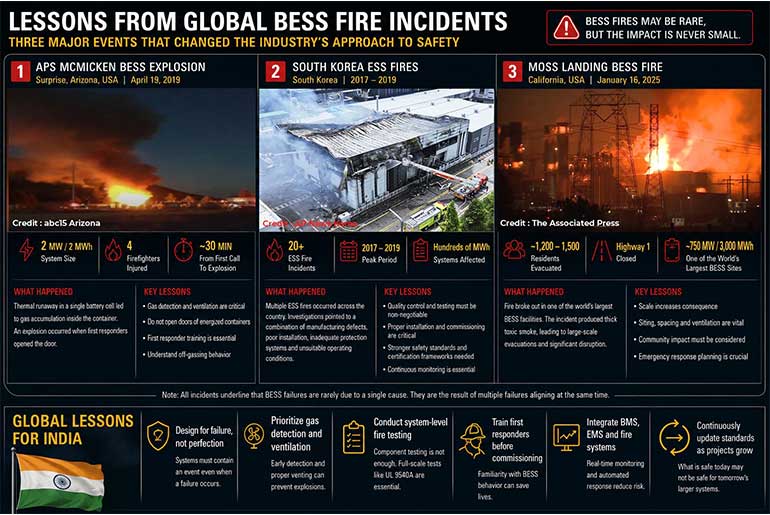
The battery industry often describes large-scale BESS fires as “rare events.” While statistically true, recent global incidents have demonstrated that when failures do occur, their consequences can be significant—affecting infrastructure, emergency responders, surrounding communities, and public confidence in energy storage itself.
Perhaps no incident reshaped industry thinking more than the Arizona Public Service (APS) McMicken BESS explosion in 2019. The 2 MW/2 MWh facility in Surprise, Arizona, experienced thermal runaway initiated by a single battery cell failure. Flammable gases accumulated inside the container and exploded when first responders opened the door, injuring four firefighters. Investigations later identified inadequate gas management, insufficient thermal barriers, and limited understanding of off-gassing behaviour as contributing factors. The incident fundamentally altered global approaches to gas detection, ventilation, and firefighter protocols.
South Korea offered another crucial lesson. Between 2017 and 2019, the country recorded more than 20 ESS fire incidents, prompting a nationwide investigation. Investigators attributed the fires to a combination of factors, including inadequate protection systems, poor installation practices, manufacturing defects, and adverse operating conditions. The incidents forced the industry to rethink quality assurance, system integration, and operational practices, while also accelerating the adoption of more stringent safety standards.
Most recently, the January 2025 fire at Moss Landing, California—one of the world’s largest battery storage facilities—once again brought BESS safety under intense scrutiny. The incident triggered the evacuation of approximately 1,200 to 1,500 residents, prompted highway closures, and highlighted the challenges associated with managing fires in large, containerized storage systems. Significantly, Moss Landing was originally constructed before modern standards such as NFPA 855 came into force, reinforcing the importance of continuously evolving safety regulations as storage projects increase in scale.
The message for India is clear: large-scale battery failures rarely result from a single factor. They typically emerge from multiple failures occurring simultaneously—cell defects, inadequate system integration, insufficient ventilation, weak emergency preparedness, or operational lapses.
As India prepares to deploy hundreds of gigawatt-hours of storage capacity, the industry has a unique opportunity: to learn from global incidents rather than repeat them.
The Fire Suppression Dilemma: Can Conventional Firefighting Work for BESS?
• Unlike conventional fires, lithium-ion battery fires are driven by self-sustaining electrochemical reactions, making them significantly harder to extinguish.
• One of the biggest challenges is re-ignition. Global incidents have shown that damaged battery systems can re-ignite hours, days, or even weeks after the initial event.
• During thermal runaway, batteries release flammable and toxic gases such as hydrogen, carbon monoxide, methane, and hydrogen fluoride (HF), creating explosion hazards in enclosed BESS containers.
• While large volumes of water remain one of the most effective cooling agents to prevent fire propagation, firefighting operations may continue for several hours or even days.
• Modern BESS installations increasingly deploy advanced mitigation technologies including water mist systems, gas detection sensors, thermal barriers, explosion venting, and automatic emergency shutdown systems.
• The industry’s safety philosophy is now shifting from “detect and extinguish” to “detect, isolate, contain, and prevent propagation.”
Safe BESS Is More Than Chemistry
• Lithium Iron Phosphate (LFP) has become the preferred chemistry for utility-scale BESS owing to its superior thermal stability. LFP cells typically enter thermal runaway at around 230°C-300°C, significantly higher than Nickel Manganese Cobalt (NMC) cells, which can become unstable at 150°C-210°C.
• Despite their lower thermal stability, NMC batteries continue to find applications where higher energy density and compact system design are critical.
• Emerging sodium-ion batteries are attracting interest for stationary storage applications due to their inherently safer characteristics, including lower heat release rates and reduced risk of thermal propagation.
• However, global BESS incidents have demonstrated that no battery chemistry is completely fire-proof.
• In utility-scale storage, safety is ultimately determined by system architecture rather than chemistry alone.
Critical safety layers include:
• Battery Management System (BMS) for cell monitoring and fault detection.
• Energy Management System (EMS) for operational control and emergency response.
• Power Conversion System (PCS) for safe charging and discharging.
• Advanced cooling systems to maintain temperature uniformity.
• Gas and temperature sensors for early anomaly detection.
• Robust enclosure design, compartmentalization, and ventilation to prevent fire propagation.
• In the era of gigawatt-hour-scale storage, the industry must focus on building safe systems, not merely safe cells.
The Regulation Gap: Can India’s Safety Framework Keep Pace?
India’s BESS market is expanding rapidly, with the Central Electricity Authority (CEA) projecting a requirement of 236.22 GWh of battery storage capacity by 2031-32. However, the country’s regulatory framework is still evolving.
Unlike the United States, India does not yet have a dedicated national fire-safety code exclusively for utility-scale BESS. Developers currently rely on a combination of BIS standards, CEA regulations, international certifications, and project-specific safety requirements.
Globally, NFPA 855, introduced in 2020, has emerged as the benchmark standard for BESS installation, fire protection, emergency planning, and separation distances. It works alongside UL 9540A, the industry’s most widely accepted large-scale fire test methodology for assessing thermal runaway propagation, gas generation, and fire spread.
Internationally, the IEC 62933 series governs electrical energy storage system safety and integration, while IEC 62619 addresses safety requirements for industrial lithium batteries.
Recognising the growing importance of storage, the CEA released draft Technical Standards for Construction of BESS Regulations, 2025, proposing provisions for continuous monitoring, explosion-proof enclosures, ventilation systems, automatic shutdown mechanisms, and minimum separation distances.
Yet significant gaps remain, particularly in large-scale thermal propagation testing, dedicated firefighter training, emergency response protocols, and domestic testing infrastructure.
As India’s storage ambitions accelerate, regulations must evolve from fragmented guidelines into a comprehensive and enforceable national BESS safety framework.
Industry Voices: Does India Need a Dedicated BESS Fire Safety Framework?
Does India need a dedicated national BESS fire-safety framework tailored to Indian conditions, or are existing international standards sufficient? What additional measures would you like to see from regulators and industry bodies?
Akash Kaushik, Founder of GoodEnough Energy, said “India absolutely needs a dedicated national BESS fire safety framework tailored to our climate, urban density and institutional realities – but it should be anchored in proven international standards rather than reinventing the wheel. Standards like NFPA 855, UL 9540/9540A, IEC 62933 and related IEEE guidance already encapsulate hard won lessons on separation distances, hazard mitigation analysis, gas management and emergency planning for large scale storage. Countries that aggressively adopted these frameworks have seen incident rates fall dramatically even as installed capacity grew by orders of magnitude.
India is moving in the right direction: MNRE has issued draft guidelines for battery testing, states like Rajasthan have proposed BESS guidelines, and the CEA has begun to integrate ESS into construction standards and planning documents. But today this sits as a patchwork. What we need is a unified “National BESS Safety Code” that ties together siting rules, technology qualification, large scale fire testing, operations, decommissioning and data sharing, and that is mandatory for all utility scale and critical infrastructure projects.
I would like to see three specific measures from regulators and industry bodies. First, mandatory hazard mitigation analysis and large scale fire/venting tests (UL 9540A type) for projects above a certain MWh threshold, with clear requirements on gas detection, explosion control and combustible concentration reduction, in line with the latest NFPA 855 thinking. Second, a national incident and near miss reporting database for BESS – anonymised but mandatory – so that lessons from one project are not lost to the rest of the sector. Third, defined training and certification pathways for integrators, O&M teams and even local fire departments, supported by BIS, CEA and state regulators. If we get this right, India can scale to hundreds of gigawatt hours of storage while setting a benchmark on safety, not simply following it – and that is the standard we should hold ourselves to at Goodenough Energy.”
Samrath S Kochar, Founder and CEO at Trontek Electronics Ltd., said, “While foundational international standards like UL 9540A, NFPA 855, and IEC 62933 are vital references, they are insufficient on their own for India’s harsh environments. India absolutely needs a dedicated national BESS fire-safety framework tailored specifically to our extreme thermal profiles, high-dust conditions, and grid infrastructure.
Additional measures from regulators like the CEA and BIS should include mandating full, container-level destructive burn tests under high ambient baselines, rather than blindly accepting localized cell or module-level test certificates from overseas facilities. Furthermore, to qualify for financial incentives like Viability Gap Funding (VGF), compliance policies must mandate indigenously developed, localized Energy Management Systems (EMS) capable of real-time, multi-layer safety voting logic. Finally, industry bodies must institute mandatory certification and training playbooks for state-level DISCOMs and emergency first responders, as containing a utility-scale chemical fire requires completely specialized emergency protocols.”
Integrated Safety Architecture Matrix (5MWh BESS Line)
Subsystem Layer Technical Component Safety Function & Software Integration BMU (Cell Level) A-Grade LFP Monitoring Sensors Executes real-time voltage/temperature tracking and continuous cell balancing. BCU (Rack Level) High Voltage Control Box Monitors insulation resistance and drives high-speed contactor safety tripping logic. BAU (System Level) Cluster Combiner Unit Coordinates parallel rack buses, preventing cross-rack circulating current spikes. FSS (Container Level) Novec 1230 / Aerosol Suppression Automated multi-sensor voting logic (Smoke + CO + Heat) for localized gas discharge.
Pratik Kamdar, Co-Founder & CEO of Neuron Energy, said, “International standards provide an important foundation, but India will ultimately benefit from a dedicated BESS safety framework tailored to its own operating conditions, deployment patterns, and climate realities.
Indian installations often operate under higher ambient temperatures, varying grid conditions, dust exposure, and diverse site environments compared to many global markets. While international standards offer valuable guidance, a localised framework is essential to ensure that safety requirements remain practical, relevant, and enforceable for domestic deployments.
Encouragingly, regulators have already started taking steps towards building a more structured approach to BESS deployment. Going forward, I would like to see greater standardisation around system design, testing protocols, commissioning practices, emergency response procedures, and lifecycle monitoring requirements.
Industry bodies also have an important role to play by creating knowledge-sharing platforms, documenting operational learnings, and promoting best practices across manufacturers, developers, EPC players, and asset owners.
As India’s storage market matures, safety must become a shared responsibility across the value chain. A strong regulatory framework, backed by industry-wide collaboration, will be critical to building confidence in large-scale energy storage deployment and ensuring the sector grows sustainably.”
The Mitigation Roadmap: How India Can Build Fire-Safe BESS
• Smart Battery Management Systems (BMS) must serve as the first line of defence by continuously monitoring cell voltage, temperature, State of Charge (SoC), and abnormal operating conditions, while enabling automatic fault isolation and emergency shutdown.
• The industry must increasingly adopt AI-powered predictive maintenance technologies capable of detecting thermal anomalies, identifying early signs of cell degradation, and predicting failures before they escalate into thermal runaway events.
• Real-time monitoring systems, digital twins, gas detection sensors, and cloud-based analytics can significantly improve operational safety and asset reliability.
• India must urgently strengthen the capabilities of its first responders. Dedicated training programmes, mock drills, site-specific emergency response plans, and standardized firefighting protocols for lithium-ion battery incidents should become mandatory before project commissioning.
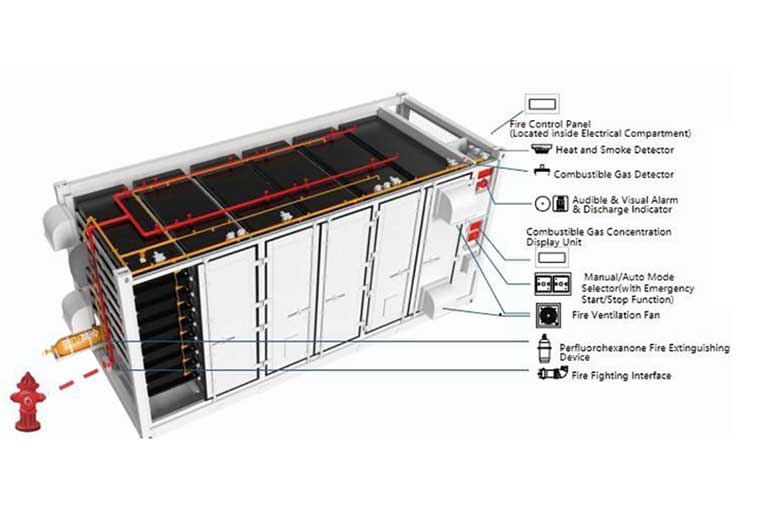
• Safety must be integrated at the design stage itself. Every BESS project should incorporate adequate separation distances, ventilation systems, explosion venting, fire suppression technologies, compartmentalization, and continuous monitoring systems.
• As storage deployments scale towards hundreds of gigawatt-hours, India’s BESS strategy must shift from reactive firefighting to proactive risk prevention and system resilience.
Conclusion
India stands on the threshold of the world’s next great energy transformation.
Over the coming decade, hundreds of gigawatt-hours of battery storage will quietly become the invisible backbone of the nation’s power system—storing solar energy after sunset, stabilizing the grid, powering industries, and enabling the country’s clean energy ambitions. Yet, as history has repeatedly shown, every technological revolution carries its own set of risks.
From Arizona and South Korea to Moss Landing, the global energy storage industry has learned a difficult lesson: battery fires are rarely caused by a single failed cell. They are the consequence of overlooked warnings, compromised designs, inadequate testing, and delayed action.
India now has a rare opportunity—one that many mature markets never had. It can build safety into its storage ecosystem from day one.
Because in the race towards a 236 GWh future, success will not be measured merely by how many batteries India installs.
It will be measured by how many incidents it prevents.
The country’s storage revolution is inevitable.
Whether it becomes resilient, trusted, and truly future-ready will depend on one simple principle:
In the age of gigawatt-hour-scale storage, safety can no longer be an afterthought. It must become the foundation upon which the entire industry is built.
 Electrify your feed! Click here to join our Whatsapp group and to get the latest updates, expert insights, and innovations driving India’s energy storage revolution.