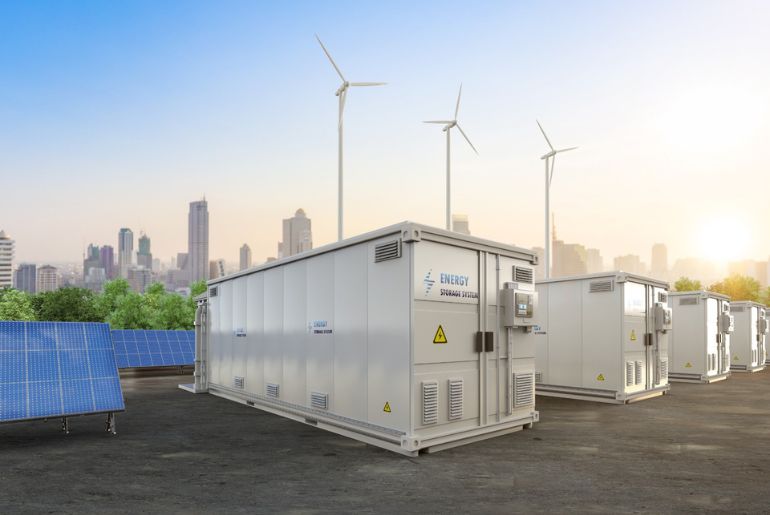
The Energy and Resources Institute (TERI), acting as the bid manager for BSES Rajdhani Power Limited (BRPL), has invited bids to develop a 57.5 MW/115 MWh Battery Energy Storage System (BESS) at four 66/11 kV grid substations in BRPL’s licensed distribution area in Delhi. The project will be awarded through a tariff-based competitive bidding process, with bid submissions scheduled to close on 27 July 2026.
The proposed BESS installation is aimed at strengthening Delhi’s electricity distribution network by supporting renewable energy integration and addressing the challenges arising from the increasing penetration of renewable energy, distributed energy resources and electric vehicles. The project is expected to improve grid flexibility, enhance power flow management, strengthen network stability and ensure a more reliable electricity supply.
The battery energy storage systems will be installed at four grid substations with a combined storage duration of two hours. The planned capacities include 30 MW/60 MWh at Sagarpur-DESU Colony, 15 MW/30 MWh at Bindapur, 7.5 MW/15 MWh at Hari Nagar and 5 MW/10 MWh at the G4 substation. The systems will be connected to BRPL’s 66 kV/11 kV grid substations and will provide charging and discharging services under an agreement with the buying utility.
The selected developer will be responsible for the complete execution of the project, including site surveys, planning, design, engineering, procurement, transportation, supply, insurance, unloading, handling, installation, integration, testing, commissioning, and operation and maintenance of the BESS for 12 years from the Commercial Operation Date (COD), in accordance with the tender’s technical specifications.
The Request for Proposal (RFP) comprises three volumes covering bidder instructions and evaluation criteria, the draft Battery Energy Storage Service Agreement (BESSA), and the detailed technical specifications and scope of work. BRPL has already received in-principle approval for the project from the Delhi Electricity Regulatory Commission (DERC).
Bidders are required to submit an Earnest Money Deposit (EMD) of ₹2.5 crore, in the form of a bank guarantee or a Payment on Order Instrument (POI) issued by the Indian Renewable Energy Development Agency (IREDA), Power Finance Corporation (PFC) or REC Limited to participate. Technical and financial bids are to be submitted electronically through the Bharat Electronic Tender portal, while the original EMD documents and bid passphrases have to be submitted offline within two working days after the bid submission deadline. Non-compliance with these requirements will lead to bid rejection.
The tender is open to companies registered under the Companies Act, foreign companies, SEBI-registered Alternative Investment Funds (AIFs) and consortiums of a maximum of two eligible entities. The successful bidder shall be required to set up a wholly owned special purpose vehicle (SPV) in India before signing the battery energy storage service agreement.
Bidders and their affiliates should not have any history of wilful default or blacklisting by any government agency or international financial institution. Applicants should also agree to conduct detailed site surveys prior to the submission of the bids and implement the project on an “as is, where is” basis.
From a technical standpoint, bidders must have commissioned at least 4 MWh of grid-connected BESS capacity in India over the past five years. The projects should have been integrated with electrical grids operating at 11 kV or above and include an energy management system (EMS) and SCADA integration. Commissioning certificates, client references and valid type-test certificates issued by CPRI, ERDA or internationally accredited agencies for the proposed BESS components are mandatory. Required management certifications include ISO 9001:2015, ISO 14001:2015 and ISO 45001:2018, while ISO 27001:2022 is preferred.
Financially, bidders must demonstrate a minimum net worth equivalent to 20% of the estimated project capital cost.
The tender also specifies several operational and safety requirements. The BESS must be equipped with systems capable of continuously monitoring and recording project performance while providing 24×7 remote access to the monitoring portal for the buying utility, the Ministry of New and Renewable Energy (MNRE), the State Load Dispatch Centre (SLDC), the National Load Dispatch Centre (NLDC) and other designated agencies. The project must also be geo-tagged, and all battery installations must include fire protection systems with a minimum three-hour fire resistance rating.
Under the contract, the buying utility may schedule up to two charge-discharge cycles per day. Charging and discharging may be carried out either as continuous two-hour cycles or in multiple intervals, provided the cumulative energy charged or discharged does not exceed the rated energy capacity of the system. The buying utility will release monthly payments within 45 days of bill submission during official working hours.
The latest tender builds upon BRPL’s ongoing efforts to expand battery energy storage infrastructure in Delhi. Earlier, AmpereHour Energy, in partnership with IndiGrid through their consortium Kirlokari BESS, commissioned one of India’s first regulatory-approved projects for battery energy storage in collaboration with BRPL. In parallel, four standalone utility-scale BESS projects are currently under development across South and West Delhi, adding 55.5 MW/111 MWh of storage capacity. The broader grid modernisation programme also includes underground cabling works in Chandni Chowk and the development of a 66/11 kV, 63 MVA GIS indoor grid substation at Mandoli, which further strengthens the capital’s power infrastructure.
 Electrify your feed! Click here to join our Whatsapp group and to get the latest updates, expert insights, and innovations driving India’s energy storage revolution.