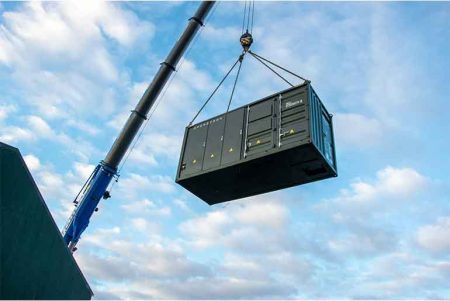

Commissioning proves that your BESS can perform. BESS O&M determines whether it can keep performing. Once the battery containers are energised, the PCS is operating and the plant has successfully demonstrated its contractual parameters, the responsibility does not end. The system now has to deliver repeatedly—through routine operation, equipment faults, maintenance, degradation and changing operating conditions.
And this is where BESS O&M becomes much larger than battery maintenance.
Depending on the contract, your responsibility may extend across the battery and BMS, PCS, transformers, switchgear, controls, power evacuation system, safety systems, civil infrastructure and critical spares. The exact boundary, however, is contractual.
SECI’s 600 MW/1,200 MWh Nandiyal BESS is a useful example. Its AC package covers the Balance of System and five years of comprehensive O&M, while specifically excluding the BESS containers, PCS, EMS and associated cables. SECI separately procured the 600 MW/1,200 MWh DC BESS package with 15 years of comprehensive service and maintenance.
So before you ask how to maintain a BESS, ask a more fundamental question:
What exactly are you contractually responsible for maintaining?
That scope boundary determines almost everything that follows—from manpower and spare parts to response obligations, performance risk and the eventual cost of BESS O&M.
What Does BESS O&M Actually Cover?
If you are pricing or executing BESS O&M, do not begin with a generic maintenance checklist. Begin with the contract.
A BESS project can divide responsibilities across multiple packages, and the equipment covered by one O&M contractor may not be the same as that covered by another. In a large project, the responsibility can extend from the battery and BMS to the PCS, transformers, switchgear, power-evacuation system, EMS/SCADA, fire and safety systems, auxiliary equipment and even civil infrastructure.
The Nandiyal procurement makes this distinction particularly clear. SECI’s 600 MW/1,200 MWh project separates the DC BESS package from the AC Balance-of-System package. The AC package includes design, engineering, procurement, civil works, installation, testing, commissioning, performance demonstration and five years of comprehensive O&M, but excludes the BESS containers, PCS, EMS and associated cables. The separate DC package covers the BESS supply with 15 years of comprehensive service and maintenance.
That means “five years of BESS O&M” cannot automatically be interpreted as five years of maintenance for every system at the site.
For you as an EPC or O&M contractor, the first exercise should therefore be a scope matrix:
Equipment → Included package → O&M responsibility → Warranty responsibility → Replacement responsibility
Only after this is clear should you estimate manpower, spares, service infrastructure and long-term BESS O&M cost.
The lesson is simple: O&M begins with defining what you have promised to maintain.
Preventive Maintenance: Keeping Failure From Becoming an Event
Once the scope is clear, the next question is how the plant will be maintained. In a BESS, waiting for equipment to fail before acting can affect availability, dispatch commitments and contractual performance. That makes preventive maintenance a core part of BESS O&M, not an optional service layer.
Preventive maintenance means carrying out planned inspections, servicing and checks before a component develops a failure. Corrective maintenance begins when an equipment fault or failure has already occurred.
Indian BESS procurement documents show that this distinction is contractual, not merely theoretical. In the Nandiyal AC package, the O&M contractor is required to prepare a Preventive/Routine Maintenance Schedule based on OEM recommendations and good engineering practices. The contractor must also deploy suitably experienced O&M personnel and arrange additional manpower when necessary.
For a contractor, that means the maintenance plan needs to be built around the actual equipment included in the package.
The battery and BMS may require one set of inspections. PCS and transformers require another. Switchgear, protection systems, auxiliary equipment and site infrastructure each have their own maintenance requirements.
The important point is coordination.
A BESS is an interconnected plant, so maintenance on one system can affect another. Planned work may require isolation, shutdown, testing and controlled restoration before the equipment can return to service.
Your BESS O&M plan therefore needs to answer three basic questions:
What needs to be maintained? When does it need to be maintained? And how will the plant return safely to operation afterward?
That is how preventive maintenance moves from a checklist into a strategy for protecting availability and long-term BESS performance.
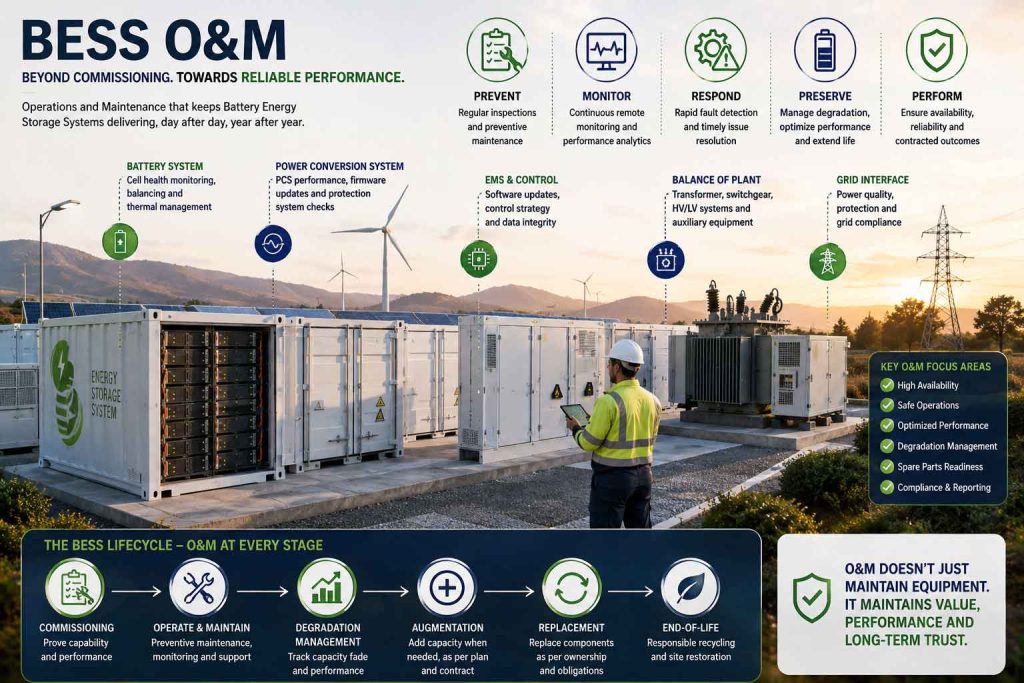
When Something Fails: From Alarm to Restoration
Preventive maintenance can reduce failures, but it cannot eliminate them. A BESS operates with hundreds of interconnected components, and an alarm or equipment fault can quickly become an availability issue if it is not diagnosed and resolved properly.
This is where BESS O&M needs a defined response process.
A useful way to look at corrective maintenance is:
Fault detection → Diagnosis → Isolation → Repair → Testing → Restoration → Root Cause Analysis
The first step may come from the BMS, PCS, EMS/SCADA or another protection system. The O&M team then needs to determine whether the problem is confined to one component or has affected another part of the plant.
Indian tender documents show that this response is often measured contractually. In the Nandiyal AC package, the contractor is required to maintain a complaint log, recording details including the complaint timing, a unique complaint number, closure time and Root Cause Analysis (RCA). The contractor is also responsible for maintaining the serviceability of the equipment and infrastructure covered by its package.
This matters because closing an alarm is not necessarily the same as resolving the problem.
If a PCS trips repeatedly because of an underlying electrical or thermal issue, simply resetting it may restore operation temporarily without addressing the cause. A proper RCA can identify whether the failure originated in the equipment itself, another connected system, operating conditions or maintenance practices.
Response times can also form part of the contract. Different Indian tenders have specified different timelines, including 48-hour and 72-hour requirements for particular equipment or fault categories. These should therefore never be treated as a universal BESS standard.
For you as an O&M contractor, the real question is not just “How quickly can we repair it?”
It is:
“How quickly can we safely restore the promised plant performance—and prevent the same failure from returning?”
The BESS Is Available Only When the Whole Chain Is Available
A battery can be healthy and the BESS can still be unavailable.
That is one of the most important ideas to understand when planning BESS O&M. The storage plant does not deliver electricity through the battery alone. Its performance depends on a chain of interconnected systems working together:
Battery → BMS → PCS → Transformer → Switchgear → Power Evacuation → Point of Interconnection
The control layer can be equally important. Depending on the project architecture and contractual scope, EMS, SCADA and communication systems may determine whether the plant can receive, execute and report operating commands correctly.
This is why BESS availability needs to be considered at system level, rather than by looking at individual equipment in isolation.
The Kajra solar-plus-BESS tender provides a useful example. Its definition of BESS Equipment Availability encompasses the Battery, BMS, PCS, EMS and BESS power-evacuation system up to the specified interface.
Consider a simple situation. The battery racks are fully healthy, but the PCS has failed. The stored energy exists, but it cannot be converted into the required AC power. The battery is available; the BESS is not.
The same can happen if a transformer, switchgear or power-evacuation component prevents energy from reaching the grid.
For an O&M contractor, this changes the maintenance philosophy. Monitoring individual equipment health is necessary, but it is not enough. The team must understand the interfaces between systems, identify which failures can affect plant-level availability and coordinate restoration accordingly.
Ultimately, the owner is not buying an isolated battery.
The owner is buying a functioning energy-storage plant.
And the job of BESS O&M is to keep that entire chain capable of delivering it.
Spares Are Part of the O&M Business
A BESS can be well designed and still lose valuable operating time if the right replacement component is not available when a failure occurs. That makes spares management an important part of BESS O&M, particularly for large projects where a relatively small component can affect an entire operating block.
The question is not simply, “What equipment can fail?” It is also:
What needs to be available on site to restore it quickly?
SECI’s Nandiyal AC package requires the O&M contractor to prepare a list of spares needed during the O&M period, including specifications, supplier details and indicative prices. The contractor is also required to maintain the necessary spare inventory throughout the O&M period and replenish mandatory spares as required.
The tender also links future-spares planning with equipment reliability, including Mean Time Between Failures (MTBF). That makes the exercise more than simply storing a few replacement parts. The contractor has to think about which components are critical, how quickly they can be sourced and what happens if a particular failure occurs repeatedly.
For you as an O&M contractor, this creates a second layer of cost beyond manpower and routine servicing:
Spares → Inventory → Storage → Logistics → Replacement → Replenishment
And the risk becomes more significant for components with long procurement lead times or equipment that is supplied by a limited number of OEMs.
This is also why the O&M scope should be studied alongside the warranty and replacement clauses. If a failed component is covered by the OEM warranty, the commercial responsibility may be different from a component that the O&M contractor has to replace from its own inventory.
So when you calculate BESS O&M cost, don’t count only engineers, technicians and maintenance visits.
The ability to restore the plant depends on having the right parts available before the failure happens.
Degradation: The Battery Will Not Stay at Day-One Capacity
Even with disciplined maintenance, a battery does not retain exactly the same usable capacity throughout its operating life. Degradation is an expected part of battery operation, but for a BESS operator, the important question is when that degradation becomes a contractual problem.
A battery may gradually lose capacity while the overall BESS continues to meet its contractual requirements. The problem arises when the plant can no longer provide the dispatchable energy, availability, efficiency or other performance parameters promised under the contract.
This distinction is particularly important in large Indian procurements.
In the MSEDCL 2,000 MW/4,000 MWh BESS procurement, subsequent amendments expressly permitted annual degradation and defined requirements around minimum dispatchable energy. The amended provisions also removed an earlier explicit requirement to augment or replace the battery system.
That changes how an O&M contractor or project developer should think about degradation.
The question is not simply:
“How much will the battery degrade?”
It is:
“How much degradation does the contract permit, and what must we do if the plant falls below the required performance?”
A developer may choose to install additional capacity at the beginning, accept the degradation allowed under the contract, or plan future augmentation. The appropriate strategy depends on the technology, operating profile, economics and contractual requirements.
MSEDCL’s procurement also makes the commercial responsibility clear: where augmentation or replacement is required during the contract period, it has to be managed by the BESS developer without compromising the committed availability or performance obligations.
So degradation should not automatically be treated as failure.
Degradation is a technical reality. Whether it becomes an O&M problem is ultimately determined by the performance promise written into the contract.
Augmentation vs Replacement: Two Different Lifecycle Decisions
Once degradation begins to affect the usable capacity of a BESS, the next question is what you do about it. Augmentation and replacement are not the same thing, and the choice depends on the contract, the condition of the battery and the project’s long-term performance requirements.
Augmentation generally means adding new battery capacity to compensate for capacity lost through degradation. Replacement means removing failed or end-of-life battery capacity and installing new equipment in its place.
For a project designed around long-term performance, there can be several approaches.
Oversize at the Beginning
The developer may install more battery capacity at commissioning than is strictly necessary for the initial requirement. This increases upfront investment but can provide additional capacity to absorb future degradation.
Augment Later
The project can be designed so that additional battery capacity is installed when required. This reduces the need to install all future capacity at COD but creates another engineering and operational exercise later.
Operate Within Contractually Permitted Degradation
Where the contract allows capacity to decline within defined limits, the project may continue operating without immediate augmentation or replacement.
The MSEDCL procurement illustrates why this cannot be treated as a universal formula. Its amended provisions permitted degradation and removed the earlier explicit requirement for augmentation or replacement. Where augmentation or replacement is undertaken during the contract period, however, the developer remains responsible for managing it without affecting committed availability or performance.
And augmentation is not simply a matter of bringing additional battery containers to site. The original BESS design may need to accommodate space, foundations, cable routes, electrical capacity, controls, access and installation activities for future equipment.
That connects directly to the Balance of Plant decisions we discussed earlier.
The key point for BESS O&M is simple:
You are not only maintaining today’s battery. You may also be managing the infrastructure and contractual responsibility for tomorrow’s capacity.
Who Pays for Battery Replacement?
This is where BESS O&M becomes a much bigger commercial question than routine maintenance. When a battery component fails or its usable capacity falls below the contractual requirement, someone has to bear the cost of replacement—and the answer depends on the contract.
Do not automatically assume that the battery manufacturer will replace it, or that the O&M contractor will pay for it. Three separate contractual layers need to be checked:
Warranty → O&M obligation → Performance guarantee
A warranty may cover specified equipment defects for a defined period. The O&M contract may separately require the contractor to maintain or replace equipment. A performance guarantee may require the project to continue meeting defined capacity or efficiency requirements for much longer.
The distinction becomes clear in the Kajra solar-plus-BESS tender, where specific provisions placed replacement responsibility on the EPC contractor for BESS failures during the defined O&M and subsequent guarantee period, subject to the conditions of that tender. This means that, under such a structure, replacement exposure can become part of the contractor’s long-term commercial risk.
The Rajnandgaon BESS provides another perspective. In its regulatory proceedings, CERC considered a project-specific methodology for estimating future BESS replacement costs, including replacement around the 12th year of the project. The Commission also considered the fact that the battery component has a different replacement profile from longer-lived associated equipment.
That distinction matters.
If the battery modules eventually need replacement, you do not automatically replace the PCS, transformer, switchgear, SCADA system and civil infrastructure along with them.
For an O&M contractor, therefore, the right question is not simply:
“What does battery replacement cost?”
It is:
“Under this contract, who carries the replacement risk, what equipment is covered, when does the obligation arise, and what performance must the plant demonstrate afterward?”
That is where BESS O&M moves from maintenance planning into lifecycle risk management.
O&M Cost Is a Lifecycle Question
By this point, it should be clear that BESS O&M cost cannot be estimated by counting technicians and maintenance visits alone. The real cost of keeping a storage plant operational can extend across preventive maintenance, corrective repairs, spare inventory, logistics, replacement exposure and long-term performance obligations.
This is particularly important when O&M is contracted for several years. A contractor may need to maintain critical spares, deploy additional manpower during major failures, coordinate OEM support and undertake replacement work where the contract places that responsibility on them.
The Kajra solar-plus-BESS tender demonstrates why lifecycle costing matters. Its procurement structure required bidders to consider both the EPC component and the long-term O&M requirement, with the O&M cost forming part of the overall commercial evaluation. The tender also placed specific replacement and performance obligations on the contractor during the applicable periods.
So two bids with similar EPC prices can carry very different long-term risks.
One contractor may have:
Higher initial EPC cost → lower expected maintenance exposure
while another may offer:
Lower EPC cost → greater future O&M or replacement exposure
For the project owner, therefore, the relevant question is not simply:
“Which contractor is cheapest?”
It is:
“Which proposal provides the required performance at an acceptable lifecycle cost and risk?”
For the contractor, the reverse question matters:
“Have we priced every obligation we may have to carry for the entire O&M period?”
That includes the less visible costs—spares, emergency response, replacement components, specialist manpower, logistics and performance risk.
In a BESS project, the lowest O&M quotation is not necessarily the lowest-cost O&M solution. A realistic price has to reflect what it takes to keep the contracted plant performing, not merely what it takes to keep people on site.
End-of-Life: O&M Does Not Automatically End With Battery Replacement
A BESS can continue operating long after individual battery components have been replaced, but the contract needs to make clear what happens to the equipment that is removed and what responsibilities continue after the original O&M or warranty period.
If battery modules or other components are replaced, several questions arise:
Who owns the removed equipment? Who arranges its transportation? Who is responsible for disposal or recycling? Who bears the associated cost?
These should not be assumed to belong automatically to the O&M contractor. The answer depends on the EPC, O&M, warranty and supply contracts, along with the applicable regulatory requirements.
The same principle applies when the original O&M period expires. A plant may still have substantial operational life remaining, but the owner may then need a new maintenance arrangement, extended OEM support or a fresh long-term service contract.
This is why end-of-life planning should begin much earlier than the actual end of the battery’s useful life.
For a large BESS, lifecycle planning should consider:
Initial operation → degradation → maintenance → augmentation/replacement → continued operation → eventual retirement
The objective is not simply to keep replacing components indefinitely. It is to understand when replacement remains economically and technically sensible, what happens to the removed equipment, and who carries each responsibility.
That makes end-of-life planning another part of good BESS O&M, rather than something left until the battery has already reached the end of its useful life.
A BESS Is a Long-Term Performance Contract
The real test of a BESS does not end when the plant passes commissioning.
It begins with whether the system can continue delivering its promised power and energy through years of operation, maintenance, faults and battery degradation. That is why BESS O&M needs to be viewed as a lifecycle responsibility rather than a routine maintenance service.
The scope may begin with preventive maintenance and fault response, but it can extend into spare-parts management, system-level availability, performance monitoring, degradation management and, depending on the contract, augmentation or replacement.
The most important lesson for both owners and contractors is that the battery is only one part of the performance equation.
A healthy battery cannot deliver energy if the PCS is unavailable. A working PCS cannot export power if the transformer or switchgear is unavailable. And a technically healthy plant can still fall short if it no longer meets the capacity or performance obligations written into the contract.
So the objective of BESS O&M is ultimately simple:
Keep the complete storage plant capable of delivering what the contract promised, for as long as the project requires it.
- Commissioning proves capability.
- Maintenance preserves it.
- Monitoring measures it.
- Degradation challenges it.
- And sound lifecycle planning protects it.
That is what turns BESS O&M from a maintenance activity into a long-term performance strategy.
 Electrify your feed! Click here to join our Whatsapp group and to get the latest updates, expert insights, and innovations driving India’s energy storage revolution.