Battery Energy Storage Systems (BESS) are rapidly becoming a backbone of modern power systems. By storing electricity from renewables or the grid, they provide backup power, smooth out generation peaks, and help balance supply and demand. Global deployment is growing explosively – in 2025 the world installed 106 GW of new storage, bringing total capacity to about 270 GW (630 GWh). This is roughly a 20-fold increase over five years. Falling battery prices and supportive policies are driving this growth. In fact, BESS prices have plummeted: average global BESS costs in 2025 were only about one-third of what they were in 2020. As a result, batteries now account for over 15% of all new lithium-ion capacity, up from almost zero a decade ago.
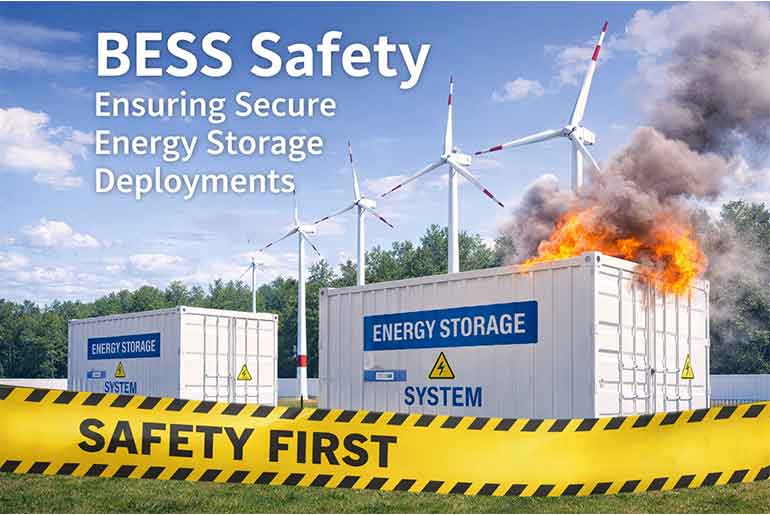
Despite their benefits, BESS present new safety and reliability challenges. Lithium-ion batteries can overheat and catch fire if not managed carefully. Recognizing this, governments and industry have developed extensive standards and codes. These rules cover everything from installation and testing to performance and fire safety, ensuring safe operation in homes, industry, and on the grid.
Key Standards and Regulations
Global Standards
Battery systems must meet numerous international standards. The IEC (International Electrotechnical Commission) has published the IEC 62933 series, which defines terminology and safety requirements for BESS. Other IEC standards (e.g. IEC 62109 for converters) also apply to components. In practice, regulators typically require conformance to UL, IEEE, NFPA, and local building codes:
- NFPA 855 (US) – A fire-safety code for stationary storage installations. It mandates hazard analyses, spacing rules, emergency plans, and proof of fire containment. NFPA 855 now references testing like UL 9540A to show that a fire in one battery rack won’t cause neighboring racks to also go into thermal runaway.
- UL 9540 / 9540A (US) – UL 9540 is the safety standard for complete energy storage systems, requiring a formal safety analysis (hazard ID, risk evaluation) and robust design. UL 9540A is a test method for thermal runaway propagation. It simulates a cell fire and checks that it does not spread through the system.
- UL 1973 (US) – Covers safety for battery modules and racks used in stationary storage.
- UL 1741 (US) – Applies to inverters and controllers used with DER (including storage).
- IEEE 1547 (US) – Grid-interconnection requirements for distributed energy resources (DER) such as BESS.
- NFPA 70 (US NEC) – The National Electric Code includes provisions for battery safety in electrical installations.
- ISO 50001 (International) – An energy-management standard encouraging efficient and safe energy use (relevant to systems that include storage).
Codes and Building Rules:
In addition to equipment standards, BESS installations must follow building and fire codes. For example, the International Building Code (IBC) and International Fire Code (IFC) have sections on energy storage. In the U.S., NFPA 855 is enforced via NFPA 1 (Fire Code) and local jurisdictions. In Europe, EN standards and CENELEC rules (like EN 50549 for grid connections) apply. The UL guide notes that local building codes vary, but typically demand fire suppression, ventilation, signage, and electrical safety measures.
Country-Specific Regulations (India)
India is formalizing BESS rules. The Bureau of Indian Standards (BIS) has a committee (ETD 52) writing IS 17067, aligning with IEC 62933. As of 2025, Part 1 (vocabulary) and Part 2.1 (general testing) are published, with more to come. Additionally, in 2025 the Central Electricity Authority (CEA) issued draft safety regulations. These proposals include two-fault tolerance (systems must remain safe even if two failures occur), certified testing per standard, and multi-level fire/explosion protection at cell, module, cabinet, and site levels. BMS (battery management) systems must monitor cell voltages, temperatures, and “thermal runaway” indicators. Once finalized, these rules will be part of the national electric-safety code.
Testing and Certification
Because of the risks, many BESS components and systems require third-party testing. Independent labs (like UL Solutions, Intertek, KEMA, etc.) certify that batteries, racks, and inverters meet safety standards. For example, UL 9540A tests are demanded by codes such as NFPA 855 to ensure that fire events are contained. International consensus standards such as IEC 62619 (safety of Li-ion cells for industrial use) and IEC 62620 (performance of automotive traction batteries) often form the basis for national requirements. Manufacturers typically also build systems to global specs (UL or IEC) even if local mandates lag, both for market access and insurance compliance.
Safety and Testing
Safety is a top concern for BESS. Lithium-ion cells store a lot of energy in a compact space, and if they fail (due to abuse, defects or external damage) they can enter thermal runaway – an uncontrollable heat release that can ignite fires. Unlike simple fuel tanks, Li-ion fires can reignite for hours or even days and emit toxic gases (hydrofluoric acid, carbon monoxide) as they burn. This makes extinguishing and ventilating battery fires especially challenging.
To manage these risks, BESS designs incorporate multiple layers of protection:
- Battery Management System (BMS): Monitors cell voltages, currents, and temperatures. A good BMS enforces safe charging/discharging, detects anomalies (over-voltage, over-temperature), and disconnects the system if unsafe conditions arise. Draft regulations require BMS to track thermal runaway events and faults at the cell level.
- Thermal/Fire Detection: Many systems include sensors (thermal, smoke, flame detectors) and automated shutdown. Early detection is crucial, as suppressing an ongoing lithium fire is very difficult.
- Ventilation and Explosion Control: Proper venting paths are mandatory, so that if a cell does vent gas, it doesn’t build up pressure. Some guidelines (e.g. NFPA 855) actually assume batteries will burn and focus on directing hot gases safely outside the enclosure (explosion control) rather than trying to stop the flames.
- Containment and Spacing: Systems are often separated by fire barriers or distance. NFPA 855 now includes “Large-Scale Fire Test (LSFT)” requirements – a test that intentionally burns one rack and verifies it won’t trigger its neighbor when spaced per manufacturer specs.
- Two-Fault Tolerance: As noted for India’s draft regs, a well-designed BESS should survive at least two simultaneous failures without catastrophic heat release.
Third-party fire testing is key
The UL 9540A test method involves forcing a thermal runaway in a single cell and observing if it propagates. Results from this test must be submitted to authorities to qualify for code waivers. As the NFPA article explains, the new 2026 NFPA 855 will require LSFT results to justify reduced prescriptive measures, making the approval process performance-based. In short, designers must prove through testing (or analysis) that “complete combustion of one enclosure will not cause thermal runaway in adjacent units”.
Guidance for Installers and Responders
Agencies have published guidance for BESS siting and incident response. For example, the U.S. EPA has a safety guide noting that BESS must meet zoning, fire-code, and environmental regulations, and that first responders should be involved early. It emphasizes that lithium fires are hard to extinguish and can emit harmful fumes, so communities should plan for specialized hazmat response and cleanup. The EPA also notes an important trend: “improvements in BESS quality and design have led to a decrease in the number of failure incidents per gigawatt-hour deployed”. In other words, as systems improve and best practices spread, failure rates are falling.
Technology and Performance
Most BESS today use lithium-ion battery cells. Key performance factors are:
Efficiency (Round-Trip Efficiency, RTE): This is the percentage of stored energy you actually get back out. Lithium-ion systems typically have round-trip efficiencies around 80–90%, depending on depth of discharge and power rates. In practical terms, a system might consume 10–20% of its stored energy in losses (heat, conversion losses).
Lifetime (cycle life): A storage battery’s life is often measured in charge/discharge cycles or years. Li-ion batteries can often operate for 3,000–10,000 cycles before their usable capacity drops to ~60%. In real-world terms this means roughly 10–20 years of use under typical conditions. (High-cycle chemistries like LFP may last longer in partial-duty applications.) Calendar age and temperature also affect life.
Chemistry: Within Li-ion, Lithium Iron Phosphate (LFP) chemistry is dominant in stationary storage (and is widely used in EVs in China). Over 90% of grid batteries use LFP cellsbecause they are very stable and inexpensive, though they have slightly lower energy density. Other chemistries like Nickel-Manganese-Cobalt (NMC) have higher energy density but are more prone to thermal events and use scarce metals. (Emerging chemistries like solid-state or sodium-ion are being explored, but lithium reigns for now.)
Energy vs. Power Ratings: Systems are rated in kW (power) and kWh (energy). Utility-scale BESS often target 2–4 hour durations (e.g. 2–4 kWh for each kW of power) to balance daily demand swings. In fact, the average utility-scale project built in 2025 had about 2.5 hours of storage duration. Some specialized projects run longer (e.g. 3–4 hours in Chile/Saudi projects where evening solar shifts are large).
Non-Li-ion Options: Other storage types exist. Pumped hydro (70–85% efficient) dominates global storage in volume but is site-specific. Flow batteries (vanadium, etc.) have lower efficiency (~60–85%) but can be safer and scale easily. As LFP and other Li-ion costs fall, these alternatives are mainly used where safety or long-term cycling is paramount. (For example, vanadium flow is inherently non-flammable and has essentially infinite cycle life, which is attractive for some C&I or remote applications.)
Market Trends and Deployment
Global Growth. As noted, the global BESS market is booming. According to Wood Mackenzie, annual installations topped 100 GW in 2025 (a record 106 GW added). China leads by far – in 2025 it alone accounted for 54% of all new storage capacity, driven by policies linking renewables to storage and state procurements. The U.S. market also grew fast: 2025 installations there jumped 53% despite shifting incentives. Overall, analysts project continued growth toward 1,500 GW by 2034 under current trends.
Regional Highlights
Australia saw 55% growth in 2025, thanks to national incentives and state auctions (6.5 GW under construction). Germany remains Europe’s leader in distributed (rooftop) storage; its strong residential market is fueled by high retail power prices and solar+storage pairing. The Middle East (e.g. Saudi Arabia) is emerging with multi-GW grid projects for solar firming. Even so, outside China storage represents a small share of generation today, so most markets expect major acceleration in the 2026–2030 period.
India’s Market
India’s storage industry is smaller but poised for rapid growth. In 2025 India added 547 MWh of battery storage (a 26% jump from 2024), bringing its total to about 1.08 GWh. Policymakers are actively supporting storage: tenders now often bundle solar/wind with batteries (54% of India’s storage is solar+storage), and a future target of hundreds of GWh by 2030 is under discussion. Storage is popular for smoothing intermittent renewables and offsetting expensive diesel generation in remote areas.
Use Cases
BESS installations range from small residential systems (coupled with rooftop solar) to giant grid-scale plants. Key applications include:
- Renewable Integration: Smoothing solar and wind output. For example, late-afternoon solar peaks can be stored and discharged in the evening. In China and parts of the U.S., large battery farms are being built next to wind/solar plants for this purpose.
- Grid Services: Batteries can instantaneously inject power or absorb excess to balance frequency and voltage. This rapid response helps prevent blackouts and reduce the need for spinning reserves. Frequency regulation (seconds response) and reserve capacity (minutes to hours) are common uses in Europe and North America.
- Peak Shaving and Demand Charges: In commercial/industrial sites, BESS can cut peaks to reduce utility demand charges. This is common in factories, office buildings, and campuses.
- Uninterruptible Power: Data centers, hospitals, telecom towers and remote communities use batteries as backup, often replacing or supplementing diesel generators. Unlike generators, batteries switch on instantly and produce no on-site emissions.
- Grid Resilience and Microgrids: In disaster-prone areas, storage tied to microgrids keeps critical loads online when the main grid fails. Notable examples include island grids (e.g. Hawaii, Puerto Rico) and military bases.
Overall, these cases show BESS providing flexibility and resilience across many sectors. As the IEA notes, BESS is “an important source of flexibility and resilience for power systems”.
Implementation and Best Practices
To ensure safe, effective BESS deployment, operators and regulators emphasize best practices:
- Follow Codes Strictly: Comply with all relevant standards (NFPA 855, UL 9540, IEC 62933, local electrical codes, etc.). Permitting authorities (AHJs) usually require detailed submission of hazard analyses, fire test data, and system specs.
- Site Design: Choose locations with adequate space and ventilation. Follow clearance and fire-separation rules. Install fire suppression/containment systems (sprinklers, water mist, gas-based systems) as required by code.
- Quality Components: Use well-tested battery modules and inverters certified to safety standards (UL, IEC, BIS). Validate manufacturing quality and cell matching. A strong BMS is critical.
- Monitoring and Maintenance: Continuously monitor system health (cell temperatures, voltages). Schedule preventive checks. Replace weak cells/modules promptly.
- Emergency Planning: Coordinate with local fire and hazmat teams. Pre-plan response procedures (e.g., coolants, ventilation after a fire). The EPA stresses that clear, practiced incident-response plans are critical.
- Training: Ensure installers and first responders are trained on BESS specifics. Many agencies now publish BESS-specific training material (for example, NFPA’s battery training for firefighters).
- Insurance and Liability: Because BESS is new, insurance companies often require proof of adherence to codes and may mandate additional protections (spill containment, remote shutdown, etc.).
By integrating these practices, project developers can minimize risks. Indeed, many recent incident investigations (e.g. in California) have attributed larger fires to flaws in installation rather than an inherent fault of batteries. Designing for “two-fault tolerance”, as India’s draft rules put it, helps ensure that even if multiple things go wrong, the system will fail safely.
Battery storage is transforming energy systems worldwide. Technological advances (higher energy densities, better chemistry) and falling costs make it attractive across many markets. Global projections suggest continual rapid growth: even if 2026 sees a temporary slowdown (due to policy shifts), long-term forecasts show multi-GW deployments annually through 2030 and beyond.
For industry, this means an ever-expanding market. For regulators and society, it means ensuring standards keep pace. As the IEA commentary emphasizes, storage is now a cornerstone of the clean-energy transition. By following robust standards (IEC, UL, NFPA, BIS, etc.), sharing best practices, and continuing R&D on safety (e.g. safer chemistries, advanced cooling), the sector can grow with confidence.
In summary, BESS offers enormous benefits: firming renewables, enhancing reliability, and enabling more sustainable poweAr use. However, those benefits come with new responsibilities. Comprehensive regulations and thorough testing are critical to make sure each battery system is safe and performs as intended. With careful attention to standards, design and operations, battery storage will continue to play a key role in a resilient, low-carbon energy future.
 Electrify your feed! Click here to join our Whatsapp group and to get the latest updates, expert insights, and innovations driving India’s energy storage revolution.