A battery fire is usually visible only at the end of a much longer chain of events. Thermal Runaway in BESS can begin inside a single cell, where heat generation starts to outrun the cell’s ability to dissipate it. What happens next determines whether that failure remains isolated—or becomes a fire, gas-release event, propagation incident or, in severe circumstances, an explosion hazard.
As India moves toward increasingly large Battery Energy Storage Systems, understanding Thermal Runaway in BESS is becoming fundamental to designing safer storage projects.
The critical question is therefore not simply whether a battery can catch fire.
It is:
What happens between the first abnormal cell condition and the moment flames appear—and can the system intervene before one failed cell becomes hundreds or thousands?
That is the real safety challenge facing grid-scale BESS.
What Is Thermal Runaway in BESS?
Thermal Runaway in BESS describes a self-accelerating thermal failure in a battery cell or group of cells.
Under normal operation, a lithium-ion cell generates heat during charging and discharging, but its thermal-management system keeps temperatures within an acceptable operating range.
A serious fault can change that balance.
If the rate of heat generation becomes greater than the rate at which heat can be removed, the cell temperature can rise rapidly. Increasing temperature can accelerate internal chemical reactions, which can generate still more heat.
The process can therefore become self-reinforcing:
Abnormal condition → heat generation → temperature rise → accelerating reactions → more heat → cell failure
At sufficiently severe conditions, the cell can vent gases, ignite or damage neighbouring cells.
This is why Thermal Runaway in BESS should not be understood simply as “a battery getting hot.”
It is a failure process.
And that distinction matters enormously for fire-safety engineering.
What Actually Starts Thermal Runaway in BESS?
There is no single universal trigger.
Thermal Runaway in BESS can originate from several categories of electrical, thermal, mechanical or manufacturing-related failures.
1. Internal cell failure
A defect inside a cell can create an internal short circuit or another abnormal condition.
Potential contributors include:
- manufacturing defects;
- contamination;
- separator damage;
- internal structural defects;
- ageing-related degradation; and
- other cell-level faults.
The difficulty is that an internal fault may not always be obvious from outside the battery.
A cell can therefore become the starting point of an event without the operator initially seeing an external physical problem.
2. Overcharging and abnormal electrical conditions
Charging outside the manufacturer’s specified operating limits can increase electrical and thermal stress.
Other abnormal conditions can include:
- excessive current;
- external short circuits;
- over-discharge;
- incorrect charging control; and
- protection-system failures.
This is one reason why the battery management system is such an important layer of BESS safety.
But the BMS is not a guarantee against every cell-level failure.
That distinction is essential.
3. Excessive temperature
Temperature is central to Thermal Runaway in BESS.
High ambient temperatures, inadequate cooling, blocked airflow, cooling-system failures or localised hot spots can all create more challenging operating conditions.
A grid-scale BESS may contain thousands of cells operating within a relatively compact space.
Consequently, thermal management has to control not only average temperature but also temperature distribution and abnormal local heating.
4. Mechanical damage
Cells can also be affected by physical damage.
Crushing, puncturing, impact or deformation can damage internal structures and potentially create conditions conducive to thermal runaway.
This makes transportation, installation, maintenance and physical protection relevant to BESS fire safety—not just battery operation.
5. Manufacturing and ageing
A BESS is not static over its operating life.
Cells age.
Their electrical and thermal characteristics can change.
Manufacturing quality therefore matters from the beginning, while monitoring and maintenance matter throughout the operating period.
A project that performs well during commissioning cannot simply assume that the same risk profile will exist years later.
That is one reason Thermal Runaway in BESS needs to be considered as a lifecycle issue rather than a commissioning issue.
Does Not Mean Flames Appear Immediately
One of the most important misconceptions about Thermal Runaway in BESS is that the event begins when an operator sees fire.
It doesn’t necessarily work that way.
Abnormal heating and internal reactions can precede visible flames.
Depending on the battery and the failure conditions, the cell may produce gases and heat before ignition occurs.
This creates a critical safety window.
A BESS may have several opportunities to identify an abnormal event through:
- cell and module temperature monitoring;
- voltage monitoring;
- current monitoring;
- BMS alarms;
- smoke detection;
- gas detection;
- heat detection;
- flame detection; and
- other system-level safety controls.
The earlier an abnormal condition is detected, the greater the opportunity to isolate the affected equipment and prevent escalation.
This is also why thermal-runaway detection and fire detection should not be treated as identical concepts.
Fire detection may identify the consequence.
The objective of earlier monitoring is to identify the developing failure.
What Happens Inside a Battery During Thermal Runaway?
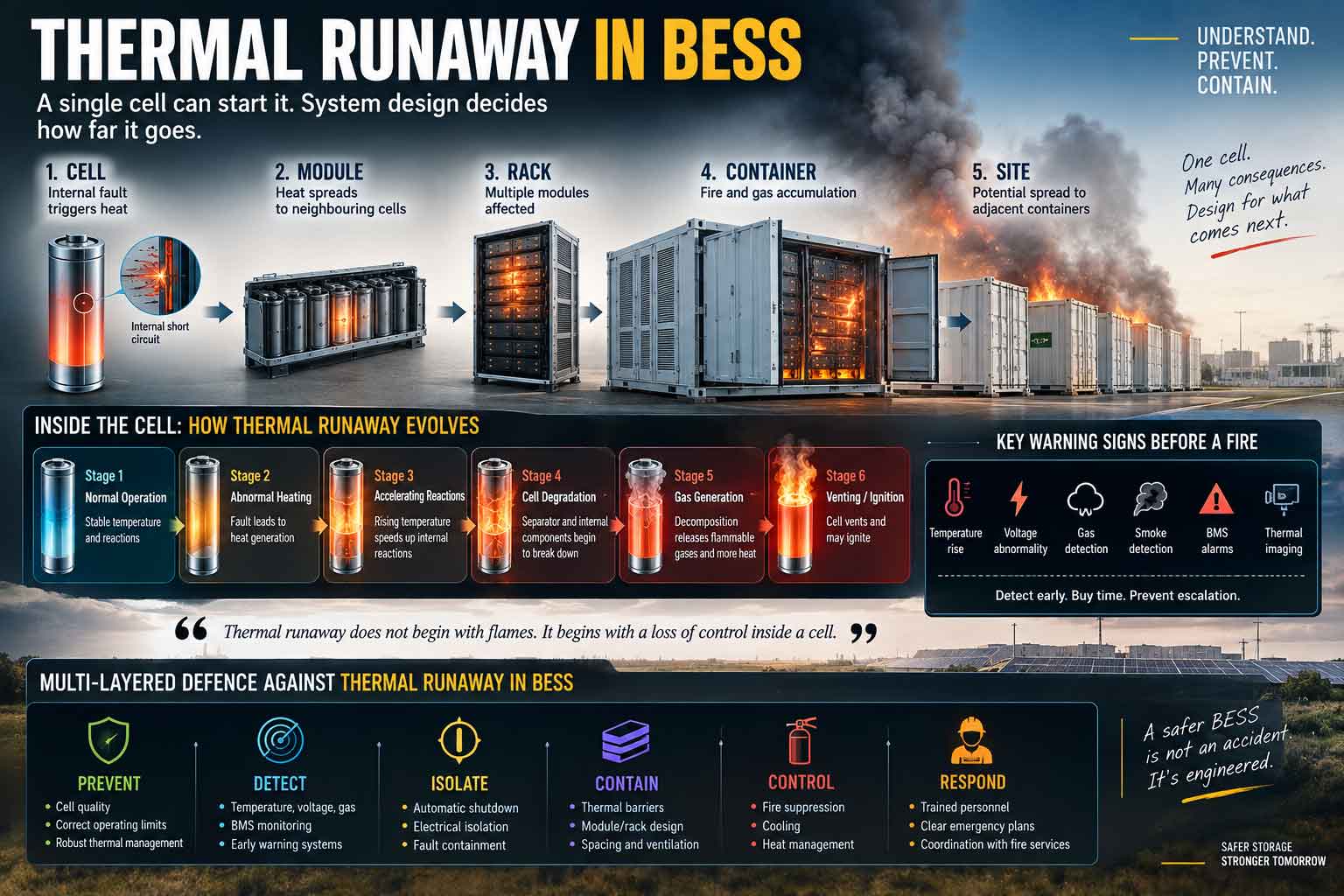
To understand Thermal Runaway in BESS, it helps to look at the progression inside a cell.
Stage 1: Heat begins accumulating
An abnormal electrical, mechanical or thermal condition causes heat generation.
Stage 2: Temperature rises
The cell’s ability to dissipate the generated heat becomes increasingly important.
Stage 3: Internal reactions accelerate
As temperature rises, internal reactions can become increasingly difficult to control.
Stage 4: Internal components begin to fail
The cell’s internal structures can lose their ability to maintain normal operating conditions.
Stage 5: Rapid heat and gas generation
Decomposition reactions can release additional heat and gases.
Stage 6: Venting or ignition can occur
Depending on the conditions, gases may vent from the cell and potentially ignite.
Stage 7: Neighbouring cells may be affected
If sufficient heat reaches nearby cells, the failure can propagate.
This final stage is where a cell-level problem becomes a BESS-level safety problem.
The Biggest Question: Can Thermal Runaway Spread?
Yes, thermal runaway can potentially propagate from one cell to neighbouring cells under sufficiently severe conditions.
And this is arguably more important for a utility-scale BESS than the failure of an individual cell.
Consider the hierarchy:
Cell
↓
Module
↓
Rack
↓
Battery container
↓
Adjacent equipment
↓
Potential site-wide event
A well-designed BESS should be engineered to interrupt this chain.
That means Thermal Runaway in BESS has to be considered together with propagation prevention.
The engineering questions become:
- How far apart are cells and modules?
- What thermal barriers exist?
- How is heat removed?
- What happens when one cell vents?
- Can neighbouring cells withstand the resulting heat?
- Can a rack be electrically isolated?
- Can an affected container be isolated from the rest of the site?
- Can gases escape safely?
- Can fire protection control the resulting heat?
- What happens after the initial event?
These are system-design questions.
Thermal Runaway Propagation Is the Real BESS Safety Challenge
There is a fundamental difference between proving that an individual cell is safe and demonstrating that a complete BESS can manage a cell failure.
A battery can satisfy component-level requirements while the complete installation may present additional risks because of:
- cell density;
- enclosure geometry;
- thermal interactions;
- electrical connections;
- cooling configuration;
- ventilation;
- gas accumulation;
- neighbouring equipment; and
- site layout.
That is why system-level testing has become such an important part of international BESS safety practice.
Thermal Runaway in BESS needs to be studied at increasing levels of scale.
A useful conceptual progression is:
Cell → Module → Unit → Installation
The purpose is not simply to determine whether a cell can fail.
It is to understand what happens when it does.
Why UL 9540A Matters to the Thermal-Runaway Conversation
UL 9540A is frequently discussed in the global BESS industry because it evaluates thermal-runaway fire propagation and related hazards at different levels of the energy-storage system.
The important lesson is methodological.
A test at cell level cannot automatically answer what happens at container level.
Likewise, the behaviour of one battery configuration cannot necessarily be assumed to represent another configuration with different:
- chemistry;
- cell format;
- module architecture;
- rack arrangement;
- enclosure;
- cooling system;
- state of charge; or
- fire-protection configuration.
For project developers, this creates an important procurement question:
Has the safety evidence been generated for the system that is actually being installed?
That is a much stronger question than simply asking whether a supplier possesses a safety certificate.
Can the BMS Prevent Thermal Runaway in BESS?
The short answer is:
The BMS is a critical safety layer, but it is not the whole safety system.
A BMS can monitor operating parameters and identify conditions outside specified limits.
Depending on the architecture, it can monitor parameters such as:
- cell voltage;
- temperature;
- current;
- state of charge;
- cell imbalance; and
- other battery operating conditions.
When abnormal conditions are detected, protective actions may include alarms, current limitation, charging interruption or system isolation.
But there is an important limitation.
If a severe Thermal Runaway in BESS begins because of an internal cell defect, software may not be able to reverse the physical process once it has progressed beyond a certain point.
That is why relying entirely on the BMS is not an adequate fire-safety strategy.
The BMS is one layer.
The complete safety architecture has to provide several more.
Cooling Is a Safety System, Not Just a Performance System
Cooling is often discussed in terms of battery efficiency and lifecycle performance.
But it also has a direct connection with Thermal Runaway in BESS.
A properly engineered thermal-management system needs to deal with:
- heat generated during normal operation;
- ambient temperature;
- charging and discharging loads;
- temperature gradients;
- localised hot spots;
- equipment failures;
- airflow or coolant problems; and
- changing conditions as the battery ages.
The key question is not simply:
“Does the BESS have cooling?”
It is:
“What happens if cooling fails?”
A robust design should have monitoring and protective responses for abnormal thermal conditions.
This is where redundancy and fault tolerance become important.
What Happens When Thermal Runaway Produces Gas?
This is the point where the Thermal Runaway in BESS story connects directly with another major BESS hazard: explosion risk.
A thermal event can generate flammable gases.
If gases accumulate inside a confined enclosure and reach an ignitable concentration, the event can become significantly more dangerous.
That means a BESS safety architecture has to consider:
thermal event → gas generation → gas accumulation → ignition potential
Gas management therefore becomes part of fire prevention.
Relevant safety measures can include:
- gas detection;
- ventilation;
- controlled gas release;
- pressure management;
- explosion protection;
- emergency shutdown; and
- appropriate separation.
This is also why simply installing a fire-suppression system does not solve every BESS fire risk.
A future article in this cluster will examine this issue in greater depth under BESS explosion risk.
Can Fire Suppression Stop Thermal Runaway?
This question needs a nuanced answer.
Fire suppression can be an important tool for controlling the consequences of a battery event, including cooling equipment and limiting fire spread.
But suppression should not automatically be described as a way of “turning off” the electrochemical failure inside every affected cell.
This distinction matters.
If a cell has already entered severe thermal runaway, the safety objective may shift from preventing that cell’s failure to:
- controlling heat;
- protecting surrounding cells;
- preventing propagation;
- managing gases;
- protecting people;
- isolating the affected section; and
- preventing secondary incidents.
In other words:
Fire suppression is one layer of BESS safety—not the entire answer to Thermal Runaway in BESS.
Why India Is Taking Thermal Risk More Seriously
India’s BESS safety framework is evolving alongside the country’s storage deployment.
The Central Electricity Authority’s Measures Relating to Safety and Electric Supply Amendment Regulations, 2026 introduce a dedicated BESS safety framework covering issues including fault tolerance, BMS monitoring, fire and explosion protection, battery containers, ventilation, hazard detection, automatic fire suppression and emergency shutdown.
The framework also requires BESS installations to address safety at different levels of the system rather than treating the battery as a conventional electrical load.
The regulations are scheduled to come into force on 1 April 2027.
That timing matters.
India is simultaneously building a much larger BESS pipeline, meaning projects being designed and procured today need to think beyond today’s minimum requirements.
For Thermal Runaway in BESS, that means asking whether the safety architecture can remain effective over the entire project life—not merely whether it meets a checklist at commissioning.
What Should a BESS Developer Ask About Thermal Runaway?
This is where the technical discussion becomes commercially useful.
Before procuring a large BESS, developers and owners should be asking suppliers questions such as:
What happens if one cell enters thermal runaway?
Don’t accept only a statement that the battery is “safe.”
Ask for evidence of propagation behaviour.
What happens if cooling fails?
The failure of an auxiliary system should be part of the safety analysis.
What does the BMS actually detect?
Understand the monitored parameters, alarm thresholds and automatic protective actions.
What gases can be generated?
The answer affects detection, ventilation and explosion protection.
How is propagation prevented?
Ask about module, rack and container-level design.
What testing has been performed?
More importantly, ask whether the testing represents the actual deployed configuration.
What happens after shutdown?
A BESS should not be assumed safe simply because it has been electrically disconnected.
Residual heat and damaged cells can remain a concern.
How is an incident managed?
The emergency-response plan needs to address operators, fire services, neighbouring equipment and post-incident handling.
These questions turn Thermal Runaway in BESS from an abstract technical concept into a project-development and procurement issue.
The Five Layers of Thermal-Runaway Defence
A useful way to think about BESS safety is as a series of defensive layers.
1. Prevent
Use appropriate cell quality, battery design, electrical protection and thermal management to reduce the likelihood of failure.
2. Detect
Identify abnormal temperature, voltage, current, gas, smoke or other warning conditions as early as practical.
3. Isolate
Disconnect the affected electrical section and prevent the fault from spreading through the electrical system.
4. Contain
Use physical design, thermal barriers, spacing, ventilation and fire protection to limit propagation.
5. Respond
Give operators and emergency personnel the information, procedures, equipment and training required to manage the incident.
This is the fundamental principle behind modern Fire Safety in BESS.
The goal is not to assume that failure is impossible.
The goal is to ensure that failure remains controlled.
The BESS Safety Question India Cannot Avoid
India’s storage ambitions are growing rapidly.
That makes the question around Thermal Runaway in BESS increasingly important because the consequences of a failure grow with the scale and density of an installation.
But the answer should not be fear.
Lithium-ion BESS can be engineered with multiple layers of protection, and safety engineering continues to evolve.
The real danger lies in treating safety as a single piece of equipment.
A suppression system cannot replace thermal management.
A BMS cannot replace propagation testing.
Gas detection cannot replace ventilation.
A safety certificate cannot replace good installation and maintenance.
And a fire department cannot be expected to compensate for weaknesses in the original design.
Thermal Runaway in BESS is therefore not one problem with one solution.
It is a chain of potential failures that must be interrupted at multiple points:
- Prevent the fault.
- Detect the abnormality.
- Isolate the equipment.
- Control the heat.
- Manage the gases.
- Stop propagation.
- Protect people.
- Recover safely.
As India moves deeper into grid-scale storage, that is the standard the industry should be working toward.
Because the most important BESS fire is not the one that firefighters successfully extinguish.
It is the one that never gets the chance to become a fire.
 Electrify your feed! Click here to join our Whatsapp group and to get the latest updates, expert insights, and innovations driving India’s energy storage revolution.