


Close Menu
The Battery MagazineThe Battery Magazine
  • Just In
  • Batteries
    • Battery Manufacturing (BESS)
    • Battery Materials & Chemistries
    • Battery Recycling
    • C&I Storage
  • Solar
  • Renewable energy
    • Wind Energy
    • Hydropower
    • Green Hydrogen
    • Bioenergy
  • Tenders
    • Energy Storage
    • Solar Energy
    • Wind Energy
  • Policy
    • Storage
    • Solar
    • Wind
    • EV
    • Transmission
  • EV
    • EV Batteries
    • EV Charging Infrastructure
    • Electric Mobility Trends
  • Grid
    • Transmission & Distribution
    • Grid Infrastructure
    • Power Generation
    • Power Equipments
  • Exclusive
    • Cover Story
    • Watt Matters
    • Perspective
    • Articles
  • More
    • E-Mag
    • Events
    • Contact Us
Facebook LinkedIn WhatsApp
The Battery MagazineThe Battery Magazine
  • Just In
  • Batteries
    • Battery Manufacturing (BESS)
    • Battery Materials & Chemistries
    • Battery Recycling
    • C&I Storage
  • Solar
  • Renewable energy
    • Wind Energy
    • Hydropower
    • Green Hydrogen
    • Bioenergy
  • Tenders
    • Energy Storage
    • Solar Energy
    • Wind Energy
  • Policy
    • Storage
    • Solar
    • Wind
    • EV
    • Transmission
  • EV
    • EV Batteries
    • EV Charging Infrastructure
    • Electric Mobility Trends
  • Grid
    • Transmission & Distribution
    • Grid Infrastructure
    • Power Generation
    • Power Equipments
  • Exclusive
    • Cover Story
    • Watt Matters
    • Perspective
    • Articles
  • More
    • E-Mag
    • Events
    • Contact Us
LinkedIn Facebook WhatsApp YouTube
The Battery MagazineThe Battery Magazine
Home » Batteries » Battery Manufacturing (BESS) » New Nanofluid Electrolyte Could Boost Electrically Rechargeable Zinc-Air Batteries
Battery Manufacturing (BESS)

New Nanofluid Electrolyte Could Boost Electrically Rechargeable Zinc-Air Batteries

Shivangi GuptaBy Shivangi GuptaJuly 24, 20263 Mins Read
Facebook Twitter LinkedIn WhatsApp
New Nanofluid Electrolyte Could Boost Electrically Rechargeable Zinc-Air Batteries

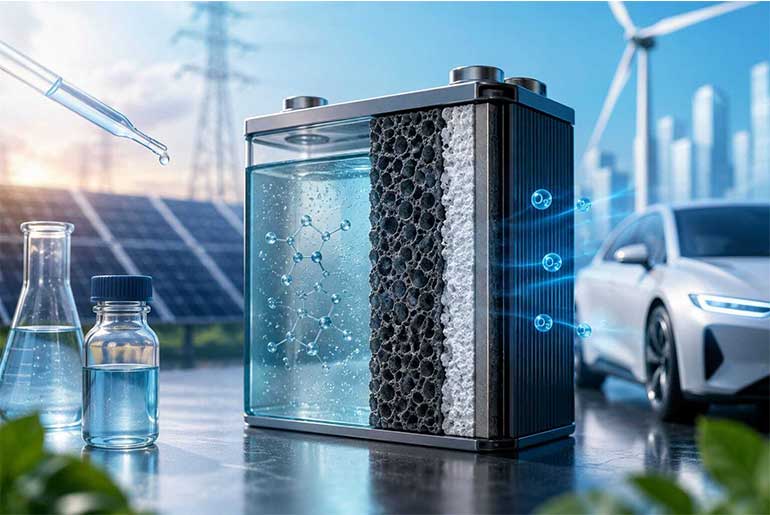
Scientists have developed a new nanofluid electrolyte that could improve cathode efficiency in electrically rechargeable zinc-air batteries, potentially paving the way for safer, more affordable, and sustainable next-generation energy storage technologies. The newly developed electrolyte remains stable for up to three months and could have direct applications in the zinc-air battery industry. The technology also holds potential for large-scale grid energy storage and electric mobility applications in India.

Conventionally, costly corrosion inhibitors are added to suppress zinc corrosion, but these often-hinder oxygen reaction kinetics.

This challenge was solved by scientists from SASTRA Deemed University, Thanjavur, dispersed small amounts of inexpensive silica and zinc oxide nanoparticles into the standard electrolyte, creating “nanofluid electrolyte”. This work supported by Department of Science and Technology (DST) under the Nano and Advanced Materials Division suppressed the hydrogen reaction while simultaneously inhibiting corrosion and enhancing oxygen reaction performance at the cathode, solving both electrode problems with one low-cost intervention.

The technology protected by a granted Indian patent (IN570691), is ready for usage.

As the world race toward cleaner energy storage, aqueous batteries are gaining attention as a safe, low-cost, environmentally friendly alternative to lithium-ion systems. Among them, the electrically rechargeable zinc-air battery (ZAB) stands out for its high theoretical energy density, low-cost, and water-based chemistry.

The team led by Dr. S. Devaraj at SASTRA Deemed University, initiated efforts to resolve the two stubborn problems have held this green technology back — unwanted hydrogen gas evolution at the zinc anode wastes charge and corrodes the metal, while oxygen reactions at the air-cathode remain sluggish without expensive platinum or ruthenium catalysts.

Apart from engineering the nanofluid electrolyte to suppress parasitic hydrogen evolution and zinc corrosion simultaneously they developed earth-abundant bifunctional catalysts to drive both oxygen reduction (ORR) and oxygen evolution (OER) efficiently and explored waste-derived materials as viable electrode candidates.

Their research identified α-MnO2 as the top catalyst performer, owing to its open tunnel-like architecture. Strategic copper doping pushed performance beyond commercial benchmarks, outperforming both Pt- and Ru-based standards at a remarkably low dopant loading of just 2 wt%.

They recovered spent activated carbon from exhausted household water filters and hydrothermally converted it into MnO2/C nanocomposites developing both efficient bifunctional electrocatalysts and high-performing supercapacitor electrodes. This process has been patented (Application No. 202441032753).

Separately, post-pandemic surgical face masks were chemically upcycled into activated carbon with a record-high surface area, rivalling platinum in oxygen reduction activity.

The approaches developed have prospects beyond this technology. The waste-derived carbon can be tuned for multiple applications beyond zinc-air batteries, and the upcycling approach is adaptable to virtually any waste carbon source. Similarly, the nanofluid electrolyte concept can potentially extend to other aqueous battery systems, offering a generalisable strategy for safer, cheaper, next-generation green batteries.

whatsapp icon Electrify your feed! Click here to join our Whatsapp group and to get the latest updates, expert insights, and innovations driving India’s energy storage revolution.
cleaner energy India News nanofluid electrolyte SASTRA Deemed University zinc-air batteries
Shivangi Gupta
  • Website

Shivangi Gupta is a journalist passionate about writing and delivering accurate, clear, and informative news stories across a wide range of topics.

Keep Reading

Jinko ESS Signs 100 MWh BESS Deal with German Integrator for Central Europe Projects

Jinko ESS Signs 100 MWh BESS Deal with German Integrator for Central Europe Projects

Bondada Engineering Secures NTPC REL Contract for 100 MWh Battery Energy Storage System

Bondada Engineering Secures NTPC REL Contract for 100 MWh Battery Energy Storage System

Ark Energy Approves AUD 1.3 Billion Solar-Storage Hybrid Project in NSW

Ark Energy Approves AUD 1.3 Billion Solar-Storage Hybrid Project in NSW

Leave A Reply Cancel Reply

1 × 1 =

Renewable energy
Ark Energy Approves AUD 1.3 Billion Solar-Storage Hybrid Project in NSW

Ark Energy Approves AUD 1.3 Billion Solar-Storage Hybrid Project in NSW

July 24, 2026
ACME Solar Expands Rajasthan BESS Footprint to 3.62 GWh Across Three Sites

ACME Solar Expands Rajasthan BESS Footprint to 3.62 GWh Across Three Sites

July 24, 2026
China Targets 3.5 TW Renewable Energy Capacity by 2030 Under New 2026-2030 Plan

China Targets 3.5 TW Renewable Energy Capacity by 2030 Under New 2026-2030 Plan

July 24, 2026
Navitas Solar Partners With Caelux to Scale 5 GW Perovskite-TOPCon Module Production in India

Navitas Solar Partners With Caelux to Scale 5 GW Perovskite-TOPCon Module Production in India

July 24, 2026
Batteries
Jinko ESS Signs 100 MWh BESS Deal with German Integrator for Central Europe Projects

Jinko ESS Signs 100 MWh BESS Deal with German Integrator for Central Europe Projects

July 24, 2026
Bondada Engineering Secures NTPC REL Contract for 100 MWh Battery Energy Storage System

Bondada Engineering Secures NTPC REL Contract for 100 MWh Battery Energy Storage System

July 24, 2026
New Nanofluid Electrolyte Could Boost Electrically Rechargeable Zinc-Air Batteries

New Nanofluid Electrolyte Could Boost Electrically Rechargeable Zinc-Air Batteries

July 24, 2026
ACC Battery PLI Scheme Attracts ₹5,180 Crore Investment, No Incentive Claims Yet

ACC Battery PLI Scheme Attracts ₹5,180 Crore Investment, No Incentive Claims Yet

July 23, 2026

Subscribe for Updates

Get the latest news about energy storage in your inbox.

    © 2026 Thebatterymagazine.com.
    • Home
    • About Us
    • Contact Us
    • Privacy Policy
    • Terms of Service

    Type above and press Enter to search. Press Esc to cancel.