

What if the next source of India’s critical minerals is not a mine, but a discarded battery?
Imagine an electric vehicle battery that has spent years powering a car, travelled thousands of kilometres and finally reached the end of its useful life. To most people, it may look like a piece of industrial waste. But what if that discarded battery still holds materials that could help manufacture the next generation of batteries? Inside it are valuable resources waiting to be recovered. Lithium, cobalt, nickel and manganese, depending on the battery chemistry, do not necessarily have to leave the manufacturing ecosystem when a battery reaches the end of its life. With the right recycling and refining processes, they can find their way back into the supply chain. This is precisely where battery black mass enters the conversation.
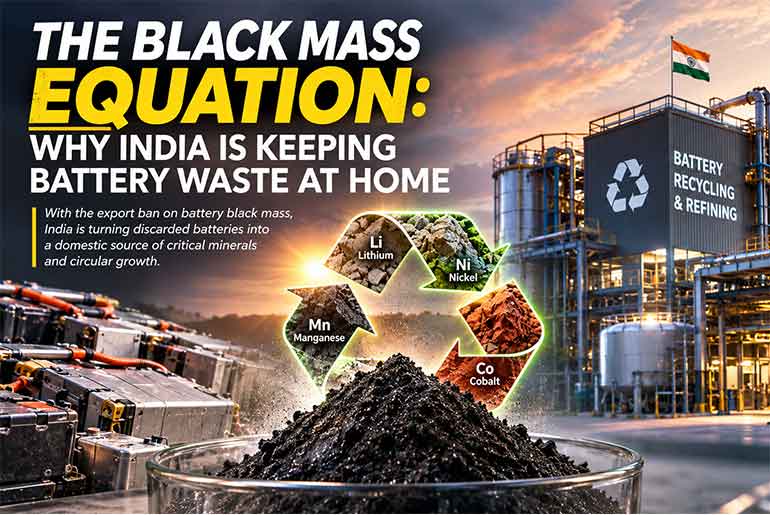
A dark, powder-like material produced during the mechanical processing of spent lithium-ion batteries, black mass carries recoverable critical minerals that have become increasingly important to the global energy industry. For India, retaining this material could mean more than improving waste management. It could open another route towards securing the raw materials needed for electric mobility, battery manufacturing and energy storage.
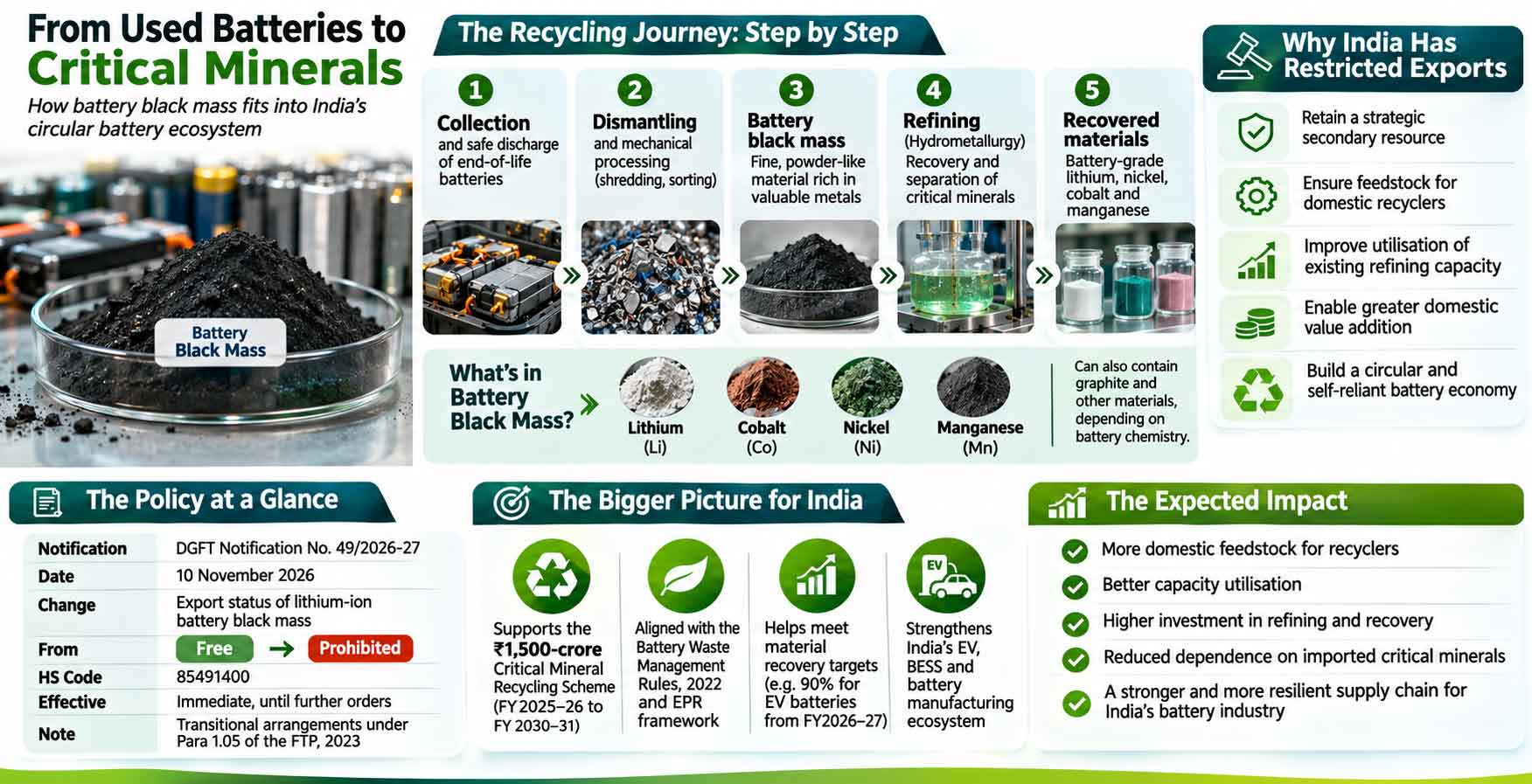
Recognising this opportunity, the Government of India has taken a significant policy step. On 10 November 2026, the Directorate General of Foreign Trade (DGFT), under the Ministry of Commerce and Industry, prohibited the export of lithium-ion battery black mass covered under ITC (HS) Code 85491400, changing its export status from ‘Free’ to ‘Prohibited’ with immediate effect, until further orders.
Announced through Notification No. 49/2026-27, the decision is intended to retain domestically generated black mass for recycling and refining within India. The government has identified inadequate feedstock availability as a constraint on the utilisation of domestic recycling and refining capacity, even as some locally generated black mass has been exported and domestic recyclers have, in certain cases, imported material to meet their requirements.
The announcement raises an important question: if India already has valuable battery-derived resources and facilities capable of processing them, why should the materials needed by its recycling industry leave the country in the first place?
Black mass: Understanding the value hidden inside battery waste
Before examining the implications of the export prohibition, it is worth understanding what happens to a battery once it is discarded.
A lithium-ion battery is not simply dismantled and turned into reusable metal. Recycling involves a series of controlled processes, beginning with collection, discharge and safe dismantling. The battery is then mechanically processed through shredding, separation and other treatment stages to recover different material fractions.
One of the most important outputs of this process is black mass. It is generally a fine, dark powder containing a mixture of valuable materials from the battery’s electrodes and other components. Its composition varies according to the chemistry of the original battery, the quality of the feedstock and the processing method used.
Depending on the battery chemistry, black mass can contain lithium, cobalt, nickel, manganese and graphite, among other materials. These are not recovered in their final, battery-ready form simply by producing black mass. Further refining is required to separate and purify the individual materials.
Hydrometallurgical processing, for example, uses chemical solutions and controlled treatment stages to extract valuable metals from the intermediate material. The recovered products can then undergo further purification and processing to meet the specifications required by downstream industries.
This distinction matters. Black mass is not the same as battery-grade lithium, nickel or cobalt. It is an intermediate resource that carries the potential to produce these materials.
The commercial value of black mass therefore depends on several factors, including its metal content, battery chemistry, moisture levels, impurities, recovery yields and prevailing commodity prices.
For a country looking to reduce its dependence on imported critical minerals, this intermediate material represents an opportunity to recover resources that have already entered its economy once. Rather than relying entirely on fresh mineral extraction, India can recover a portion of its material requirements from products that have completed their first life.
This is the idea behind urban mining: recovering valuable resources from discarded products and industrial waste instead of depending exclusively on conventional mining.
The challenge, however, is to move beyond collection and shredding. The real value lies in the ability to refine the recovered material into high-purity products that can re-enter the manufacturing chain.
Why India wants to keep black mass within its borders
For years, the global battery recycling industry has operated through an interconnected network of waste collectors, processors, refiners and material buyers. Depending on their capabilities and commercial arrangements, companies may sell intermediate recycling products to facilities in other countries for further processing.
Black mass is part of this international trade. A company equipped to collect and mechanically process batteries may not necessarily have the technology, investment or scale required to recover individual metals. Selling the intermediate material to an established overseas refiner can therefore be commercially attractive.
But this arrangement also creates a problem for countries trying to develop their own refining industries.
When domestically generated black mass is exported, the opportunity to recover its valuable minerals and capture the subsequent processing value moves elsewhere. The material may eventually return to the international market in a more refined form, but the country that generated the original waste may have to import the recovered materials or other battery-grade inputs.
This is the supply-chain gap that India’s latest decision seeks to address.
In its 11 November 2026 statement, the Ministry of Commerce and Industry explained that domestic battery recycling and critical mineral refining capacity has grown, but remains underutilised because of inadequate feedstock availability. It also acknowledged that some domestic recyclers have imported black mass to meet their processing requirements while valuable material generated within India has been exported.
This creates an unusual situation: the country has a growing recycling industry, but the availability of suitable material does not always match the capacity being developed to process it.
Retaining black mass could help address this imbalance by making more domestically generated feedstock available to Indian recyclers and refiners. Better feedstock access, in turn, could improve plant utilisation, support investment decisions and strengthen the economics of domestic processing.
The notification also needs to be understood in its precise legal context. It covers the specified unsorted battery waste and scrap under ITC (HS) 85491400, including the lithium-ion battery black mass identified in the notification. It should not be interpreted as a blanket prohibition on every processed metal, refined intermediate or category of battery-related export. The notification also provides for transitional arrangements under Para 1.05 of the Foreign Trade Policy, 2023.
The distinction is important because the objective is to retain the specified critical mineral-bearing waste stream for domestic recovery, not to suggest that every material emerging from battery recycling is automatically prohibited from international trade.
The economics of keeping resources at home
A recycling facility is only as commercially viable as its ability to secure feedstock, process it efficiently and sell the recovered materials at competitive prices.
Building a plant requires substantial capital investment in equipment, processing technology, environmental safeguards, laboratories and skilled personnel. Once the facility is operational, it also needs a steady supply of suitable battery waste to maintain production.
Without sufficient feedstock, even a technically capable facility may operate below its designed capacity. This affects production costs, revenue visibility and the ability to recover the initial investment.
The black mass export prohibition could help ease one part of this challenge by retaining more domestic feedstock. For recyclers, a more dependable supply of material could improve capacity utilisation and create greater confidence in expanding refining operations.
The opportunity is not limited to companies already engaged in recycling. Greater domestic availability of black mass could encourage investments in advanced processing technologies, including hydrometallurgical recovery, purification and the production of higher-value metal compounds.
It could also strengthen the links between recyclers and downstream manufacturers. Recovered materials could potentially supply chemical producers, cathode material manufacturers and other businesses involved in battery manufacturing, provided they meet the required technical specifications.
The government has already introduced a financial mechanism to encourage this development. In September 2025, the Union Cabinet approved a ₹1,500-crore Incentive Scheme to Promote Critical Mineral Recycling under the National Critical Mineral Mission (NCMM).
The scheme has a six-year tenure, covering FY2025–26 to FY2030–31, and aims to develop domestic capacity for separating and producing critical minerals from secondary sources such as battery waste and electronic waste. The Ministry of Mines issued its implementation guidelines in October 2025.
The export prohibition complements this initiative. Financial incentives can encourage companies to establish recycling and refining facilities, but those facilities also need access to the materials they are designed to process. Retaining black mass within India could help connect the two sides of the equation: investment in processing capacity and the availability of domestic feedstock.
For the wider battery industry, the potential benefit is equally important. Recovered critical minerals could contribute to a more diversified domestic supply of battery materials, reducing some exposure to international supply disruptions, foreign exchange movements and import-related uncertainties.
However, these benefits will depend on the quality and quantity of material available, the recovery rates achieved and the commercial competitiveness of the recovered products. The export prohibition creates an opportunity; it does not automatically guarantee lower costs or cheaper battery materials.
Industry Voices: What the recycling industry expects from the decision
For companies operating in battery recycling and critical mineral recovery, the announcement is significant because it addresses a challenge that extends beyond waste collection. The availability of feedstock, the economics of refining and the ability to recover high-purity materials will determine how much value India can retain from its growing battery waste stream.
Industry leaders have welcomed the move, while also pointing towards the importance of implementation, enforcement and investment in advanced processing capabilities.
Bhuwan Purohit, Executive Director – Corporate Strategy & Planning, Rubamin
The Government of India’s decision to prohibit the export of lithium-ion battery black mass and battery waste is a significant step towards strengthening India’s critical mineral security and domestic battery recycling industry.
This decision recognises that black mass is not waste but a strategic secondary resource containing valuable critical minerals such as lithium, cobalt, nickel and manganese. Retaining these resources within India will help reduce import dependence, create domestic value and build a stronger circular battery economy.
This policy also provides an important impetus to move beyond battery collection and shredding towards advanced refining and the production of high-purity materials.
However, effective enforcement will be critical. Government Agencies must examine past exports under misdeclared HSN codes, with appropriate action wherever discrepancies are established. This notification clarifies that 85491400 is the correct classification of black mass giving authorities the necessary clarity.
Environment authorities must prevent the export of partially processed residues disguised as cobalt or nickel intermediates or multi-metal hydroxide precipitates (MHP) which are waste material for metal recovery that are disguised as products.
We commend the Ministry of Mines and DGFT for this timely intervention, which protects investments already committed to the sector. India has significant installed refining capacity that remains underutilised due to inadequate feedstock, even as valuable secondary resources leave the country.
This is essential to building a globally competitive, self-reliant battery recycling ecosystem.
Nitin Gupta, Co-Founder & CEO, Attero
“The ban on black mass exports will be a significant boost for India’s domestic critical minerals recycling industry. At present, a substantial opportunity is lost when black mass extracted from end-of-life batteries is exported for refining and the processed materials are subsequently imported back into the country. This not only weakens domestic value addition but also exposes India to geopolitical risks and potential supply disruptions.
Retaining black mass within the country will ensure a more reliable supply of feedstock for domestic recyclers, improve capacity utilisation, encourage fresh investments in refining infrastructure and enable companies to scale up operations. It creates an opportunity to expand domestic processing capabilities and reduce India’s dependence on imported refined critical minerals.
The move will therefore strengthen the economics of domestic recycling, deepen value addition within India and make the critical minerals ecosystem more resilient.”
The capacity question: Does India have enough infrastructure to process what it retains?
Retaining black mass within the country is an important policy intervention, but it also brings an immediate question into focus: is India’s recycling and refining ecosystem ready to process the material that will now have to find a domestic destination?
India’s recycling industry has been expanding, with companies investing in battery shredding, material separation and critical mineral recovery. However, the availability of processing infrastructure should not be confused with the ability to recover battery-grade materials at scale.
Ministry of Environment, Forest and Climate Change document based on discussions held in January 2025, noted that 16 units in India were processing lithium-ion batteries. Of these, 12 units registered on the Central Pollution Control Board’s Extended Producer Responsibility (EPR) portal were also processing black mass to recover metal compounds. Their combined input capacity was reported at 75,500 tonnes annually.
This figure provides an indication of the infrastructure already present in the country. However, it represents reported input capacity, not actual annual processing, black mass output or the quantity of refined critical minerals recovered. Actual utilisation depends on feedstock availability, battery chemistry, processing technology and commercial conditions.
This distinction is important. A recycling plant may have the equipment to process thousands of tonnes of material, but its economics will remain under pressure if it cannot secure a consistent supply of suitable batteries and manufacturing scrap.
There is also a difference between producing black mass and refining it. Mechanical recycling facilities can recover an intermediate material, but extracting individual metals to the required purity involves additional investment, technical expertise and specialised processing infrastructure.
For India, the next stage must therefore involve strengthening the entire recycling chain, from collection and dismantling to advanced refining and the production of usable materials.
The export prohibition could improve the availability of domestic feedstock, but companies will still need commercially viable processing technologies, reliable buyers and predictable operating conditions to expand their businesses.
The rules behind the recycling economy
The export decision also needs to be viewed alongside India’s existing battery waste management framework.
The Battery Waste Management Rules, 2022, notified by the Ministry of Environment, Forest and Climate Change, introduced an Extended Producer Responsibility framework for battery producers. Under this system, producers are responsible for ensuring that batteries placed on the market are collected and sent for recycling or refurbishment at the end of their useful lives.
The rules cover different battery categories, including portable, automotive, industrial and electric vehicle batteries. They also establish minimum material recovery targets for recyclers.
For electric vehicle batteries, the scheduled recovery target increased from 70% in FY2024–25 to 80% in FY2025–26 and reaches 90% from FY2026–27 onwards. Portable batteries also reach a 90% recovery target in FY2026–27. Automotive and industrial batteries have a scheduled target of 60% from the same financial year.
These targets are measured against the dry weight of the battery, subject to the rules’ provisions concerning non-recoverable hazardous material content.
The framework also provides for EPR certificates generated through the Central Pollution Control Board’s centralised online portal. Recyclers and refurbishers can generate certificates based on the quantity processed and the applicable recovery requirements, which producers can purchase to meet their obligations.
In effect, India already has a regulatory mechanism intended to bring discarded batteries back into the formal recycling system. The new export restriction adds another dimension by seeking to retain a specific intermediate material within the domestic value chain.
Together, these measures could strengthen the connection between battery producers, collection networks, recyclers and material recovery companies.
But regulation must work on the ground. Collection networks need to become more organised, informal handling must be addressed, and recyclers must comply with environmental and safety requirements. Battery waste contains hazardous substances, and improper handling, storage or processing can create serious environmental and workplace risks.
The challenge is not simply to recycle more batteries. It is to ensure that they are collected, transported and processed safely, with measurable recovery outcomes and proper traceability.
The challenges beyond the export prohibition
There is a reason why keeping a valuable resource within the country and making it commercially useful are two different things.
The first challenge is feedstock collection. India’s battery waste stream is spread across vehicle manufacturers, fleet operators, repair networks, electronic waste channels, industrial users and individual consumers. Recovering these batteries through formal collection systems will require coordination between producers, recyclers, aggregators and authorised waste handlers.
The second challenge is material quality. Black mass is not a uniform product. Its composition changes according to the original battery chemistry and the efficiency of the mechanical processing stage. LFP and NMC batteries, for instance, have different material compositions and therefore offer different recovery economics. Refiners must be equipped to handle these variations.
The third challenge is technology and cost competitiveness. Recovering lithium, nickel, cobalt and manganese at high purity requires reliable processes, consistent quality control and effective management of processing residues. Companies must be able to produce materials that meet the requirements of downstream manufacturers at commercially competitive prices.
The fourth challenge concerns market development. Even if domestic recyclers recover critical minerals successfully, a reliable domestic market must exist for the resulting products. Cell manufacturers and battery material suppliers need confidence in the quality, consistency and availability of recycled materials before integrating them into their production processes.
Finally, there is the question of enforcement. The classification and movement of partially processed materials will require regulatory clarity. Authorities must distinguish between prohibited black mass and legitimate processed products, while ensuring that waste is not misdeclared to circumvent the export restriction.
The notification therefore needs to be accompanied by effective customs oversight, transparent classification practices, environmental compliance and clear procedures for businesses handling different stages of battery recycling.
There is also a commercial consideration. Restricting exports may change the available market for black mass, its pricing and the negotiating position of recyclers and refiners. Domestic buyers will need to offer viable terms. Otherwise, feedstock retention alone may not translate into a sustainable recycling business.
A successful policy outcome will require a balance between resource security, fair commercial conditions, environmental protection and the ability of Indian companies to compete internationally.
From discarded batteries to India’s next mineral resource
India’s battery industry is entering a phase in which the conversation is expanding beyond manufacturing capacity and raw material imports. As electric mobility and energy storage continue to develop, the country will also need to consider what happens to the batteries that have already served their purpose.
The black mass export prohibition brings this question directly into the policy discussion. It signals an effort to ensure that the materials recovered from domestically generated battery waste contribute more meaningfully to India’s own industrial ecosystem.
The move also complements the broader objectives of the National Critical Mineral Mission, which seeks to strengthen the country’s capabilities across the critical mineral value chain. While primary mineral exploration and processing remain important, recycling offers an additional source of material that can support domestic supply security.
There is, however, a longer journey ahead. India must strengthen battery collection, invest in refining technologies, improve material recovery, establish reliable markets for recycled products and ensure that environmental standards are not compromised in the pursuit of higher output.
The real test will be whether the country can move beyond producing black mass to recovering materials that can actually return to battery manufacturing. That would create a stronger connection between the batteries entering the market today and the resources that can be recovered from them tomorrow.
For an industry seeking to reduce import dependence, this is an opportunity worth pursuing. A discarded battery should not mark the end of a material’s journey. With the right infrastructure and technology, it can become the starting point for another manufacturing cycle.
India’s decision to keep black mass at home may be one step towards that future. But the bigger achievement will come when the country can recover, refine and reuse those materials at scale.
Because the real value of a battery does not disappear when its first life ends. The question is whether India has the capability to bring that value back into its economy.
 Electrify your feed! Click here to join our Whatsapp group and to get the latest updates, expert insights, and innovations driving India’s energy storage revolution.