
India’s battery storage opportunity is quickly turning into an execution challenge. Gigawatt-hour-scale projects are moving from policy documents and tender portals to actual sites, opening a new field of opportunity for engineering and construction companies. But knowing how to bid for BESS EPC projects is very different from bidding for a conventional power project. A battery storage contractor is not simply pricing containers and cables; it is putting a price on engineering decisions that may have to perform for years after the project is commissioned.
That distinction is becoming increasingly important as India’s BESS pipeline expands. The Central Electricity Authority (CEA) is now publishing dedicated monthly updates on the development and deployment of BESS projects in the country. At the same time, utilities and public-sector companies are tendering storage projects at a scale that would have appeared extraordinary only a few years ago. Recent NTPC-group EPC packages include 240 MW/960 MWh at Devikot, 550 MW/2,200 MWh at Shimboo Ka Burj and 800 MW/3,200 MWh at Khavda, while an NGEL tender at the Bikaner Solar Plant covers 7,800 MWh of BESS capacity.
Yet the size written on the tender cover tells only part of the story.
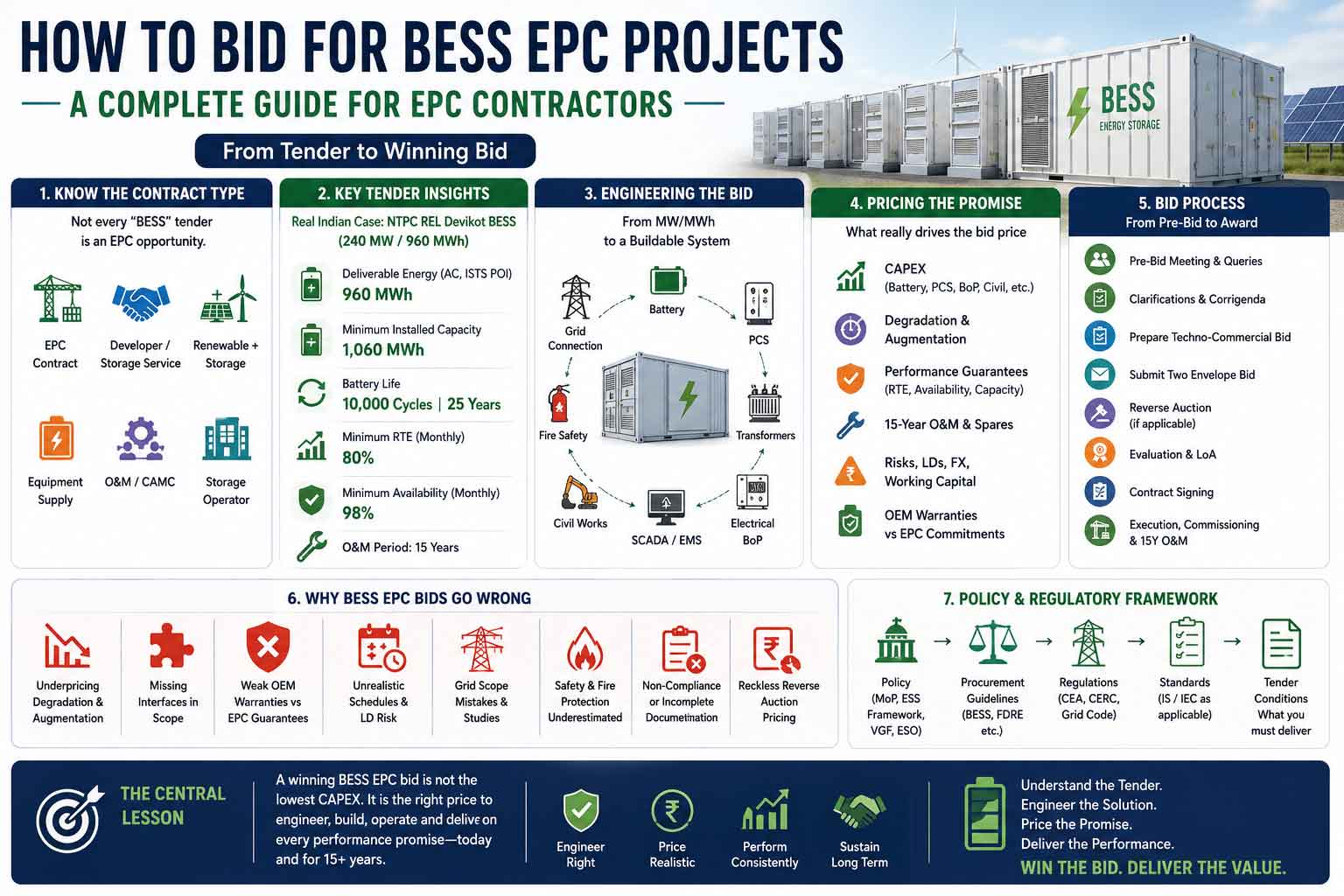
Consider NTPC Renewable Energy Limited’s 240 MW/960 MWh Devikot BESS tender. The project calls for at least 1,060 MWh of installed nameplate battery capacity to meet its specified deliverable requirement. It also specifies batteries rated for at least 10,000 cycles, a 25-year design life, 98% monthly availability, minimum 80% monthly round-trip efficiency at the specified measurement point and comprehensive O&M obligations extending for 15 years. Augmentation needed to meet the specified capacity criterion during the relevant period sits within the bidder’s scope. These are requirements of this particular tender—not universal benchmarks for every Indian BESS project—but they reveal how much lies behind a seemingly simple MW/MWh figure.
This is where BESS bidding becomes both an engineering and a commercial exercise. Before quoting, a contractor has to ask: Do we qualify? What exactly falls within our EPC battery limits? How much battery capacity must actually be installed? Who supplies the PCS and transformers? What happens as the battery degrades? Who pays for augmentation? Where is round-trip efficiency measured? What availability has been guaranteed? What happens if commissioning is delayed? And do the OEM warranties actually support the guarantees being offered to the project owner?
Even the type of tender must be identified correctly. A standalone BESS EPC package is not the same as a developer tender under a storage-service agreement, just as a solar-plus-storage EPC package differs from an FDRE procurement. For companies entering this market, understanding the distinction is the first step towards identifying the right opportunity. Our guide to Top EPC Contractors for Energy Storage & Battery Storage Projects in India explores the companies executing this infrastructure; this article goes inside the tender room to understand how such projects are actually bid.
From qualifying requirements and OEM partnerships to EPC Scope in Battery Storage Projects, Balance of Plant for Battery Storage, Civil Works in BESS Projects and the Electrical Scope in Battery Storage, every interface eventually finds its way into the bid price. The same is true for SCADA Requirements in BESS, Fire Protection Requirements, Commissioning of Battery Storage Systems and long-term O&M Contracts for BESS. Missing one responsibility at the bidding stage can turn into an expensive surprise after award.
This guide therefore follows the journey of a BESS EPC bid from the first tender document to the final commercial offer. Using actual Indian procurement examples, it explains how to evaluate qualification requirements, build a compliant technical solution, price degradation and augmentation, assess performance and contractual risks, manage documentation and avoid the mistakes that can turn a winning tender into a loss-making project.
Because in battery storage EPC, winning the bid is only the beginning. The real test is whether the price you win with can still deliver the project you promised.
Before You Bid: Know What BESS Contract You Are Looking At
The first mistake can happen before a contractor opens the price schedule. Not every tender carrying the words “Battery Energy Storage System” is asking an EPC company to build one.
India’s storage market now operates through several procurement structures. There are standalone BESS EPC packages where the successful contractor takes responsibility for engineering, procurement, construction, installation and commissioning. There are also tenders seeking BESS developers, where the selected company may finance, own and operate the storage asset and provide storage services under a long-term agreement. Renewable energy projects can bundle solar or wind with storage, while Firm and Dispatchable Renewable Energy (FDRE) procurements use storage to help deliver a contracted power profile. Equipment-supply and O&M packages create still different responsibilities.
The distinction is visible in actual Indian procurement. NTPC Renewable Energy Limited’s Devikot tender, for instance, is explicitly an EPC package for development of a 240 MW/960 MWh ISTS-connected BESS. By contrast, storage procurements issued under developer or storage-service models place a different set of commercial and ownership responsibilities on the bidder.
So, before asking how much should we quote?, the bidding team should answer a more basic question:
What exactly are we being asked to become—the EPC contractor, equipment supplier, system integrator, project developer, owner/operator or long-term service provider?
Read the Tender in the Right Order
Once the opportunity is identified as an EPC package, resist the temptation to jump directly to the BOQ.
Start with the Notice Inviting Tender or Invitation for Bids, followed by the Instructions to Bidders and, most importantly, the Qualifying Requirements (QR). Then move through the scope of work, technical specifications, General and Special Conditions of Contract, price schedules, performance requirements and supporting forms.
This order matters because a technically attractive project is irrelevant if the company cannot qualify for it.
NTPC REL’s Devikot procurement demonstrates how specific qualification can become. Among its qualification pathways, the tender includes experience thresholds involving grid-interactive BESS of 80 MWh cumulative capacity, with at least one qualifying 20 MWh reference installation and stipulated successful operating experience. These figures belong specifically to that procurement; another BESS EPC tender may set entirely different requirements.
A contractor must therefore establish its qualification route before committing substantial resources to bid preparation. Depending on what a particular tender permits, that route could involve its own project credentials, battery or system-integration experience, an OEM relationship, technical collaboration, consortium or joint venture arrangement.
The BHEL pre-bid tie-up for the 750 MWh TGTRANSCO Maheswaram BESS project illustrates this well. Its tender documentation explicitly permitted consortium/JV participation. But that permission cannot be carried over to another tender automatically. Every procurement has to be read on its own terms.
This is where the bid/no-bid decision should happen.
Does the company meet the technical QR? Does it satisfy the financial requirements? Can it secure a compliant battery and PCS supplier? Does it possess the engineering depth required for the specified EPC Scope in Battery Storage Projects? Can it meet the delivery schedule? And, perhaps most importantly, can it accept the performance and lifecycle obligations without pricing the project into a future loss?
Never Bid From the Original Tender Alone
There is one more document that can quietly change all of these answers: the corrigendum.
Tender deadlines move. Technical specifications are amended. Qualification conditions can be clarified. Bidder queries can change the interpretation of a clause. Price schedules may be revised.
A professional BESS bidding team therefore works from a controlled tender register:
Original tender → Pre-bid queries → Clarifications → Amendments → Corrigenda → Final bid documents
The BHEL Maheswaram documentation also offers a valuable practical lesson: bidders were advised to understand site conditions and statutory requirements before quoting and to seek necessary clarifications before submission. A misunderstanding discovered after award does not automatically become the owner’s commercial problem.
That is why learning how to bid for BESS EPC projects begins long before battery sizing or commercial pricing. The first successful engineering decision is often knowing exactly what the tender asks, whether your company qualifies to deliver it and which risks you are agreeing to carry before you decide to bid at all
Engineering the BESS Bid: From MW/MWh to a Buildable System
Once the bid/no-bid decision is made, the tender moves from the commercial desk to the engineering table. This is where how to bid for BESS EPC projects becomes a question of translating a capacity written on paper into a system that can actually deliver that capacity at the specified point of connection, under the operating conditions promised in the contract.
Start With Deliverable Energy, Not the Battery Catalogue
A tender asking for 240 MW/960 MWh does not necessarily mean that installing batteries with exactly 960 MWh of nameplate capacity will satisfy the requirement.
NTPC Renewable Energy Limited’s Devikot tender provides a useful real-world example. For its 240 MW/960 MWh ISTS-connected BESS, the tender specifies a minimum 1,060 MWh of installed nameplate battery capacity. The required capacity is considered at the AC point of injection at the ISTS substation, and the tender separately accounts for specified transformer and transmission-line losses.
That difference—960 MWh required versus at least 1,060 MWh installed—captures one of the most important lessons in BESS EPC bidding.
Between the battery cell and the grid sit the PCS, transformers, cables, auxiliary loads and other equipment. Battery operation is also governed by usable State-of-Charge limits, Depth of Discharge and system losses. A bidder must therefore work backwards from the tender’s guaranteed delivery point rather than simply matching the battery catalogue to the headline MWh figure.
Engineer for Year 15, Not Just Day One
Then comes a challenge unique to battery infrastructure: the asset ages.
The Devikot specification requires batteries rated for at least 10,000 cycles and specifies a 25-year design life. More importantly, its lifecycle requirements make battery degradation and augmentation part of the bidding decision.
A battery that meets its energy requirement during commissioning may not deliver exactly the same usable capacity years later. The bidder must therefore model expected cycling, operating temperature, SOC window, degradation and capacity retention before deciding how much battery capacity to install.
There are broadly two engineering choices: oversize more heavily at the beginning or plan additional capacity through future augmentation. In practice, a project may use a combination of both.
But augmentation cannot be treated as somebody else’s future problem when the contract puts it within bidder scope. In the Devikot procurement, augmentation required to meet the specified capacity criterion during the relevant 15-year period is explicitly assigned to the bidder.
That makes degradation a commercial number before the project has even been awarded.
Look Beyond the Battery Container
A utility-scale BESS is an interconnected power plant, and the contractor must map the complete EPC Scope in Battery Storage Projects before freezing its price.
The battery package sits alongside the Power Conversion System (PCS), transformers, switchgear, protection systems, cabling, auxiliary power, earthing, metering and grid interconnection. Around these sit the Balance of Plant for Battery Storage—the infrastructure that allows the storage system to operate as one facility.
The Civil Works in BESS Projects can include equipment foundations, container pads, internal roads, drainage, cable trenches, control buildings, fencing and site development. The Electrical Scope in Battery Storage can extend from DC and AC cabling to transformers, MV/HV switchgear, protection, metering, auxiliary systems and the project’s connection with the substation or evacuation infrastructure.
These interfaces need a clear responsibility matrix:
What will the battery OEM supply? What belongs to the PCS supplier? What is owner-supplied? What remains inside the EPC contractor’s battery limits?
One missed interface can become an unpriced cost after award.
BMS, EMS and SCADA Must Work as One Control Architecture
Controls deserve the same attention as physical equipment.
The Battery Management System (BMS) monitors and protects the battery, tracking parameters such as voltage, temperature, State of Charge and State of Health. The Energy Management System (EMS) determines how the BESS should operate—when it should charge, discharge or respond to operating commands. SCADA gives operators supervisory monitoring and control while connecting the storage asset with the wider plant or control-room environment.
In simple terms:
BMS protects the battery. EMS manages the energy. SCADA lets the plant see and control the system.
The Devikot project, for example, requires EMS integration with the existing solar plant and relevant scheduling requirements. This is why SCADA Requirements in BESS should be examined during bidding, not left for the commissioning team to resolve later.
Grid Integration and Safety Cannot Be Afterthoughts
The BESS ultimately has to perform at the grid connection point, not inside the battery container. Depending on the tender and applicable requirements, the EPC bidder may need to account for grid-compliance studies, protection coordination, power quality, metering, communication and interconnection infrastructure.
Fire and electrical safety are equally fundamental. Battery technology, container configuration, thermal management, detection, emergency shutdown and fire-protection requirements must be mapped against the tender specifications, applicable Indian regulations and the standards referenced by that particular procurement. There is no responsible one-size-fits-all fire specification for every Indian BESS project.
This makes Fire Protection Requirements in BESS part of bid engineering rather than a safety package that can simply be added near project completion.
By the time the technical configuration is frozen, the bidder should know not only how many megawatt-hours of batteries it intends to buy, but how the complete plant will deliver the contracted output, communicate, connect to the grid, operate safely and continue meeting its guarantees as the battery ages.
Only then is the technical solution mature enough to be priced.
Pricing the Promise: What Does a BESS EPC Bid Really Cost?
Once the technical design is frozen, the spreadsheet opens. But pricing a BESS EPC project is not simply a matter of adding the battery, PCS, transformer, civil works and a contractor’s margin. The real commercial question is larger: what will it cost to deliver every promise made in the technical bid over the period for which the contractor remains responsible?
The starting CAPEX includes the battery system, PCS, transformers, electrical and civil Balance of Plant, EMS and SCADA, fire and safety systems, logistics, installation, testing and commissioning. Beyond this sit engineering costs, insurance, project management, statutory requirements and site-specific infrastructure. Yet even that does not reveal the full bid cost.
Put a Price on Degradation and Augmentation
Battery degradation turns time into a cost.
If the contract requires the BESS to maintain a specified usable capacity over several years, the contractor must model how cycling, temperature, operating conditions and ageing will affect that capacity. Initial oversizing may reduce future augmentation, but increases Day-One CAPEX. Installing less initially may lower the opening cost, but can create substantial augmentation expenditure later.
The 240 MW/960 MWh Devikot BESS tender makes this relationship unusually clear. Its requirements include a 25-year design life and place augmentation needed to satisfy the specified capacity criterion during the relevant 15-year period within bidder scope.
That means augmentation cannot be left outside the commercial model.
The bidder needs assumptions for when additional battery capacity could be required, how much may be needed, what installation and integration could cost, whether adequate physical and electrical headroom exists and how future additions will remain compatible with the original system.
Future battery prices should also be stress-tested rather than assumed to fall indefinitely. Technology, raw-material markets, currency movements, logistics and compatibility can all influence what an augmentation programme eventually costs.
Performance Guarantees Carry a Price
Then come the guarantees.
In the Devikot tender, NTPC REL specifies minimum 80% monthly round-trip efficiency at the stated measurement point and 98% monthly availability. These are requirements of that particular project, not universal thresholds for Indian BESS tenders. But they demonstrate why contractors must read performance clauses as carefully as equipment specifications.
Round-trip efficiency is influenced not only by battery chemistry, but also by PCS efficiency, transformer and cable losses, thermal management and auxiliary consumption depending on the contractual measurement boundary. Availability can be affected by failures across batteries, PCS, HVAC, controls, transformers and other plant systems depending on how availability is defined.
Higher redundancy may improve availability but increase CAPEX. More efficient equipment may cost more upfront but help protect an RTE guarantee.
In other words, engineering choices become commercial choices.
Where a contract provides liquidated damages for performance shortfalls, the bidder should understand the exposure associated with failing guaranteed capacity, efficiency, availability or other specified parameters. Delay liquidated damages create a second risk if procurement, construction or commissioning misses the contractual schedule.
A low equipment price means little if the resulting system cannot satisfy the guarantees attached to it.
Make the OEM Warranty Match the EPC Promise
This is where supplier contracts become critical.
Suppose an EPC contractor promises the owner a particular capacity-retention or performance obligation, but its battery supplier provides a narrower warranty. Or the contractor accepts a long-term availability commitment while the PCS supplier’s support agreement ends much earlier.
The difference becomes the EPC contractor’s risk.
Battery warranties themselves can depend on cycling, energy throughput, temperature, Depth of Discharge, State-of-Charge limits and operating profile. The bidder must therefore check whether the way the project is expected to operate actually fits within the warranty being offered.
As far as commercially possible, major supplier guarantees should support the obligations the EPC contractor has accepted from the owner.
Price O&M Before You Promise It
Long-term O&M Contracts for BESS can extend commercial exposure far beyond construction.
Both the Devikot procurement and BHEL’s pre-bid tie-up for the 750 MWh TGTRANSCO Maheswaram BESS project illustrate the importance of long-term service obligations, with 15-year O&M/CAMC responsibilities appearing in the respective procurement structures.
Fifteen years can mean thousands of operating days after commissioning.
The bid may therefore need to account for preventive and corrective maintenance, remote monitoring, specialist manpower, spares, software support, HVAC and PCS maintenance, battery-related interventions and other obligations defined in the contract. Whether long-term O&M pricing is fixed, indexed or otherwise adjustable also needs to be understood before the price is submitted.
The same applies to Commissioning of Battery Storage Systems. Testing is not simply the moment when the plant is switched on. Depending on the tender, successful commissioning can require the BESS to demonstrate capacity, controls, protection, grid integration and specified performance guarantees. Those tests—and the resources needed to pass them—belong in the bid from Day One.
Finally, Price the Risks Around the Equipment
A commercially complete offer should also examine working-capital requirements, supplier payment milestones, performance securities, logistics, imported-component and foreign-exchange exposure where relevant, insurance, taxes and the delivery schedules of long-lead equipment such as transformers, switchgear, PCS and battery systems.
Cash flow matters. A contract can show a healthy accounting margin while placing enormous pressure on working capital if suppliers must be paid months before corresponding owner milestones are released.
The same principle applies to schedules. A completion date should be built around realistic engineering, manufacturing, delivery, construction and commissioning timelines—not around the most optimistic date needed to make the commercial offer attractive.
For anyone learning how to bid for BESS EPC projects, the lesson is simple but easy to overlook: do not price only what it costs to build the battery storage plant. Price what it costs to stand behind it.
A winning bid should survive degradation, augmentation, performance guarantees, warranties, O&M and commissioning—not merely the reverse auction.
From Pre-Bid Meeting to Price Bid: Getting the Submission Right
A technically sound BESS design and a carefully calculated price still do not constitute a valid bid. Before an EPC contractor can compete commercially, it has to prove that its offer is responsive to the tender—technically, contractually and administratively.
This is where document control becomes as important as engineering.
Use the Pre-Bid Window Before It Closes
Questions should be raised while the tender still allows them.
The NTPC REL Devikot BESS procurement, for example, specified a pre-bid conference and a last date for bidder queries before final submission. Its IFB expressly stated that queries would not be entertained beyond the stipulated pre-bid/query deadline.
That makes the pre-bid stage the right time to resolve uncertainties around battery limits, owner-supplied infrastructure, interconnection, testing, performance measurement, O&M, warranties, augmentation, civil interfaces and other contractual responsibilities.
If two clauses appear inconsistent, ask. If a drawing conflicts with the written scope, ask. If the measurement point for a guarantee is unclear, ask.
An assumption hidden inside an EPC calculation is far more dangerous than a question raised before bidding.
Build a Tender Compliance Matrix
For a large BESS EPC package, hundreds of requirements can sit across technical specifications, commercial conditions, drawings, annexures and subsequent corrigenda. Trying to remember them is not a bidding strategy.
A compliance matrix should track every material requirement against the contractor’s response:
| Bid Area | Final Check |
| Qualification | Technical and financial QR satisfied |
| Credentials | Required project certificates submitted |
| Scope | Battery limits and interfaces frozen |
| Battery/PCS | Compliant OEM and configuration |
| Performance | Capacity, RTE, availability and other guarantees checked |
| Lifecycle | Degradation and augmentation included |
| Safety | Tender-specified requirements incorporated |
| Grid | Interconnection and compliance scope identified |
| O&M | Duration, manpower, spares and warranties priced |
| Schedule | OEM lead times and construction programme validated |
| Commercial | Taxes, logistics, FX and working capital considered |
| Securities | Bid/performance security requirements checked |
| Documents | Forms, undertakings and declarations complete |
| Corrigenda | Every applicable amendment incorporated |
This final review matters because tender compliance is binary in places: a commercially attractive offer can still become non-responsive if a mandatory requirement is missed.
Record Deviations—Do Not Hide Them
A bidder may occasionally be unable to accept a technical or commercial condition exactly as issued. Such deviations should be handled only through the mechanism permitted by the tender.
The BHEL pre-bid procurement for the TGTRANSCO Maheswaram BESS project is instructive because its documentation required bidders to address technical and commercial deviations through the prescribed tender process. BHEL also advised bidders to understand site conditions and statutory requirements before submitting their offers. Its March 2026 procurement explicitly covered a BESS EPC pre-bid tie-up with 15 years of comprehensive O&M-cum-CAMC.
The lesson is simple: clarify before quoting and disclose permitted deviations properly.
Do not price an assumption that contradicts the tender and expect to negotiate it after winning.
Separate Technical Compliance From Commercial Competition
Actual procurement structures show how this works.
For the 240 MW/960 MWh Devikot BESS, NTPC REL invited bids through a Single Stage Two Envelope process:
- Envelope I — Techno-Commercial Bid
- Envelope II — Price Bid
followed by a Reverse Auction.
The logic is important. The contractor first has to establish that its proposed solution and credentials satisfy the procurement requirements. Only then does price become decisive through the subsequent commercial process.
This is also why aggressive pricing should not begin by stripping away technical provisions necessary to meet the tender guarantees.
Treat Corrigenda as Part of the Tender
The tender downloaded on the first day may not be the tender submitted against weeks later.
NTPC’s current archive itself marks the Devikot BESS procurement as having a corrigendum, alongside other 2026 BESS EPC packages such as the 300 MW/1,200 MWh Nokhra project.
Every amendment therefore needs to flow through the bid:
Corrigendum issued → requirement identified → engineering checked → OEM informed → costing updated → compliance matrix revised → final documents replaced.
A change that reaches the commercial team but not the engineering team—or vice versa—can create a bid based on two different versions of the same project.
Submit Only After a Final Bid/No-Bid Check
There should be one last question before the upload button is pressed:
Would we still want this project if we won it at this price tomorrow?
By then, the bidder should know the complete EPC responsibility, OEM commitments, project schedule, performance obligations, augmentation exposure, O&M cost, warranty position, cash-flow requirement and contractual risks.
That final question matters particularly where a reverse auction encourages further price reduction.
Knowing how to bid for BESS EPC projects is not about finding the lowest number a spreadsheet can produce. It is about knowing the lowest number at which the company can still engineer, procure, construct, commission and support the BESS it has promised to deliver.
The objective is not merely to submit a competitive bid.
It is to submit a bid worth winning.
Why BESS EPC Bids Go Wrong
A BESS EPC bid can fail in two ways. It can lose during evaluation—or, more dangerously, it can win at a price that later proves impossible to deliver profitably. Many of the biggest risks begin with assumptions that looked small while the tender was being prepared.
Underpricing Battery Degradation
A battery is not a static asset. Its usable capacity changes with cycling, temperature, operating conditions and age. If the bidder prices only the capacity required at commissioning while ignoring future performance obligations, degradation can eventually translate into unplanned augmentation costs.
The first question should therefore never be simply, “How much does the battery cost today?” It should also be, “How much capacity are we contractually responsible for delivering later?”
Missing an EPC Interface
Battery, PCS, transformer, SCADA, fire protection, civil infrastructure and grid interconnection may come from different suppliers and contractors. The danger lies in the space between their scopes.
Who provides the cable between two packages? Who integrates the EMS with the owner’s SCADA? Who performs the grid study? Who supplies auxiliary power? Who is responsible for future augmentation connections?
If neither side has priced an interface, the gap eventually lands somewhere—and in a turnkey contract, that can be the EPC contractor.
This is why clearly defining the EPC Scope in Battery Storage Projects and the Balance of Plant for Battery Storage before pricing is so important.
Accepting Guarantees the OEM Does Not Support
An EPC contractor should also look downstream before promising upstream.
If the project owner requires a particular capacity-retention, availability or efficiency performance but the battery or PCS supplier provides a narrower warranty, the difference can remain with the EPC contractor.
The same applies to operating conditions. A battery warranty based on one cycling or temperature profile may not adequately support a project expected to operate under another.
The tender guarantee and OEM warranty should therefore be compared clause by clause—not merely by warranty duration.
Building an Impossible Schedule
BESS projects bring together equipment with very different manufacturing and delivery timelines. Batteries may be available while transformers are not. Civil works may be ready while switchgear is delayed. Hardware can reach site while EMS integration or grid approvals remain unfinished.
An aggressive completion schedule may help a bid appear competitive, but delay liquidated damages can quickly erase that advantage.
A realistic programme should therefore work from engineering approvals, OEM manufacturing schedules, logistics, site readiness, electrical works, testing and Commissioning of Battery Storage Systems towards the completion date—not simply backwards from the deadline the bidder hopes to promise.
Underestimating Grid, Safety and Site Conditions
The battery containers may be the most visible part of a BESS project, but they are not necessarily where the largest surprises occur.
Unexpected evacuation works, difficult foundations, drainage requirements, long cable routes, protection modifications, grid-compliance requirements or underestimated Fire Protection Requirements in BESS can materially change project economics.
Site diligence therefore matters. BHEL’s Maheswaram pre-bid documentation specifically advised bidders to familiarise themselves with site conditions and statutory requirements before submitting their offers—an important reminder that two projects with identical MW/MWh capacities need not carry identical EPC costs.
Treating the Reverse Auction as a Race to Zero
Finally comes perhaps the most tempting mistake: continuing to reduce the price simply because the auction allows it.
Before every reduction, the contractor should know its commercial floor—the price below which degradation, augmentation, O&M, warranties, securities, working capital, performance exposure and project margin are no longer adequately covered.
Winning below that floor does not make the risks disappear.
It merely means the contractor has agreed to carry them for less.
For companies learning how to bid for BESS EPC projects, this may be the most important lesson of all: a tender can be lost on price, but a project can also be lost by winning at the wrong price.
From Regulation to Award: The Final BESS EPC Bidding Roadmap
A BESS EPC contractor does not bid in isolation from India’s wider power-sector framework. But it is equally important not to confuse national policy, regulations, technical standards and individual tender conditions.
India’s storage ecosystem is supported by the Ministry of Power’s BESS procurement guidelines, the National Framework for Promoting Energy Storage Systems, Energy Storage Obligation and successive Viability Gap Funding mechanisms. Grid-connected projects also operate within applicable CEA and CERC requirements, while individual tenders can reference specific Indian and international technical standards.
For the bidder, however, these requirements need to be read as different layers.
Policy creates the opportunity. Procurement frameworks shape how projects are awarded. Regulations govern the applicable power-system requirements. Standards guide technical compliance where applicable. The tender defines what the contractor has actually promised to deliver.
That last distinction is crucial.
The 98% monthly availability, minimum 80% monthly RTE, minimum 1,060 MWh installed nameplate capacity for the 960 MWh deliverable requirement, 10,000-cycle battery requirement and 25-year design life discussed earlier are requirements taken from the NTPC REL Devikot procurement. They should not be mistaken for universal specifications governing every BESS EPC project in India.
Every new tender starts with a clean sheet.
The Complete BESS EPC Bid Journey
For an EPC contractor, the process can ultimately be reduced to one disciplined sequence:
Find the tender → Identify the procurement model → Read the qualifying requirements → Make the bid/no-bid decision → Establish OEM/partner strategy → Study the site and EPC scope → Raise pre-bid queries → Track corrigenda → Engineer the BESS → Define battery and Balance of Plant interfaces → Model degradation and augmentation → Check performance guarantees → Align OEM warranties → Build the project schedule → Price CAPEX and lifecycle obligations → Quantify contractual risks → Complete the compliance matrix → Submit the techno-commercial and price bids → Participate in commercial evaluation/reverse auction where applicable → Letter of Award → Contract → Detailed engineering and execution.
Each arrow represents a decision capable of changing the final price.
And the process does not end when the Letter of Award arrives. The assumptions made during bidding eventually become foundations, battery containers, transformers, cables, SCADA screens, protection systems and performance tests at site. What appeared as a single line in a spreadsheet can become a contractual obligation lasting years.
That is why understanding how to bid for BESS EPC projects ultimately means understanding the project before it exists.
The strongest bidder is not necessarily the company that finds the cheapest battery or makes the deepest cut during a reverse auction. It is the one that understands where its scope begins and ends, knows what its OEMs can genuinely guarantee, prices degradation before it becomes augmentation, allows enough time for equipment and approvals, understands its Civil Works in BESS Projects and Electrical Scope in Battery Storage, builds reliable controls around the SCADA Requirements in BESS, provides for safety, and looks beyond commissioning towards long-term O&M Contracts for BESS.
India will need companies capable of doing this well. As larger battery projects move from tender portals to substations, solar parks and grid-connected sites, EPC execution will become one of the decisive links between India’s storage ambitions and storage assets that actually work.
A tender may begin as hundreds of pages of specifications, drawings, guarantees and contractual clauses. Months later, those pages have to become a functioning battery storage plant capable of delivering electricity when the grid asks for it.
That is the real measure of a successful bid.
Winning gets the contractor onto the project. Engineering the right bid is what gets the project successfully onto the grid.
 Electrify your feed! Click here to join our Whatsapp group and to get the latest updates, expert insights, and innovations driving India’s energy storage revolution.