As the world stands on the threshold of a new mobility revolution, the skies are rapidly transforming into the next frontier of transportation. From drone logistics and precision agriculture to urban air taxis carrying passengers above densely populated cities, the future of aviation will depend not only on performance, but on one critical factor—safety. At the centre of this transformation is Dreamfly Innovations, a Bengaluru-based deep-tech company that is challenging conventional battery design through a new generation of intelligent, high-power, and non-explosive energy storage systems.
What distinguishes Dreamfly Innovations is its commitment to developing batteries that go beyond energy density and flight endurance. Through advanced thermal composite materials, graphene-enhanced architectures, predictive battery intelligence, and proprietary safety mechanisms, the company is building what it describes as a “Safety-First” battery ecosystem—one designed specifically for the demanding requirements of drones and future urban air mobility platforms.
Having already deployed thousands of batteries and accumulated over one lakh flying hours across diverse applications, Dreamfly Innovations is steadily establishing itself as a key enabler of India’s aerospace technology ambitions. Its vision extends from safer drone operations today to powering tomorrow’s air taxis and advanced aerial mobility networks.
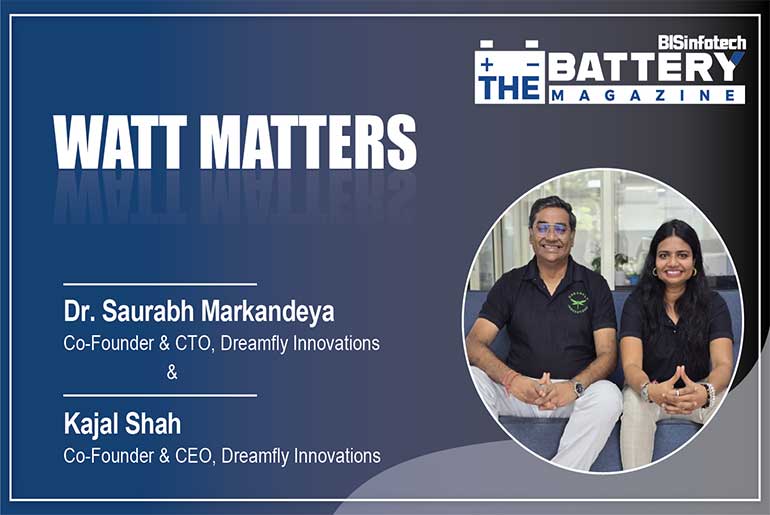
Against this backdrop, Shweta Kumari, Sub-Editor of The Battery Magazine, engaged in an insightful conversation with Kajal Shah, Co-Founder and CEO, and Dr. Saurabh Markandeya, Co-Founder and CTO of Dreamfly Innovations. During the discussion, they shared their perspectives on non-explosive battery architecture, thermal management breakthroughs, intelligent battery safety systems, supply chain localization, and the technological innovations that could shape the future of urban air mobility. Let’s delve deeper into the conversation.
Proprietary Chemistry: Could you explain the specific chemical composition of your “non-explosive” battery? Specifically, how do the solid-state components and graphene integration prevent the internal short-circuiting that typically leads to thermal runaway in lithium-based systems?
At DreamFly Innovations, our “non-explosive” battery architecture is built around a combination of advanced thermal composite materials, graphene-enhanced conductivity pathways, intelligent battery management, and next-generation structural design specifically engineered for high-power drone and urban air mobility applications. Rather than relying only on conventional lithium-ion protection systems, we have developed a multi-layered safety ecosystem that focuses on preventing thermal runaway at its source.
At the core of our technology is a proprietary lightweight composite material system that combines multiple functional materials into a single structure. This material is engineered to absorb heat from the cells at extremely high speeds, distribute it uniformly across the battery pack, and dissipate it efficiently through the battery surface before dangerous hotspots can develop. Since localised heat buildup is one of the primary causes of internal short-circuiting and thermal runaway in lithium-based batteries, managing heat at the source becomes critical for ensuring battery safety.
We have also integrated graphene-enhanced thermal pathways within our battery structure to significantly improve thermal conductivity and heat spreading. Graphene enables heat to move rapidly away from stressed cells, preventing concentrated thermal accumulation inside the pack during high-discharge aerospace operations. Its mechanical flexibility also helps accommodate electrode expansion and contraction during charging and discharging cycles, reducing the probability of internal short circuits forming within the cell architecture.
Another important layer of protection is our intelligent Battery Management System (BMS). Our BMS continuously monitors battery behaviour at an individual cell level using real-time analytics and predictive diagnostics. If the system identifies a cell that is underperforming or showing early signs of failure, our proprietary gallium nitride-based controller can actively isolate that specific cell or cell stack before the issue propagates across the entire battery pack. This is a major technological difference because most conventional systems can predict failures, but they cannot implement real-time isolation during operation.
In addition to predictive electronics, we have engineered the battery structure itself to prevent cell-to-cell fire propagation. We use lightweight, high-temperature-resistant materials such as ceramic fibres, epoxy composites, mica-based barriers, and honeycomb structures that can contain thermal events within an individual module. Even in the unlikely event of a cell entering thermal runaway, the flames remain contained and do not spread to neighbouring cells or escape the outer battery enclosure.
Our overall philosophy is what we call a “Safety-First” battery architecture — combining intelligent predictive control with passive thermal containment. As drone logistics and urban air mobility systems begin operating over densely populated cities, we believe non-explosive battery systems with multiple layers of redundancy will become a non-negotiable industry requirement.
Thermal Extremes: DFI batteries are rated to operate from what unique structural or material innovations allow the cells to maintain voltage stability at such low temperatures without the need for energy-draining internal heaters?
DreamFly innovations primarily make high-performance drone batteries, which are high in power and lighter in weight, that is, high power density batteries. Now, these batteries typically produce 10 times more heat as compared to general electric vehicle batteries, and that is what is one of the major challenges to make these batteries operate safely and consistently without adding significant weight. Dreamfly innovations have done deep material innovation to develop new innovative structural materials which not only provide the necessary strength to the battery structure but also help us conserve and manage very high heat fluxes, which are, as I mentioned, 10x as compared to electric vehicles.
So, this particular material they are specialized in absorbing heat from the cells at a very fast rate, distributing, and finally reject from the surface. The most significant achievement is that we are able to manage 10x heat with just 3% of the weight addition. That is where our Dreamfly innovations, material innovations, make such a huge difference, making our batteries globally power dense.
This thermal composite material enables batteries to operate at both temperatures, extreme temperature ends, whether it is at very low temperatures of let us say around minus 40 degrees of Leh Ladakh, to plus 55 degrees, which we typically seen in Rajasthan. In case of subzero temperatures, it conserves the heat, ensures that the heat is distributed across the battery pack, enabling equalized temperatures across the batteries. At very high temperatures, whatever heat is generated from the battery cells, it is able to absorb them at a very fast rate, distribute them so that the overall net temperature rise is maintained well below 10 degrees even at very high C discharge rates.
So, this material innovation is the core which enables cells to operate beyond their temperature ranges without requiring any active cooling device or heat rejection device.
Thermal Management: You have noted a 20°C reduction in operating temperatures compared to traditional packs. Can you detail the heat dissipation mechanism within your battery architecture that achieves this?
The material innovation is the core here. As explained for high power density batteries that are utilised for drones, they produce a huge amount of heat, and for operating conditions or operating environments like India, typically more than 80% of the year, the temperatures are about 30 to 45 degrees in that particular range. When it comes to high power density batteries, they are sensitive at higher temperatures, and that is why it is very important to manage these temperatures as well as ensure that during the whole mission time, the batteries do not cross their upper extreme limit.
The way Dreamfly innovations have tackled this issue is by developing a single composite material, which is a mixture of four different materials, enabling multiple mechanisms which is difficult to be done with a single material. and this is one of the ways that we are conserving on a weight addition, as we know that these batteries needs to be as light weight as possible. The way this mechanism works is the material can absorb the heat from the cell at the same rate at which it is produced, so it absorbs the heat generated very fast, does not allow cells to rise their temperature, and at the same time it is also distributing that heat across the battery structure, bringing it onto the surface of the battery which in turn is transferred to air flowing around these batteries.
BMS and Urban Safety: For drone logistics in high-density cities, “predictive safety” is vital. How does your Battery Management System (BMS) utilise real-time data to identify and isolate a failing cell before it compromises the entire pack?
Air urban mobility is the new era for humanity. The kind of internet revolution happened in humanity. The air mobility and the space mobility are going to be that new era on rise for humanity. So, air mobility is very important, and the most important aspect of this air mobility is that it should be sustainable at source. Definitely, you are not going to use fuel guzzling engines polluting the air,. And battery packs with high-power- and lightweight batteries become one of the major contenders for powering such urban air mobility.
Now, considering that these are aeroplanes, they are going to carry four to eight passengers flying above highly populated, highly dense cities. One of the major factors in terms of the safety of this passenger is that we should have batteries which are guaranteed non-explosive in their architecture. This is one of the most important requirements. And the first step to make these batteries safe is to be able to predict how the batteries are performing at a granular level, at a cell level. You should be able to capture the granular data and predict how the cells are performing and which are those cells are underperforming as compared to other cells. Today smart battery management systems utilise cloud-based digital twin battery technologies to identify granular failures at early stages.
However, they are limited capability to implement such actions in terms of isolating such failing cells or cell stacks. And this is where Dreamfly Innovations is developing one-of-a-kind gallium nitrate-based semiconductor chip, which enables a battery management system to isolate these failing cells or a failing stack of cells, thereby eliminating the possibility of fire incidence during critical flight mission. And this is the fundamental technological difference that we are bringing in terms of the battery management system and GaN based Battery controller, we call it as Param battery controller.
We are now enabling battery systems not just to predict that the cell is going to fail, but also give them the necessary capability to implement required control action, isolate these granular cells which are failing and ensure that as a whole battery pack continues to power up the aircraft and enable the passengers to land safely. This is mandatory compliance requirement as we have understood, based on ESA and FAA norms, that we need systematic redundancy in the propulsion system. And Dreamfly Innovations Param battery controller is the first step in achieving a systematic active redundancy in the battery packs that are required for advanced urban air mobility.
Weight vs. Safety Trade-off: Increasing safety often increases weight. How has DFI managed to keep energy density high enough for mission-critical aerospace work while adding the necessary physical protection that make the battery “non-explosive”?
Managing safety by adding weight, thereby penalizing the aircraft in terms of its flight time and capability to carry loads, is one of the major challenges, right? I mean, we cannot afford to add a lot of weight when we are making battery safe. And this is where, not just at a material level, you have to develop various types of innovative materials which can manage this kind of thermal management.
you need to build very lightweight fire-resistant materials wherein even if there is one cell that undergoes thermal runaway, the material should be capable of containing that fire within the cell module without making it propagate to the neighboring cells, which is one requirement. The second requirement is that it should ensure that the fire does not exit the battery pack system. So we need to staisfy these two requirements.
One is cell-to-cell propagation. How do you inhibit that through lightweight material innovation? And the second one is ensuring that the battery pack casing material is also lightweight and capable of ontaining the flame within the case so that the flame does not exist and damage the other surrounding aircraft components.
Towards fire safety, Dreamfly Innovations is also building innovative materials, innovative composites using various materials like epoxy, honeycombs or ceramic fibre generated high temperature materials, which are light in weight but are also very high temperature resistant. So they can withstand battery fires for,about one hour, which is required.
So utilising these materials in a very optimised weight manner and combination enables us to build very innovative battery structures which are not just lightweight but are also resistant to temperature, fire incidents, and explosions that typically have marred the drone battery industry. So, as a Dreamfly Innovation, we have two approaches. Number one, utilise our super intelligent battery management system i.e. param controller, enabling the intelligent battery controller to identify failing cells and ensure that they don’t fail at all.
But in case that particular first level of safety fails, then we have built in a second level of safety within the battery structure, which enables that even if one of the cells goes into thermal runaway, it does not allow the flame to propagate to all the neighbouring cells as well as the fire to exit the battery case. You just see a digital alarm saying that there is a critical safety issue with the battery, and the pilot gets necessary time and battery power to land safely with passengers.
Supply Chain Localisation: Moving away from import dependency is a major theme for India. How is DFI scaling its Bengaluru facility to ensure a consistent supply of aerospace-grade cells for domestic giants like Tata and L&T?
Supply chain localisation for such high-power cells is definitely one of the major challenges. As a company, we have been mainly working with some of the leading cell technology companies across the world, ensuring that our customers are able to build drones and air taxis which have state-of-the-art performance and can compete with the global players. So as a company, strategically we are not just looking at localisation, but we are focusing on working with state-of-the-art battery technologies and make it available to our local customers like Tata’s and L&T’s.
In terms of localisation, we have already started engaging with almost every cell manufacturer in India, trying to see how we can collaborate with them for the advanced cell chemistries and as the Indian local ecosystem gathers the necessary momentum we will be able to adopt these locally manufactured cells and make batteries and supply state-of-the-art air mobility battery packs which are 100% made in India by Dreamfly Innovations for the world.
Field Validation: Beyond laboratory conditions, what specific performance data can you share from your precision agriculture or surveillance trials that prove your batteries last longer under high-cycle stress?
Dreamfly Innovations has deployed more than 4,500 batteries in the last two years, catering for a wide range of drone segments, starting from agricultural, terrain mapping, logistics, defence, surveillance drone. And have a very strong performance and reliability record. Today Dreamfly Innovations is the only most reliable battery pack on which drone pilots and customers believe for all the critical missions. Dreamfly Innovations has definitely done a lot of third -party validations in terms of performance, in terms of reliability, extreme temperature operations, and extreme vibration capability.
But ultimately, we believe the on -field number of flight hours that our batteries are the real evidence of the reliability of DreamFly Innovation’s batteries. With our batteries, we have covered more than 1,00,000 flying hours across Indian terrain. across various drone segments, as I just mentioned. And this is one of the major key achievements for Dreamfly Innovation’s EIONIC drone battery brand.
Future of UAM: As we look toward Urban Air Mobility (UAM), what role will “Safety-First” battery certification play in convincing regulators to allow heavy-lift drone corridors over populated Indian metros?
Battery safety is non-negotiable. I mean, it’s not just about urban air mobility or air taxi applications, but even in general for drone applications, we see that safety is the most important aspect of any battery. So, safety first should be the case and a non-negotiable case for batteries. In terms of regulations, definitely the way forward is to adopt policy similar to AIS-156 which has been brought into the picture for electric mobility for ensure passengers safety., I think to the extent, the capability of fire propagation resistance and various other control systems are one of the major core factors for the drone batteries as we go forward. So, definitely there has to be a technological advancements in the cell chemistry, thermal-electrical-mechanical packaging and battery management systems. All these three technological verticals have to evolve to ensure that drone batteries become, safety-first.
 Electrify your feed! Click here to join our Whatsapp group and to get the latest updates, expert insights, and innovations driving India’s energy storage revolution.