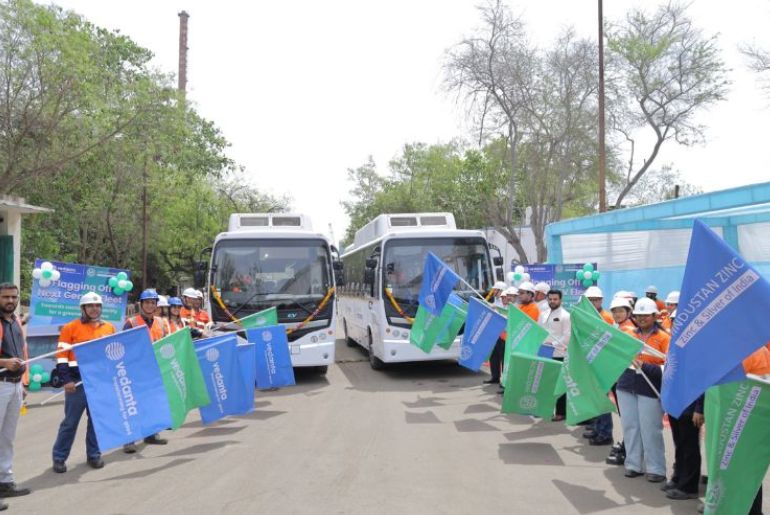
Hindustan Zinc Limited has flagged off Rajasthan’s first and largest electric bus fleet for employee transportation at its Zinc Smelter Debari unit in Udaipur, in partnership with Enviiiro Wheels Mobility Pvt. Ltd. The initiative marks a significant milestone in the company’s green mobility journey and reflects its commitment to embedding sustainability into core operations.
This deployment is part of a larger plan to put 41 electric buses into service at Hindustan Zinc’s operations in Rajasthan. The company is switching from diesel-powered transport to electric mobility to cut down on indirect emissions throughout its value chain and make getting to work less carbon-intensive.
Reducing Emissions and Supporting Net Zero Goals
The transition to electric buses by Hindustan Zinc is expected to mitigate over 11,000 tonnes of CO₂ equivalent emissions over the contract tenure. This step helps Hindustan Zinc reach its bigger sustainability goals, such as cutting Scope 3 emissions by 25% and reaching net zero emissions by 2050 or sooner.
The rollout at Zinc Smelter Debari is a real step toward making climate promises a reality, and it shows how the company is making decarbonisation a part of its daily operations.
Leadership Perspective on Decarbonisation
Speaking on the occasion, Arun Misra, CEO, Hindustan Zinc, said, “The introduction of electric buses for employee transport is a step towards decarbonizing our value chain, advancing our Net Zero ambition for 2050 or earlier, and building a future-ready mining ecosystem.”
He further highlighted that the company’s transition to sustainable mobility reflects a broader shift in industrial growth, where climate responsibility is embedded into operational strategies and aligned with global sustainability frameworks.
Aligned with Global Sustainability Frameworks
Hindustan Zinc’s work is in line with its commitments that have been approved by the Science Based Targets initiative (SBTi) and its membership in the International Council on Mining and Metals (ICMM). By including sustainability in its long-term business plan, the company is still a leader in climate action.
Over the years, Hindustan Zinc has implemented a comprehensive programme focused on enhancing energy efficiency, reducing its carbon footprint, and accelerating the adoption of clean energy. Renewable energy now contributes nearly 18% of its total power mix.
A key milestone in this transition is the company’s 530 MW round-the-clock renewable energy power delivery agreement, which is expected to meet over 70% of its total power requirement. The initial supply of renewable energy under this agreement has already commenced in the previous fiscal year.
Driving a Future-Ready Mining Ecosystem
Hindustan Zinc is moving closer to its goal of a low-carbon mining ecosystem that is ready for the future by adding electric buses and continuing to invest in clean energy. The project shows that the company is committed to environmentally friendly business practices and helps India reach its larger goals of reducing carbon emissions and moving to cleaner energy sources.
 Electrify your feed! Click here to join our Whatsapp group and to get the latest updates, expert insights, and innovations driving India’s energy storage revolution.