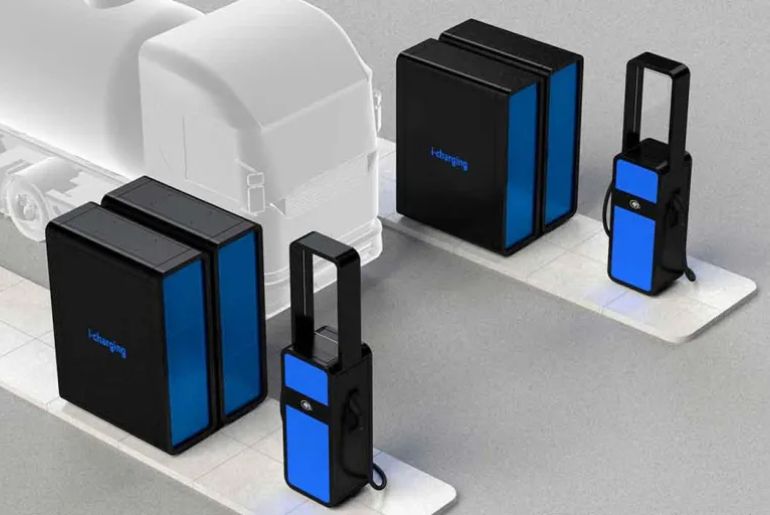
i-charging, a recognised leader in EV charging infrastructure, has expanded its charging ecosystem with MAX, a 1.6 MW modular charging power unit engineered to solve a challenge facing infrastructure
operators: building for tomorrow without locking into fixed decisions today.
MAX addresses critical site constraints (limited space, grid capacity, and layout flexibility) whilst integrating seamlessly with i-charging’s existing user interface portfolio to support installations ranging from mixed urban fleets to MW-scale public charging corridors. This new solution adapts as businesses evolve, without requiring infrastructure replacement when operational needs change.
Infrastructure challenge MAX addresses
Traditional high power charging solutions require operators to make critical decisions upfront: total power capacity, charging standards (CCS, NACS, GB/T, MCS), number of outputs, and interface configurations. When fleet composition changes, vehicle capabilities advance, or business models shift, traditional, infrastructure requires replacement or limits operational flexibility.
“In the past seven years we’ve been listening to operators describe this challenge”, said Pedro Silva, CEO of i-charging. “They need infrastructure today, but their business will evolve. Fleet composition changes. New vehicle technologies will emerge. MAX was designed around a simple principle: your infrastructure should grow with your operation, not constrain it.”
MAX provides minimal AC power distribution investment compared to a system with 8 stand-alone units, each AC powered. And the patented dynamic allocation delivers optimal use of the installed capacity eliminating the over dimensioning of those stand-alone units. Besides, each output has access to the MAX power conversion pool, so giving redundancy for each output.
Right-sized infrastructure that scales
MAX’s modular architecture enables operators to deploy exactly the capacity their operation requires today and scale to 1.6 MW as demand grows. Power expands in 50 kW increments without replacing core systems, new outputs can be added, different charging standards can be mixed, and user interface configurations can be changed to match operational context.
This modular approach enables operators to align infrastructure investment with demand growth.
Future-proof investment: MCS-ready, today
As charging standards evolve, from CCS, NACS and GB/T for light and heavy-duty fleets to emerging MCS for heavy commercial vehicles, operators face a dilemma: invest in today’s requirements and risk obsolescence or overinvest in future-proof capacity that sits underutilised.
MAX’s modular architecture eliminates this choice. It supports CCS, NACS and GB/T connectors today whilst accommodating MCS integration as heavy-duty vehicles adopt it. Operators can deploy mixed configurations serving vehicles via CCS alongside heavy-duty trucks via MCS from a single power cabinet, with the flexibility to adjust output configurations as fleet composition evolves.
For public hub operators managing diverse vehicle types, this flexibility proves essential. A single MAX installation can serve passenger vehicles, delivery vans, and electric trucks simultaneously, with the ability to reconfigure user interface types and connector standards without replacing power infrastructure. Public transport operators can integrate pantograph charging systems for electric bus operations within the same platform.
Interface options to each operational context
MAX’s modular architecture supports multiple user interface configurations to match different operational requirements:
For public charging hubs: MAX connects up to four blueberry units (each with two outputs) featuring 32″ displays, automatic cable management, and intuitive interfaces that reduce support requirements.
For fleet depots: It is possible to use the e-flow control systems, managing up to four satellites each, either blueberry or i-light, providing centralised management with minimal equipment footprint.
For heavy-duty operations: can deploy up to eight i-light units (CCS or MCS, one output each) featuring 37″ transparent displays. The transparent display technology, combined with up to 1.6 MW per MCS output, addresses the specific requirements of commercial vehicle operations.
Mixed configurations: supported within single installations. Public hubs serving both passenger vehicles and abige blueberry units with i-light units. Fleet operato Page 3 vins to heavier@chicts can add i-light outputs to existing blueberry infrastructure without replacing the power unit.This flexibility means infrastructure investments support business evolution rather than constraining operational decisions.
Dynamic power allocation
MAX incorporates i-charging’s patented dynamic power allocation technology, the same innovation deployed in the company’s solutions serving 36 countries worldwide.
Rather than dedicating fixed power to each output, which creates bottlenecks when some vehicles require maximum power whilst others charge slowly, MAX distributes 1.6 MW intelligently across up to eight vehicles based on real-time demand.
Rather than dedicating fixed power to each output, MAX distributes 1.6 MW intelligently across up to eight vehicles based on real-time demand. The system automatically adapts power distribution based on the number of vehicles charging and individual vehicle charging capabilities, eliminating the need for manual intervention. For fleet operators, the dynamic allocation enables faster vehicle turnaround and maximised infrastructure utilisation. Public hub operators benefit from improved customer experience and increased revenue per installed kilowatt.
Proven technology, new scale
MAX represents the evolution of technology i-charging has deployed successfully worldwide:
- 36 countries across six continents
- 60+ customers and partners including major CPOs, utilities, and fleet operators
The solution builds on seven years of operational learning, incorporating lessons From real-world deployments in diverse climatic conditions, regulatory environments, and use cases.
MAX was designed, engineered, and manufactured by i-charging, maintaining the same quality standards that earned the company ISO 9001, ISO 14001, and ISO 45001 certifications for quality management, environmental stewardship, and occupational health and safety.
Deployment timeline and early adopter programme
First contracted deliveries of MAX are scheduled to begin in Q3 2026. i-charging is currently working with early adopters to finalise deployment specifications and secure installation slots.
Information about deployment specifications and installation timelines is available from i-charging at www.i-charging.tech/meetmax.
Technical specifications summary
Power and performance
- Maximum Power: 1.6 MW, scalable in 50 kW increments
- Voltage: 1000 V
- Efficiency: 97% system efficiency
- Maximum Outputs: Up to 8 vehicles simultaneously
Charging standards and capabilities
- Standards Supported: CCS, NACS, GB/T, MCS (when IEC standard is published), pantograph
- Current Capabilities: Up to 800 A (CCS, liquid-cooled), up to 1500 A (MCS)
- Operating Temperature: -35 °C to +50 °C (-31 °F to 122 °F)
- Environmental Rating: IP55, IK10
- Connectivity: OCPP 1.6 and 2.0.1
- Certifications: ISO 9001, ISO 14001, ISO 45001 manufacturing standards
 Electrify your feed! Click here to join our Whatsapp group and to get the latest updates, expert insights, and innovations driving India’s energy storage revolution.