

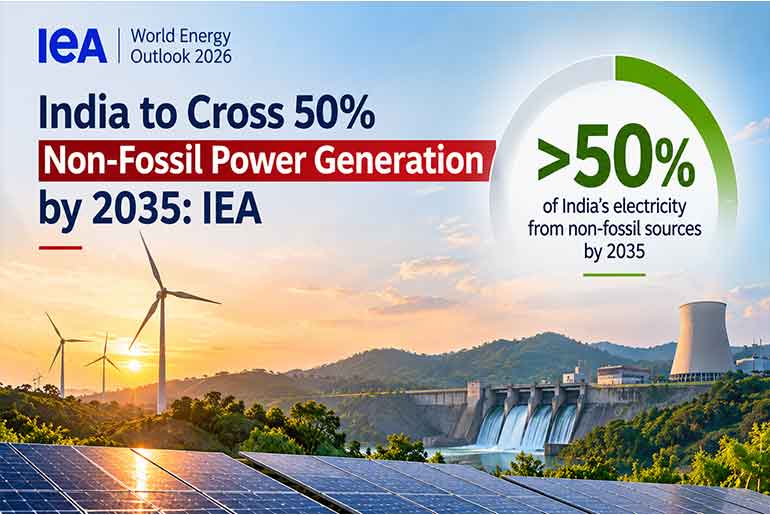
India is projected to generate more than half of its electricity from non-fossil fuel sources by 2035, as renewable energy deployment, hydropower and nuclear generation reshape the country’s power mix. The projection comes from the International Energy Agency’s (IEA) World Energy Outlook 2026, which highlights India’s growing electricity requirements and the increasing role of domestic clean-energy sources in meeting future demand.
Under the IEA’s Stated Policies Scenario (STEPS), India’s electricity demand is expected to grow by approximately 6% annually through 2035. The projection is supported by an anticipated average annual economic growth rate of 6.2% over the next decade. As industrial activity, urbanisation, electrification and household electricity consumption expand, the country will require substantial additions to its power generation and transmission infrastructure.
The report identifies India, alongside Southeast Asia, as a major contributor to global primary energy demand growth. Together, the two regions are expected to account for 45% of the increase in global primary energy demand by 2035.
Solar and Hydropower Strengthen India’s Power Mix
India’s expanding non-fossil generation base is already influencing its emissions trajectory. According to the IEA, increased solar photovoltaic (PV) installations, strong hydropower generation and lower coal consumption helped keep the country’s energy-related carbon dioxide emissions flat in 2025.
Solar energy is expected to remain an important contributor to this transition. The IEA’s separate India Renewable Energy Market Report 2026 projects renewable electricity generation to nearly double by 2030, reaching approximately 950 terawatt-hours (TWh). Renewables are forecast to account for around 35% of India’s total electricity generation by then, with solar PV contributing the largest share of additional generation.
The report also highlights the growing importance of green hydrogen and its derivatives. India is pursuing domestic green ammonia procurement for the fertiliser sector under the National Green Hydrogen Mission, with the objective of reducing dependence on imported fuels and supporting domestic clean-energy supply chains.
Electric mobility is another area witnessing rapid expansion. The IEA noted that electric car sales in India increased by approximately 120% between March and September 2026 compared with the corresponding period in 2025.
Investment and Grid Infrastructure Remain Critical
The transition towards a higher share of non-fossil electricity will require investment beyond generation capacity. Transmission networks, energy storage and system flexibility will become increasingly important as variable renewable sources account for a larger proportion of electricity supply.
The IEA estimates that supporting the global expansion of electricity systems will require at least 25 million kilometres of new power lines and 15 million kilometres of grid upgrades over the next decade. The agency also highlighted the need to strengthen domestic supply chains and avoid replacing dependence on imported fossil fuels with new technology and critical mineral dependencies.
Under the IEA’s Current Policies Scenario, India is also expected to emerge as the fastest-growing major destination for energy investment, with investment projected to rise by 85% by 2035 compared with 2025 levels. This outlook highlights the growing importance of sustained investment in strengthening India’s energy infrastructure as its electricity requirements continue to expand.
The IEA projections indicate that non-fossil sources will account for more than half of India’s electricity generation by 2035. Achieving this transition, however, will depend on sustained investment in renewable generation, energy storage, transmission infrastructure and technologies that can maintain grid reliability as electricity demand continues to rise.
 Electrify your feed! Click here to join our Whatsapp group and to get the latest updates, expert insights, and innovations driving India’s energy storage revolution.