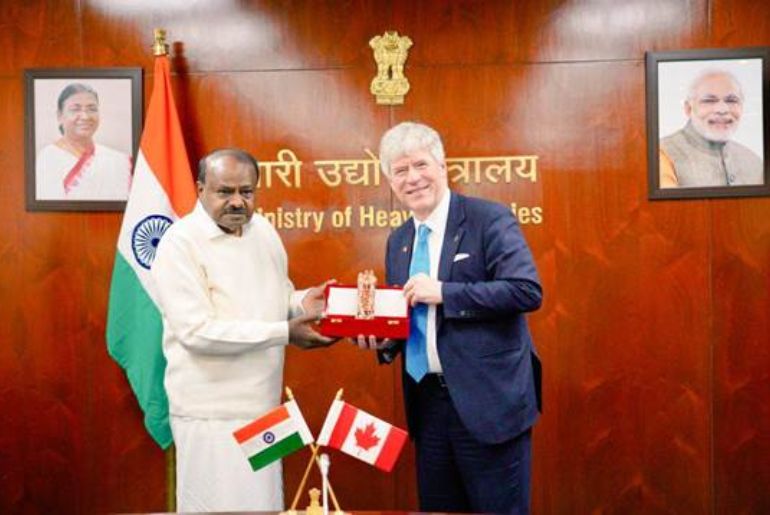
Under the leadership of Prime Minister Narendra Modi and aligned with the national vision of Viksit Bharat@2047 and India’s Net Zero by 2070 goal, Union Minister for Heavy Industries and Steel H.D. Kumaraswamy held a high-level bilateral meeting with a Canadian delegation led by “H.E. Mr. Tim Hodgson, Minister of Natural Resources, Canada,” at Udyog Bhawan, New Delhi.
The meeting focused on deepening cooperation in critical minerals, clean mobility, advanced manufacturing, and sustainable industrial development, reflecting India’s push to build resilient and future-ready industrial ecosystems.
Focus on Sustainable Growth and Manufacturing
Welcoming the Canadian delegation, H.D. Kumaraswamy highlighted the strategic importance of India–Canada collaboration in emerging technologies.
Referring to the Prime Minister’s vision, H.D. Kumaraswamy said, “Prime Minister Narendra Modi has articulated the vision of Viksit Bharat@2047 and Net Zero by 2070. The automotive, heavy electrical, and capital goods sectors are key pillars supporting this sustainable growth trajectory.”
He underlined India’s strong position in the global automobile sector, noting that the country ranks among the world’s leading manufacturers of passenger vehicles, commercial vehicles, heavy trucks, and two- and three-wheelers.
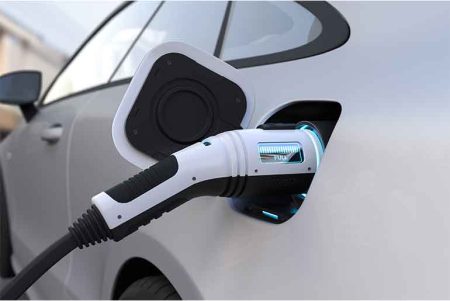
Highlighting India’s EV progress, the Minister stated, “Being among the world’s leading automobile manufacturers, India has witnessed rapid adoption of electric vehicles through the FAME-II Scheme, which supported over 16 lakh electric vehicles and enabled the creation of more than 10,900 public charging stations nationwide.”
EV Push and Battery Ecosystem
The Minister also spoke about flagship initiatives such as PM E-DRIVE and PM e-Bus Sewa, which support electric two-wheelers, three-wheelers, buses, e-trucks, charging infrastructure, and testing facilities.
“Through these initiatives, we are strengthening our domestic manufacturing capabilities and ensuring that our products meet global safety and performance standards,” he added.
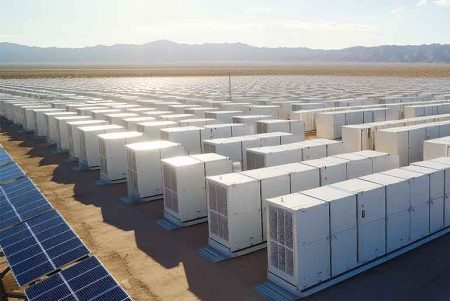
A key discussion area was battery manufacturing and access to critical minerals. Kumaraswamy said, “India has launched an ambitious incentive programme of nearly US$ 2 billion to create indigenous capability in Advanced Chemistry Cells.”
He welcomed Canada’s strengths in critical mineral availability and processing, calling it an opportunity to build resilient supply chains.
He also noted that NMDC is exploring coal reserves in Canada to support India’s steel sector and long-term energy security.
Canadian Perspective and Collaboration Areas
Minister Tim Hodgson commended the progress made by India in clean mobility and innovation, saying that “India is a leader in battery technologies globally.” He also stated that Canada is ready to share its latest battery technologies with India, which requires lithium, cobalt, graphite, and rare earth elements.
Key Areas of Cooperation Discussed:
- Battery cell and component manufacturing
- Next-generation battery R&D
- Critical mineral supply chains
- Testing and certification infrastructure
- Clean mobility solutions
- Sustainable manufacturing processes
Senior officials from the Ministries of Heavy Industries, Steel, External Affairs, NMDC, BHEL, and the Canadian delegation participated, reflecting strong institutional commitment.
Concluding the meeting, Kumaraswamy said, “Together, these initiatives are building a clean, resilient, and self-reliant automotive ecosystem, positioning India as a global hub for sustainable mobility.”
Both sides agreed to continue structured follow-ups and industry-level engagements to convert discussions into concrete partnerships.
 Electrify your feed! Click here to join our Whatsapp group and to get the latest updates, expert insights, and innovations driving India’s energy storage revolution.