Close Menu
The Battery MagazineThe Battery Magazine
  • Just In
  • Batteries
    • Battery Manufacturing (BESS)
    • Battery Materials & Chemistries
    • Battery Recycling
    • C&I Storage
  • Solar
  • Renewable energy
    • Wind Energy
    • Hydropower
    • Green Hydrogen
    • Bioenergy
  • Tenders
    • Energy Storage
    • Solar Energy
    • Wind Energy
  • Policy
    • Storage
    • Solar
    • Wind
    • EV
    • Transmission
  • EV
    • EV Batteries
    • EV Charging Infrastructure
    • Electric Mobility Trends
  • Grid
    • Transmission & Distribution
    • Grid Infrastructure
    • Power Generation
    • Power Equipments
  • Exclusive
    • Cover Story
    • Watt Matters
    • Perspective
    • Articles
  • More
    • E-Mag
    • Events
    • Contact Us
Facebook LinkedIn WhatsApp
The Battery MagazineThe Battery Magazine
  • Just In
  • Batteries
    • Battery Manufacturing (BESS)
    • Battery Materials & Chemistries
    • Battery Recycling
    • C&I Storage
  • Solar
  • Renewable energy
    • Wind Energy
    • Hydropower
    • Green Hydrogen
    • Bioenergy
  • Tenders
    • Energy Storage
    • Solar Energy
    • Wind Energy
  • Policy
    • Storage
    • Solar
    • Wind
    • EV
    • Transmission
  • EV
    • EV Batteries
    • EV Charging Infrastructure
    • Electric Mobility Trends
  • Grid
    • Transmission & Distribution
    • Grid Infrastructure
    • Power Generation
    • Power Equipments
  • Exclusive
    • Cover Story
    • Watt Matters
    • Perspective
    • Articles
  • More
    • E-Mag
    • Events
    • Contact Us
LinkedIn Facebook WhatsApp YouTube
The Battery MagazineThe Battery Magazine
Home » Batteries » India’s Battery Manufacturing Push Faces Major Shortfalls, Report Finds
Batteries

India’s Battery Manufacturing Push Faces Major Shortfalls, Report Finds

ManshiBy ManshiJanuary 22, 20262 Mins Read
Facebook Twitter LinkedIn WhatsApp
India’s Battery Manufacturing Push Faces Major Shortfalls, Report Finds

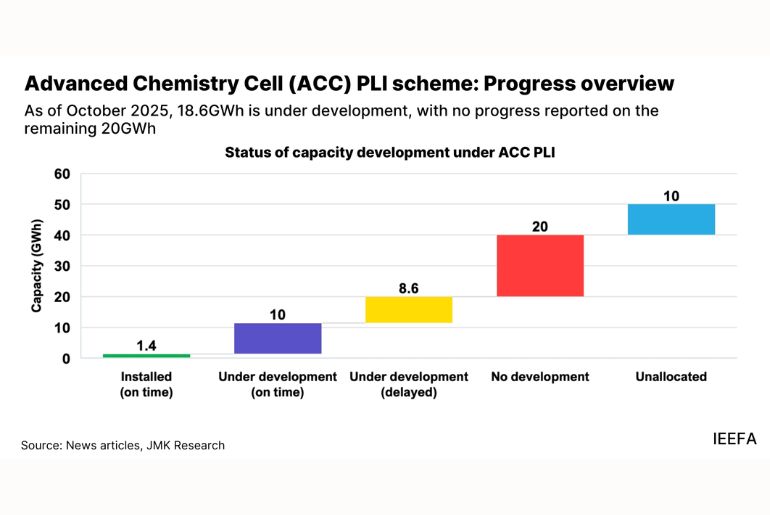
India’s ambitious plan to become a global leader in battery manufacturing is facing a reality check. A new report by JMK Research and the Institute for Energy Economics and Financial Analysis (IEEFA) reveals that the Advanced Chemistry Cell (ACC) Production Linked Incentive (PLI) scheme has significantly missed its early targets.

Launched in 2021 with a massive budget of INR 181 billion ($2.08 billion), the program aimed to set up 50 gigawatt hours (GWh) of domestic battery capacity by 2025. However, as of October 2025, only 2.8% (1.4 GWh) of that goal has been met all of it by a single company, Ola Electric.

Wide Gaps in Jobs and Investment

The report highlights a staggering difference between the government’s original goals and what has actually happened on the ground:

  • Jobs: While the scheme hoped to create over 1 million jobs, only 1,118 positions (just 0.12% of the target) have been filled.
  • Investment: Only INR 28.7 billion ($330 million) has been committed so far, covering about a quarter of the expected investment.
  • Incentives: To date, no financial rewards have been paid out because the strict production milestones have not been reached.

Prabhakar Sharma, a senior consultant at JMK Research, noted that India still depends on imports for nearly 100% of its battery cells. He warned that “on-ground progress remained sluggish” despite strong initial interest from businesses.

Why is Progress Slow?

The study identifies several “bottlenecks,” including a lack of prior expertise among some selected firms. Interestingly, established battery giants like Exide and Amara Raja did not qualify for the scheme because the rules favored new entrants promising higher local content and lower subsidies.

Additionally, major players have scaled back. Ola Electric has reduced its immediate expansion plans, and while Reliance New Energy expects to finish its first phase on time, other projects remain delayed.

The Path Forward

To get the scheme back on track, experts suggest India must focus on more than just subsidies. The report recommends:

  • Building better testing and certification centers.
  • Creating a dedicated policy for sourcing and refining “critical minerals” like lithium.
  • Attracting global battery experts to help with technology transfers.

Vibhuti Garg, Director at IEEFA, emphasized that bringing in experienced global players would “strengthen capabilities” and help steer the industry in the right direction.

whatsapp icon Electrify your feed! Click here to join our Whatsapp group and to get the latest updates, expert insights, and innovations driving India’s energy storage revolution.
battery cells battery manufacturing global battery new energy Ola Electric
Manshi
  • Website

I'm journalism graduate with professional experience working across different news websites. I have been involved in news reporting, content writing, and digital media coverage, which has helped me develop a strong understanding of current affairs and storytelling. Currently, I am working with Battery Magazine, where I continue to create accurate, engaging, and reader-focused news content.

Keep Reading

NavPrakriti and IIT Kharagpur

NavPrakriti and IIT Kharagpur Partner to Advance Battery Recycling and Critical Mineral Recovery

IIT Guwahati

IIT Guwahati Develops Perovskite Technology Achieving 25.73% Solar Cell Efficiency

India’s Clean Energy Sector

India’s Clean Energy Workforce Grows by 6.6 Lakh, Rooftop Solar Leads Job Creation

Comments are closed.

Renewable energy
IIT Guwahati

IIT Guwahati Develops Perovskite Technology Achieving 25.73% Solar Cell Efficiency

June 4, 2026
India’s Clean Energy Sector

India’s Clean Energy Workforce Grows by 6.6 Lakh, Rooftop Solar Leads Job Creation

June 4, 2026
SJVN Flags

SJVN Flags Renewable Power Demand Gap Amid Rising Capacity Additions

June 4, 2026
Kyro Capital

Kyro Capital Launches ₹100 Crore Pre-IPO Fund Targeting Renewable Energy and Growth Sectors

June 3, 2026
Batteries
NavPrakriti and IIT Kharagpur

NavPrakriti and IIT Kharagpur Partner to Advance Battery Recycling and Critical Mineral Recovery

June 4, 2026
Advait Energy Secures 150 MW/300 MWh BESS Project from GUVNL

Advait Energy Secures 150 MW/300 MWh BESS Project from GUVNL

June 4, 2026
cylib and Vianode

cylib and Vianode Partner to Advance Recycled Graphite for EV Batteries

June 4, 2026
Trina Storage

Trina Storage Wins 160 MWh Ultra-High Voltage Battery Project in Japan’s Kyushu Region

June 3, 2026

Subscribe for Updates

Get the latest news about energy storage in your inbox.

    © 2026 Thebatterymagazine.com.
    • Home
    • About Us
    • Contact Us
    • Privacy Policy
    • Terms of Service

    Type above and press Enter to search. Press Esc to cancel.