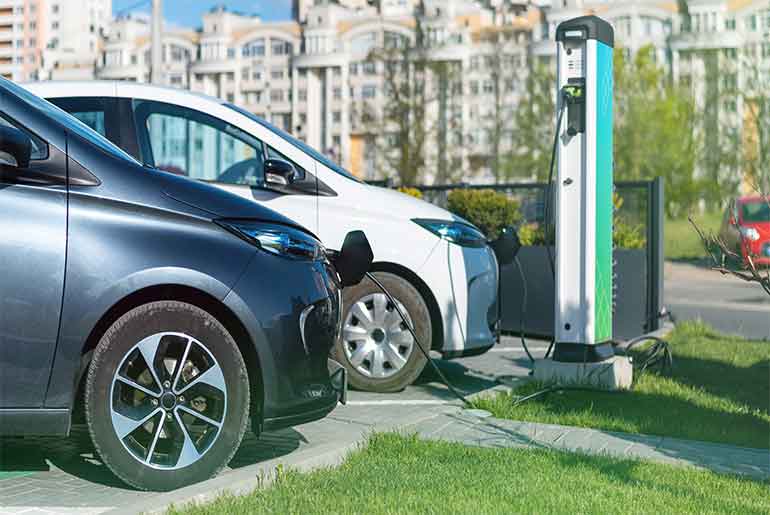
India’s electric-mobility story is no longer only about putting more EVs on the road. The real race is now to build the charging, manufacturing, public-transport and circular-economy systems that can keep those vehicles moving. At a public charging hub in a rapidly expanding Indian city, the electric-mobility transition can look deceptively simple: a scooter plugged in beside a compact electric car, a bus gliding through traffic, a digital display measuring the flow of power. But behind this emerging everyday scene lies a much larger industrial shift. Electric mobility is not merely replacing one kind of vehicle with another. It is asking India to redesign the ecosystem that powers transport. That is why the latest updates from the Ministry of Heavy Industries matter. They show that the India EV Ecosystem is moving beyond the first phase of adoption—where demand incentives did much of the heavy lifting—and into a more demanding phase of execution.
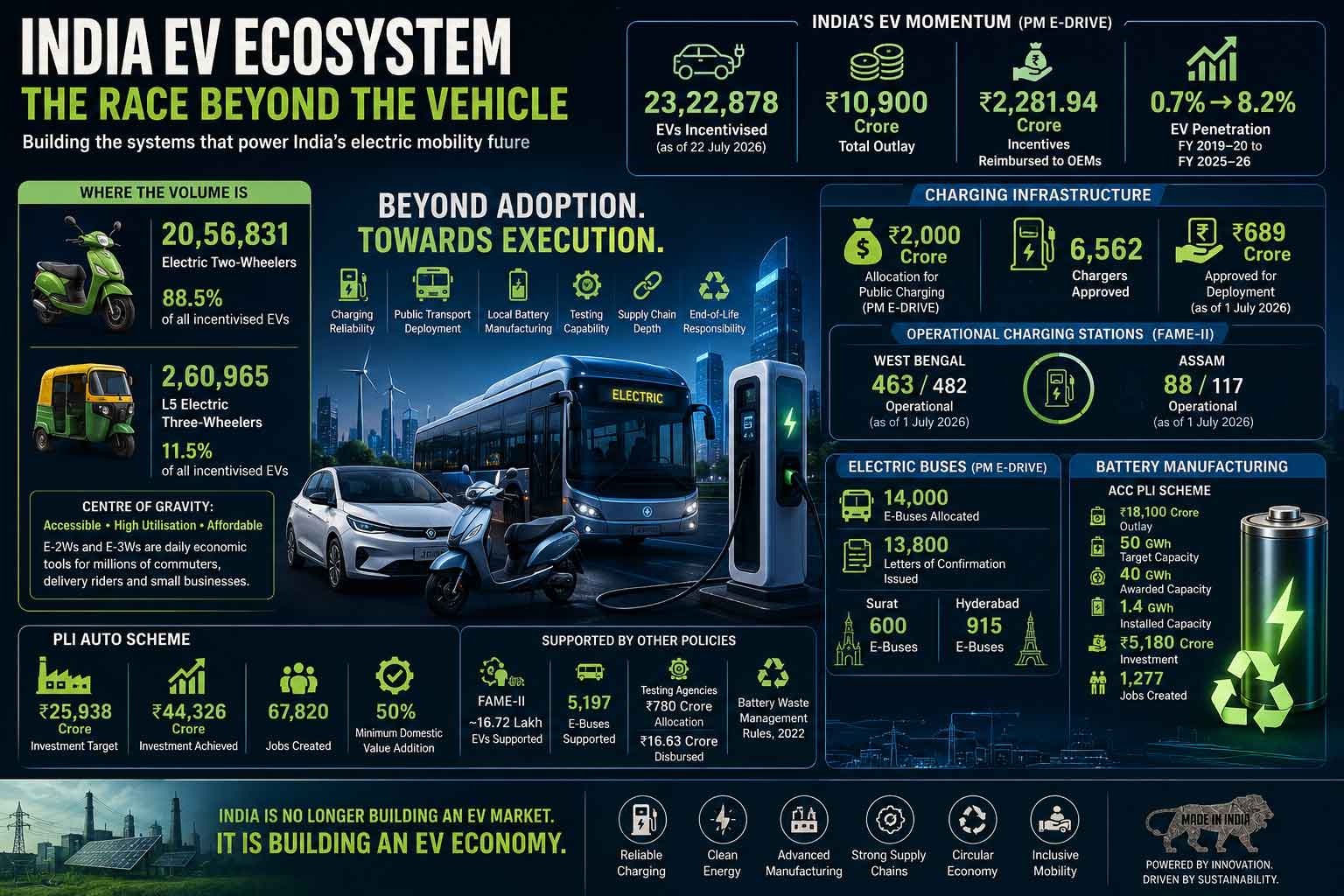
The next chapter will be defined by charging reliability, public-transport deployment, local battery manufacturing, testing capability, supply-chain depth and end-of-life responsibility. The numbers tell an encouraging story. Under the PM Electric Drive Revolution in Innovative Vehicle Enhancement (PM E-DRIVE) Scheme, 23,22,878 electric vehicles had been incentivised as of 22 July 2026. The scheme, with a total outlay of ₹10,900 crore, had reimbursed ₹2,281.94 crore to OEMs. Electric two-wheelers accounted for 20,56,831 of the incentivised vehicles, while L5 electric three-wheelers accounted for 2,60,965 units.
This is the centre of gravity of the India EV Ecosystem: accessible, high-utilisation mobility. The electric two-wheeler is not simply a consumer product; it is a daily economic tool for commuters, delivery riders and small businesses. Likewise, electric three-wheelers are becoming part of the operating infrastructure of urban and semi-urban India. Their economics, usage intensity and comparatively lower charging requirements make them especially important in a market where affordability and availability matter as much as technology.
The government has stated that EV penetration increased from 0.7% in FY 2019–20 to 8.2% in FY 2025–26, supported by PM E-DRIVE, FAME-II and other policies. That rise signals genuine momentum. Yet it also changes the question policymakers and industry leaders must ask. The question is no longer whether India can stimulate EV demand. It is whether the India EV Ecosystem can deliver a dependable ownership and operating experience at scale.
The Charging Test Has Begun
Charging infrastructure is perhaps the most visible expression of that challenge. PM E-DRIVE has allocated ₹2,000 crore for Electric Vehicle Public Charging Stations on a pan-India basis. As of 1 July 2026, ₹689 crore had been approved for the deployment of 6,562 chargers through three oil marketing companies and nine states.
The distinction between approved, installed and operational infrastructure is crucial. Sanctioned chargers demonstrate policy intent; operational chargers create consumer confidence. For a delivery rider, a fleet manager or an intercity traveller, the value of charging infrastructure lies not in an announcement but in whether the charger is available, functioning, interoperable and fairly priced when needed.
That is the practical test for the India EV Ecosystem. Charging cannot be evaluated only through headline counts.
It must be evaluated through uptime, geographic distribution, ease of payment, safety, grid readiness and the ability to serve different vehicle segments. A high-speed corridor charger, a neighbourhood two-wheeler charging point and a depot-scale bus-charging system solve entirely different problems.
The regional data released alongside the national update provides a useful reminder. Under FAME-II, 463 of 482 sanctioned public charging stations were operational in West Bengal as of 1 July 2026. In Assam, 88 of 117 sanctioned charging stations were operational. These are meaningful gains, but they also illustrate why operational status—not merely sanctioned capacity—must become the industry’s preferred measure.
For the India EV Ecosystem, charging will increasingly move from being an infrastructure headline to a service-quality question.
Public Transport Could Change the Scale of the Story
If electric two-wheelers are the volume engine of India’s transition, electric buses could become its most visible proof point. Under PM E-DRIVE, 14,000 e-buses have been allocated. Letters of Confirmation of Quantity have been issued for 13,800 buses, while Surat and Hyderabad have signed concession agreements for 600 and 915 e-buses respectively.
These figures are promising, but they should be read carefully. Allocation is not deployment. Before buses reach passengers, successful bidders must secure prototype approval, complete charging and depot planning, establish operational systems and deploy vehicles. That work is substantial—but it is also where the India EV Ecosystem can show its maturity.
An e-bus programme is never just a vehicle procurement exercise. It requires route planning, duty-cycle analysis, energy scheduling, depot charging, fleet maintenance, driver training and payment security. It demands coordination between city authorities, utilities, operators, OEMs and charging providers. When executed well, it can improve local air quality, reduce noise and make electric mobility tangible to millions of daily passengers.
India’s prior FAME-II programme supported the sale of approximately 16.72 lakh EVs and had deployed 5,197 e-buses as of 30 June 2026. The move from FAME-II to PM E-DRIVE reflects an evolution in policy thinking: the country is no longer building a market from scratch; it is trying to build the systems capable of sustaining it.
Manufacturing Is the Strategic Core
The India EV Ecosystem will ultimately be judged not only by how many vehicles are sold, but by how much value is created within the country. Here, the policy architecture is becoming broader.
The Production Linked Incentive Scheme for Automobile and Auto Components, or PLI-Auto, has a budgetary outlay of ₹25,938 crore. Approved applicants reported investments of ₹44,326 crore as of 31 March 2026, surpassing the scheme’s target investment of ₹42,500 crore by 31 March 2027. The scheme had generated 67,820 jobs, according to the Ministry. It supports Advanced Automotive Technology products, including EVs, while requiring a minimum 50% Domestic Value Addition for incentives.
Battery manufacturing is equally strategic. The ₹18,100 crore PLI scheme for Advanced Chemistry Cell battery storage aims to create a competitive domestic ecosystem for 50 GWh of ACC capacity. Forty GWh has been awarded to four beneficiary firms. A giga-scale ACC manufacturing plant with 1.4 GWh of installed capacity has been established, while the scheme had attracted ₹5,180 crore of investment and 1,277 direct jobs as of 31 May 2026.
These numbers reveal both progress and the scale of the work ahead. The India EV Ecosystem needs more than assembly capacity. It needs dependable access to cells, materials, battery-management systems, power electronics, magnets, testing equipment, software and skilled talent. It also needs suppliers capable of meeting quality, cost and safety expectations at industrial scale.
The government’s Scheme to Promote Manufacturing of Electric Passenger Cars in India adds another layer. Under the scheme, approved applicants must invest at least ₹4,150 crore, make manufacturing facilities operational within three years of approval, achieve 25% domestic value addition by the third year and 50% by the fifth year. The policy is designed to attract global EV manufacturers while pushing localisation forward.
That tension—between attracting global capital and building local capability—will shape the India EV Ecosystem for the rest of the decade.
Safety, Testing and Recycling Cannot Remain Footnotes
The industry’s next phase will also demand more attention to systems that are often less visible than vehicles and chargers. PM E-DRIVE includes ₹780 crore in grants for upgrading automotive testing agencies; ₹16.63 crore had been disbursed as of 20 July 2026. Testing is not a back-office function. It is essential for validating safety, localisation, performance and compliance as technologies evolve.
Similarly, battery recycling must move from a policy reference to a commercially robust operating system. The Battery Waste Management Rules, 2022 provide the environmental framework, but real progress will depend on traceability, collection networks, safe dismantling, material recovery and responsible producer participation. A circular battery economy will be vital if India wants to reduce material risk and create lasting value from EV adoption.
This is where the India EV Ecosystem becomes more than a transport story. It becomes a story about industrial resilience.
The Road Ahead
PM E-DRIVE is scheduled to continue until 31 March 2028, though its individual components have different terminal dates and the programme remains fund-limited within its ₹10,900 crore outlay. The latest updates indicate a clear direction: government support is widening from purchase incentives to the enabling infrastructure around them.
The industry now has a responsibility to match that policy momentum with execution. OEMs must deepen localisation without compromising quality. Charging providers must prioritise reliability over simple charger counts. Utilities must prepare for new load patterns. Cities must build e-bus systems rather than merely procure e-buses. Battery manufacturers must invest in safety, testing and lifecycle management. And recyclers must become an integral part of the value chain, not an afterthought.
India has already demonstrated that it can create demand for electric mobility. The more difficult and more consequential task is now underway: building an India EV Ecosystem that works not only in pilot projects, flagship corridors and major cities, but across daily life.
The next milestone will not be one more incentive, one more vehicle launch or one more charging announcement. It will be the moment when India’s EV transition becomes dependable enough to feel ordinary—and strong enough to last.
Data note: PM E-DRIVE figures are from Ministry of Heavy Industries parliamentary replies dated 28 July 2026 and reflect the dates specified in those replies.
 Electrify your feed! Click here to join our Whatsapp group and to get the latest updates, expert insights, and innovations driving India’s energy storage revolution.