
ICRA stated that India will need to invest nearly ₹1.4 lakh crore in Battery Energy Storage Systems (BESS) by 2030 to support the integration of rising renewable energy into the power grid.
According to ICRA’s December 2025 report titled “INR 1.4 trillion needed to scale up BESS capacity: a must for RE grid integration,” India’s renewable energy (RE) capacity is expected to rise substantially over this decade, with RE, including large hydro, projected to account for about 40% of total electricity generation by FY2030. This expansion, while necessary to meet climate and energy-security goals, brings with it a critical challenge: the variability and intermittency of wind and solar power. Without adequate storage, the grid risks instability and supply-demand mismatches.
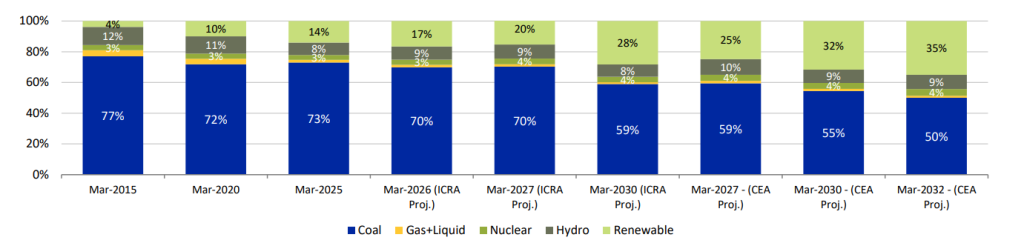
Currently, energy storage deployment in India is driven primarily by battery systems (BESS) and pumped-storage hydropower (PSP). But to absorb the anticipated surge in renewables, ICRA estimates a massive scale-up of BESS infrastructure, hence the ₹1.4 lakh crore investment requirement.
Over the past decade, global battery-pack prices have dropped significantly, improving the economics of BESS and reducing tariffs for standalone storage as well as solar-plus-storage projects. For instance, for 2- to 4-hour storage configurations, the “levelized storage cost” using BESS is now estimated at ₹4–7 per unit. a substantial reduction from the ₹8–9 per unit observed in 2022. According to the analysis, this places BESS storage cost roughly in line with pumped-storage hydropower (₹5 per unit), enhancing BESS’s attractiveness.
That said, the report flags several headwinds. Domestic manufacturing capacity for large-scale BESS remains limited; there are few major EPC players in the battery-storage domain; and many projects continue to depend heavily on imported lithium-ion components. These factors increase supply-chain vulnerability, raise execution risk, and could lead to cost volatility.
In short India’s ambitious RE target rising renewables to 40% of generation by 2030 hinges critically on storage. Meeting that ambition calls for a large-scale BESS rollout, backed by ₹1.4 lakh crore investment, but doing so will require overcoming manufacturing, execution and supply-chain challenges.
 Electrify your feed! Click here to join our Whatsapp group and to get the latest updates, expert insights, and innovations driving India’s energy storage revolution.