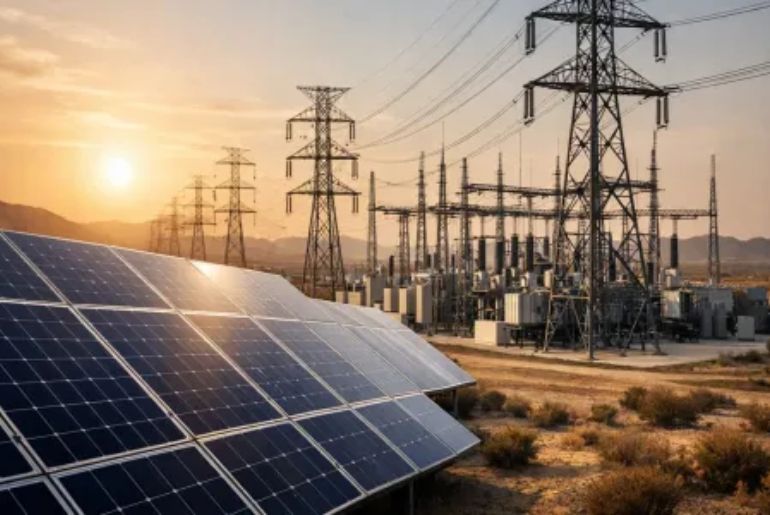
Minister of State for Power, Shripad Naik, submitted a written reply in the Rajya Sabha stated that India is rapidly strengthening its power transmission infrastructure to support the integration of large-scale renewable energy (RE) capacity. The government is expanding the Green Energy Corridors (GEC) and the Inter-State Transmission System (ISTS) to accommodate the country’s growing clean energy capacity.
The Ministry of Power says that plans are in place to add more than 500 GW of non-fossil fuel capacity by 2030 and more than 600 GW by 2032. This includes projects that are part of GEC Phase I and II.
Transmission Network Expansion
Under the National Electricity Plan, India’s high-voltage transmission network (220 kV and above) is expected to expand significantly by 2031–32.
Key targets include:
- Transmission network expansion to 6.48 lakh circuit kilometers (ckm)
- Transformation capacity increasing to 2,345 Giga Volt Ampere (GVA)
- Inter-regional transmission capacity rising from 120 GW in January 2026 to 168 GW by 2032
Transmission projects linked with renewable energy generation are being implemented in phases in line with the addition of new RE capacity.
Green Energy Corridor Development
The Green Energy Corridor (GEC) is a plan by the Ministry of New and Renewable Energy to send electricity between ten states, including Rajasthan, Karnataka, Andhra Pradesh, Himachal Pradesh, Madhya Pradesh, Kerala, Gujarat, Uttar Pradesh, Maharashtra, and Tamil Nadu.
Highlights of the programme include:
- 44 GW renewable energy evacuation capacity planned
- 26 GW already integrated into the grid
- GEC-III scheme under consideration for large-scale RE integration
Energy Storage to Manage Renewable Variability
The government is pushing for energy storage systems and hybrid power projects to deal with the fact that renewable energy sources don’t always work.
Planned energy storage capacity includes:
- 35.6 GW Pumped Storage Projects (PSP) planned under NEP up to 2031–32
- Transmission systems identified to support 100 GW PSP capacity between 2025–26 and 2035–36
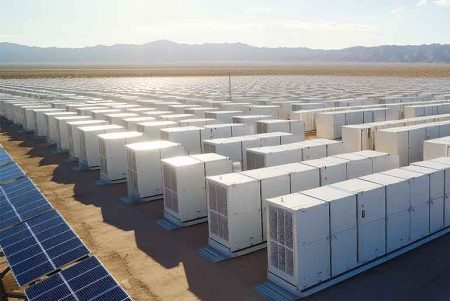
- 47 GW Battery Energy Storage Systems (BESS) targeted for grid integration by 2031–32
The government has also introduced two Viability Gap Funding (VGF) schemes to support around 43.8 GWh of BESS, launched in March 2024 and June 2025.
The Ministry of Heavy Industries is also using a ₹18,100 crore Production Linked Incentive (PLI) scheme to set up 50 GWh of ACC battery manufacturing capacity, including 10 GWh for grid-scale storage. This is part of the National Programme on Advanced Chemistry Cell Battery Storage.
Regulatory Reforms and Rooftop Solar Push
The Central Electricity Regulatory Commission has added solar-hour and non-solar-hour connectivity to the Connectivity and General Network Access to ISTS (Third Amendment) Regulations, 2025. This will make better use of transmission infrastructure and encourage hybrid projects that combine solar, wind and battery storage.
To promote distributed solar generation, MNRE is implementing the PM Surya Ghar Muft Bijli Yojana, launched in February 2024.
Key features of the scheme include:
- Target of 1 crore rooftop solar installations by FY 2026–27
- Total outlay of ₹75,021 crore
- Online subsidy disbursal through the National Portal
- Collateral-free loans for 10 years through nationalized banks
- Simplified approvals and automatic load enhancement up to 10 kW
Under the plan, about 31.04 lakh households had installed rooftop solar systems by February 2026.
Growing Renewable Capacity
As of January 2026, India had about 263 GW of renewable energy capacity. The ISTS network is currently being used to connect about 207 GW of new wind and solar power.
Also, the GEC plan calls for the integration of 18 GW of renewable energy capacity through networks within states. By 2030, about 19 GW of extra hydro capacity is also expected to be built.
 Electrify your feed! Click here to join our Whatsapp group and to get the latest updates, expert insights, and innovations driving India’s energy storage revolution.