

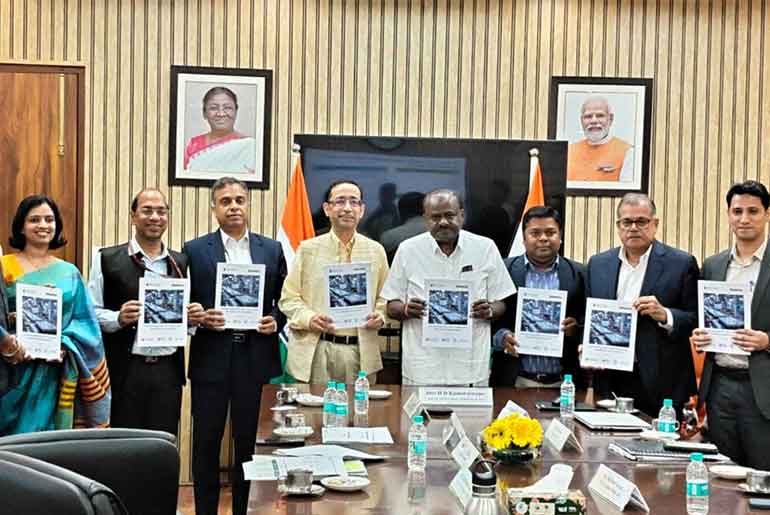
Indian battery component manufacturers face a significant cost disadvantage against global imports, with domestic production of cathode and anode materials, electrolytes, separators and copper foil costing 18% to 61% more than imported alternatives, according to a new industry study released in New Delhi. The report, prepared by the Netzero Energy Transition Alliance (NETRA) in collaboration with ARCI, CSIR-NCL, IIT Madras and Deloitte, was launched by the Ministry of Heavy Industries and is based on data from more than 20 Indian companies. The findings come as the government considers a targeted support scheme to strengthen domestic battery component manufacturing.
The study, “Accelerating India’s ACC Component Manufacturing Ecosystem,” points to China’s near-total dominance in global battery component supplies. In 2025, China accounted for 99% of LFP cathode material, 90% of anode material, 93% of electrolyte, 85% of separators, and 74% of copper foil, as per JP Morgan and Nomura data. Although China’s export restrictions on key battery materials and technologies, imposed in October 2025, have been suspended, the risk of future controls remains a concern.
“The cost data in this report comes from Indian companies that are building or planning these plants, and it shows that the gap has a different cause in each component,” said Debi Prasad Dash, Co-Founder and Executive Director, NETRA. “A flat incentive would overpay some producers and underpay others. So we have given the Government component-wise rates under three options, and each one leaves manufacturers carrying a meaningful share of the gap.”
The report finds that cost gaps for Indian producers have distinct causes for each component. For cathode materials, electrolytes, and copper foil, high raw material prices are the main factor. For graphite anodes, conversion and energy costs, depreciation, and financing add to the burden. In the case of separators, high capital intensity, imported technology, and low early utilisation rates are the primary challenges. Indian manufacturers also face much higher capital costs: building a cathode or anode plant in India costs more than twice as much as in China. Borrowing rates are 8.5% to 16% in India, compared to about 3.1% in China. New suppliers must wait 18 to 24 months for qualification by cell makers, often leaving new plants underused in their initial years.
Dr Rahul Walawalkar, Founder and President, NETRA, said, “Energy storage is becoming critical everywhere, from the grid to electric vehicles to the appliances in our homes. Staying in that game depends on processing materials to battery grade, holding quality to the micron and building our own R&D, not only on building cell factories. What people don’t realise is how long that capability takes to build. New entrants face high scrap rates for five to six years, and cell makers take 18 to 24 months to qualify a supplier. Decisions taken by March 2027 will decide whether the cell plants coming online by March 2029 can buy qualified materials made in India. We offer this evidence with options, not a single demand.”
Battery cell components account for roughly 76% of cell manufacturing costs. Indian Battery demand is projected to jump from about 33 GWh in 2025 to 236 GWh in 2032 and close to 600 GWh by 2037. Yet, current Indian capacity covers less than 3% of the cathode, anode, and electrolyte requirements projected for 2032, and there is no known domestic production of separators or battery-grade copper foil. To close the cost and capacity gaps, the report proposes three incentive options for the government: a 25% capital subsidy plus a sales-linked operating incentive offsetting about 30% of each component’s cost gap (ranging from 5% to 18% by component); an operating incentive alone, covering about 60% of the gap (11% to 37% by component) for five to seven years; or a 50% capital subsidy released alongside the investor’s own spending, as in the Semicon India programme. Each option is structured so that manufacturers still bear a meaningful share of the gap, encouraging efficiency and cost control.
The report also recommends building a national network for component testing, certification, and qualification using existing laboratories, launching a programme for domestic battery-grade raw material processing, supporting local manufacture of specialised plant and machinery, and creating integrated battery-material clusters. It points out that the Electronics Component Manufacturing Scheme currently supports these components only for digital device batteries, even though electric mobility and grid storage are expected to make up over 90% of India’s future demand.
The report has been endorsed by CSIR-NCL Director Dr Ashish Lele as an evidence-based foundation for policymaking, and by ARCI Director Dr R. Vijay for its technical assessment. Released at the Ministry of Heavy Industries in the presence of senior officials, NETRA members, Energiva Ventures, and Deloitte, the study positions India’s battery component ecosystem for rapid growth if timely support is provided. NETRA, whose membership includes battery component and cell makers, energy storage developers, fleet operators, and industrial users, commissioned the study, with Deloitte leading the analysis. No individual company data is disclosed in the report.
The Netzero Energy Transition Alliance (NETRA) is a global non-profit initiative created to drive the commercialization and scaling of net-zero technologies across grids, transportation, and industry. Its core pillars include policy advocacy, industry-led R&D, global market development, capacity building, and investment mobilization. NETRA’s founding team includes leading clean energy practitioners committed to accelerating tangible climate action.
 Electrify your feed! Click here to join our Whatsapp group and to get the latest updates, expert insights, and innovations driving India’s energy storage revolution.