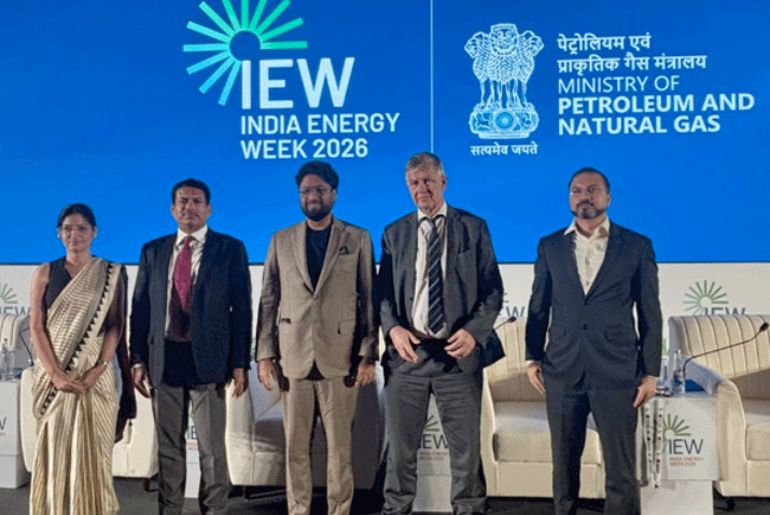
At India Energy Week 2026, Santosh Kumar Sarangi, Secretary of the Ministry of New and Renewable Energy (MNRE), said that India’s growth in renewable energy needs to go beyond just adding capacity. It needs to focus on integrating into the grid, using advanced technologies, and making things in India to make the energy transition smoother and more sustainable.
Sarangi spoke at the Leadership Spotlight Session on the third day of the event. He said that India’s installed non-fossil fuel capacity is now about 267 GW, with a goal of over 600 GW by FY 2030.
He emphasised that upcoming policy frameworks will increasingly focus on:
- Grid integration of renewable energy
- Distributed renewable energy management
- Strengthening domestic manufacturing in solar and wind value chains
These measures aim to reduce import dependence and enhance supply chain resilience.
Industry Perspective
Gyanesh Chaudhary, Chairman and Managing Director of Vikram Solar, reflected on India’s early renewable energy adoption as both an opportunity and a learning phase.
Gyanesh Chaudhary, Chairman and Managing Director of Vikram Solar stated, “Rapid scaling initially exposed gaps in domestic manufacturing and supply chains, but consistent policy direction and market creation have helped position India as one of the world’s leading renewable energy markets.”
Chaudhary added that the next phase will require:
- Deeper vertical integration
- Access to advanced technologies
- Stronger participation in global markets
These steps are crucial for India’s ambition to become a long-term renewable energy manufacturing hub.
Global and Sectoral Outlook
Erik Solheim, President of the International Advisory Board for GH2 India, said that solar energy is now one of the cheapest sources of power in the world. This makes the energy transition a chance for both the economy and the environment.
Meanwhile, Aditya Pyasi, CEO, Indian Wind Turbine Manufacturers Association (IWTMA), discussed India’s wind sector evolution, from early deployment to advanced manufacturing and global integration. He noted that Indian manufacturers are increasingly serving both domestic and international markets.
Pyasi emphasised that policy stability, component-level indigenisation, and sustained focus on job creation will be essential to drive future growth amid geopolitical uncertainties.
The session underscored India’s commitment to building a resilient, technologically advanced, and globally competitive renewable energy ecosystem, ensuring long-term sustainability and economic benefits.
 Electrify your feed! Click here to join our Whatsapp group and to get the latest updates, expert insights, and innovations driving India’s energy storage revolution.