As the government works to increase the amount of renewable energy available, Indonesia has gotten about $1.4 billion in foreign investment to help build solar power infrastructure. Rosan Roeslani, Indonesia’s Minister of Investment, made the announcement during a briefing at the Presidential Palace in Jakarta.
The investment will be used to build a large-scale solar component manufacturing facility with an annual production capacity of up to 50 gigawatts (GW). The factory will produce solar cells and modules required for Indonesia’s ambitious solar power expansion plans.
Solar Manufacturing Facility to Support Energy Transition
According to the minister, the investment began in mid-2025, and the factory is expected to be completed by the end of 2026.
“There is already an investment in Indonesia that will be completed this year for the construction of a factory an investment worth $1.4 billion with a capacity of 50 gigawatts,” Rosan Roeslani, Indonesia’s Minister of Investment said.
The new facility will be very important for building a domestic supply chain for solar technology. This will make the country less dependent on imported equipment and help the growth of renewable energy in the country.
Part of Indonesia’s 100 GW Solar Expansion Plan
The manufacturing facility is expected to support Indonesia’s broader solar program targeting up to 100 GW of installed solar capacity. The government is working to accelerate renewable energy deployment under the leadership of Prabowo Subianto, President of Indonesia.
Officials are currently reviewing financing structures and exploring partnerships with domestic companies and private technology providers specializing in solar panels and battery storage systems.
Initial 13 GW Development Phase
The government plans to begin with an initial development phase of around 13 GW of solar capacity. Early projects will focus on regions that already have adequate electricity distribution networks.
“In principle, the plan is to expand to all villages, but the initial phase will prioritize areas that already have distribution networks,” Rosan said.
Rural Electrification and Energy Storage
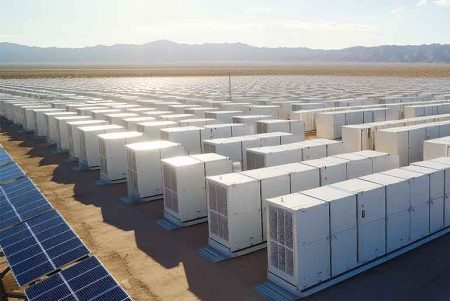
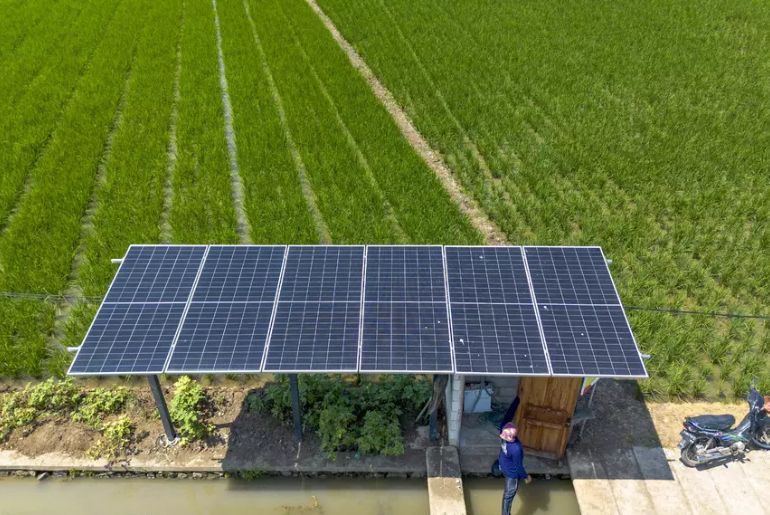
Indonesia’s solar expansion will also focus on bringing electricity to rural areas, especially those where it is still hard to get. To make sure there is always enough power, the program will have energy storage systems with a total capacity of about 320 GWh.
The initiative is expected to involve around 80,000 rural cooperatives, helping communities participate directly in renewable energy development.
In addition, Indonesia’s sovereign wealth fund Danantara has launched a 1 MW pilot solar project in Sumenep, East Java, which could be expanded if successful.
According to data from the Energy and Mineral Resources Ministry, around 5,758 villages representing roughly 1.2 million households still lack access to electricity, highlighting the potential role of solar power in improving electrification across the country.
 Electrify your feed! Click here to join our Whatsapp group and to get the latest updates, expert insights, and innovations driving India’s energy storage revolution.