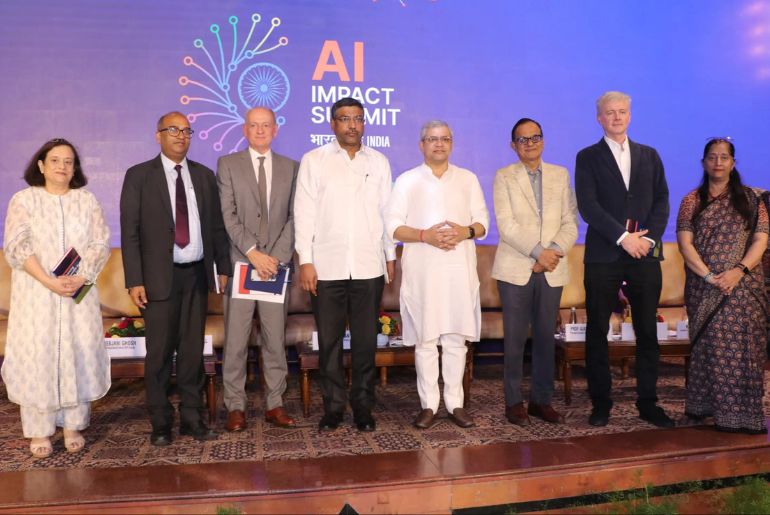
The Ministry of Electronics and Information Technology (MeitY), the Ministry of Power (MoP), and the International Solar Alliance (ISA) jointly hosted a high-level pre-summit convening on the Global Artificial Intelligence (AI) Mission for Energy in the national capital. The dialogue brought together senior government officials, power utilities, technology providers, entrepreneurs, and international development partners to advance the use of AI in strengthening the resilience, efficiency, and sustainability of energy systems in India and across the Global South.
The convening was organised as an official lead-up to the AI Impact Summit 2026, scheduled to take place in February next year. It marked an important step in India’s preparations for the summit and served as a platform to align priorities, shape mission objectives, and build collaborations around deployable AI products and real-world applications in the energy sector.
Opening the event, Ashish Khanna, Director General of the International Solar Alliance, highlighted the growing importance of digitalisation in power distribution systems amid the rapid expansion of renewable energy.
“As solar capacity continues to double globally and distributed renewable energy expands at an unprecedented pace, the digitisation of power distribution systems is no longer optional. it is fundamental,” Ashish Khanna, Director General of the International Solar Alliance said.
He added that managing variability, improving power procurement efficiency, reducing system losses, and delivering better customer service would require AI-enabled digital infrastructure such as digital twins, interoperable platforms, and open protocols.
Khanna further noted, “Challenges are common across developed, emerging, and low-income countries alike. Today’s challenge is not a lack of pilots, but fragmentation. The strength of the Global South lies in building high-quality, low-cost AI innovations, which presents a unique global opportunity.”
In his inaugural address, Ghanshyam Prasad, Chairperson of the Central Electricity Authority, underscored the operational urgency of digitalisation in the power sector.
“As we move rapidly toward large-scale deployment of distributed renewable energy, particularly rooftop solar, visibility across the distribution network becomes critical,” Ghanshyam Prasad, Chairperson of the Central Electricity Authority said. He emphasised that AI and digital tools must be deployed with clearly defined use cases focused on real operational needs, stating, “This is the moment to move decisively from experimentation to scalable implementation.”
Highlighting the international perspective, Florent Mangin, Head of the Regional Economic Department for India and South Asia and representing the ISA Co-Presidency, said AI could significantly accelerate the energy transition if implemented responsibly.
“As the energy transition accelerates, our power systems must integrate more renewables, manage greater decentralisation, and still deliver reliable and affordable electricity,” Florent Mangin, Head of the Regional Economic Department for India and South Asia and representing the ISA Co-Presidency said, adding that AI deployment must be trusted, secure, and sustainable.
The first technical session focused on India’s AI products for the global energy transition, examining how initiatives such as digital grids, the India Energy Stack, and AI-enabled grid pilots could evolve into scalable platforms. The session was moderated by Shashank Misra, Joint Secretary, Ministry of Power.
“India today operates the world’s largest single electricity grid, and with the rapid rollout of smart meters, an unprecedented volume of real-time consumer and system data is coming onto the grid,” Shashank Misra, Joint Secretary, Ministry of Power said.
He noted that effective use of this data could transform distribution utilities by improving forecasting, power procurement, theft reduction, and tariff competitiveness.
Representing the sub-national perspective, Arti Dogra, Chairman and Managing Director of Jaipur Vidyut Vitran Nigam, shared her utility’s experience with AI-driven solutions.
“At Jaipur DISCOM, we have already digitised nearly 80 percent of a vast and complex network,” Arti Dogra, Chairman and Managing Director of Jaipur Vidyut Vitran Nigam said. She added that “AI-enabled feeder- and transformer-level energy accounting allows us to identify highly localised technical and commercial losses and address them intelligently, rather than through blunt, system-wide interventions.”
The second session featured a keynote address by Abhishek Singh, Secretary, Ministry of Electronics and Information Technology.
“The Global AI Mission for Energy that is being conceptualised gives a big opportunity for the developing countries, including India, to build locally tested AI products for the energy sector,” Abhishek Singh, Secretary, Ministry of Electronics and Information Technology said.
He noted that such products could create new opportunities for local enterprises and enable startups in countries like India to offer scalable solutions to the global market.
According to the organisers, the deliberations and recommendations from the convening will directly inform the initiatives, product suites, and coalition announcements planned for the AI Impact Summit 2026. MeitY is leading a series of thematic consultations to develop actionable outcomes, while the Ministry of Power is heading the summit’s working group on resilience, innovation, and efficiency. Meanwhile, the ISA is developing a Global AI Mission for Energy to accelerate the deployment of affordable, reliable, and clean power systems across its member countries.
 Electrify your feed! Click here to join our Whatsapp group and to get the latest updates, expert insights, and innovations driving India’s energy storage revolution.