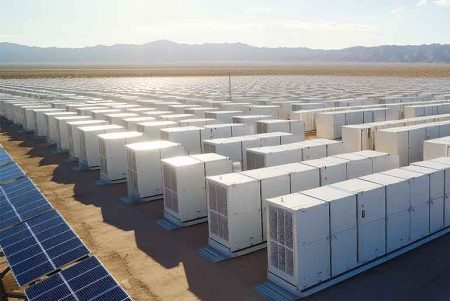
India’s energy sector is undergoing a structural transformation, driven by aggressive renewable energy targets and the need for grid stability. Battery Energy Storage Systems (BESS) have emerged as a critical enabler in this transition, allowing intermittent renewable sources like solar and wind to deliver reliable, dispatchable power.
India wants to have 500 GW of non-fossil fuel capacity by 2030, and the need for energy storage is likely to grow quickly as the country moves toward that goal. By 2032, India may need more than 74 GW / 411 GWh of storage space, which is a huge chance for EPC (Engineering, Procurement, and Construction) companies.
Within this evolving ecosystem, EPC contractors play a pivotal role by delivering turnkey BESS projects from design and engineering to procurement, installation, and commissioning.
Understanding the Role of EPC in BESS
A BESS EPC contractor is in charge of carrying out all the steps of an energy storage project. This includes:
- Designing and building systems
- Buying battery systems, inverters, and other equipment for the plant
- Building things like roads and power lines
- Combining with renewable energy sources and the power grid
- Testing, setting up, and improving performance
Given the technical complexity and capital intensity of BESS, project developers increasingly rely on experienced EPC partners with strong execution capabilities and domain expertise.
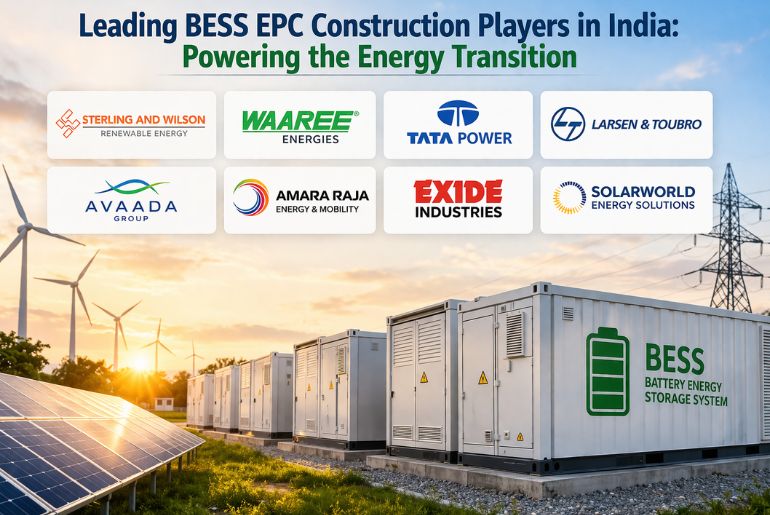
Top BESS EPC Construction Players in India
1. Sterling and Wilson Renewable Energy (SWREL)
Sterling and Wilson Renewable Energy is currently one of the most prominent EPC players in India’s BESS segment. The company has leveraged its global solar EPC experience to expand into energy storage.
A major milestone was its contract for a 1,000 MWh standalone BESS project in Rajasthan, one of the largest such installations globally.
Key strengths:
- Proven large-scale EPC execution
- Integrated solar + storage capabilities
- Strong international presence
SWREL’s early mover advantage in utility-scale storage positions it as a leader in India’s BESS EPC market.
2. Waaree Energies
Waaree Energies is known for making solar panels and doing EPC work, but it is now adding BESS to its product line.
The company sells modular lithium-ion storage systems and hybrid solar-plus-storage solutions to both utilities and businesses.
Key strengths:
- EPC solutions for solar and storage from start to finish
- A strong base of manufacturing in the US
- Rapid growth in hybrid projects
Waaree is a good partner for integrated renewable projects because it can combine generation and storage.
3. Tata Power
Tata Power is becoming an important player in the deployment of grid-scale storage thanks to its EPC arm and utility knowledge. The company is mostly a developer and operator, but it also builds big infrastructure projects like hybrid renewable + storage systems.
Key strengths:
- Deep grid integration expertise
- Utility-scale project execution
- Strong balance sheet and project pipeline
Its integrated model spanning generation, EPC, and distribution provides a competitive edge in complex BESS deployments.
4. Larsen & Toubro (L&T)
L&T is one of India’s biggest EPC companies, and it works in power, infrastructure, and heavy engineering.
L&T is not just a BESS player, but it is involved in projects to modernise the grid and integrate renewable energy sources, such as systems that link storage.
Key strengths:
- The ability to carry out mega-projects
- Strong knowledge of engineering and buying
- Experience with infrastructure for grids and substations
L&T’s scale and technical depth make it a key contender for future large-scale BESS EPC contracts.
5. Avaada Group
Avaada Group is mostly a developer of renewable energy, but they are also putting more money into energy storage solutions and EPC execution skills.
Main strengths:
- Strong pipeline of renewable projects
- A unified approach to solar, wind, and storage
- Taking part in round-the-clock (RTC) bids
Its expansion into storage reflects the growing demand for firm renewable power.
6. Amara Raja Energy & Mobility
Amara Raja is moving away from making traditional batteries and toward making more advanced lithium-ion and BESS solutions.
Main strengths:
- Strong base for making batteries
- Storage solutions from start to finish
- Growing into applications for utility scale
7. Exide Industries
Exide is one of the oldest battery makers in India, and they are putting money into lithium-ion and large-scale storage technologies.
Key strengths:
- A well-established battery ecosystem
- Strong presence in industry and utilities
- Investing strategically in next-gen storage
8. SolarWorld Energy Solutions
SolarWorld is a growing EPC company that offers complete BESS solutions that work with solar projects.
The company has built utility-scale storage systems like the 125 MW / 250 MWh and 200 MW / 400 MWh systems, which show that they can do it.
Main strengths:
- EPC and storage solutions that work together
- Put your attention on reliability and grid stability
- Experience with big deployments
Market Trends Driving BESS EPC Growth
1. Shift Toward Hybrid Projects
Developers are increasingly adopting solar + storage and wind + storage models to provide round-the-clock (RTC) power.
2. Government Policy Push
India’s policy framework, which includes viability gap funding (VGF) and storage-linked tenders, is speeding up the use of BESS.
3. Grid Stability Requirements
With rising renewable penetration, grid operators require storage for:
- Frequency regulation
- Peak shaving
- Load balancing
4. Declining Battery Costs
The falling prices of lithium-ion batteries are making projects more viable and drawing in investors.
Challenges for EPC Players
Even though BESS EPC players are growing quickly, they still have a lot of problems to deal with:
- High costs of starting up
- Reliance on imported battery cells (lithium, cobalt, nickel)
- Risks and rapid changes in technology
- Concerns about the bankability of big projects
India remains heavily dependent on imports for critical battery materials, making supply chain resilience a key concern.
Over the next ten years, the BESS EPC market in India is going to grow at an incredible rate. Utilities and government agencies are giving out big contracts, so EPC contractors who can do a good job and offer a full range of services will be in charge.
We are likely to see:
- Entry of global players through partnerships
- Growth of domestic manufacturing ecosystems
- Increasing standardization of EPC models
- Rise of long-term O&M contracts as a revenue stream
Conclusion
Battery Energy Storage Systems are no longer optional; they are essential to India’s clean energy future. EPC players are at the heart of this change, making it possible to build storage infrastructure that is reliable, scalable, and efficient.
Companies like Sterling and Wilson Renewable Energy, Waaree Energies, L&T, and Tata Power are leading the charge, while emerging players and manufacturers are rapidly strengthening the ecosystem.
As India accelerates toward a renewable-driven grid, the role of BESS EPC contractors will only become more strategic, shaping the country’s ability to deliver firm, reliable, and sustainable power at scale.
 Electrify your feed! Click here to join our Whatsapp group and to get the latest updates, expert insights, and innovations driving India’s energy storage revolution.