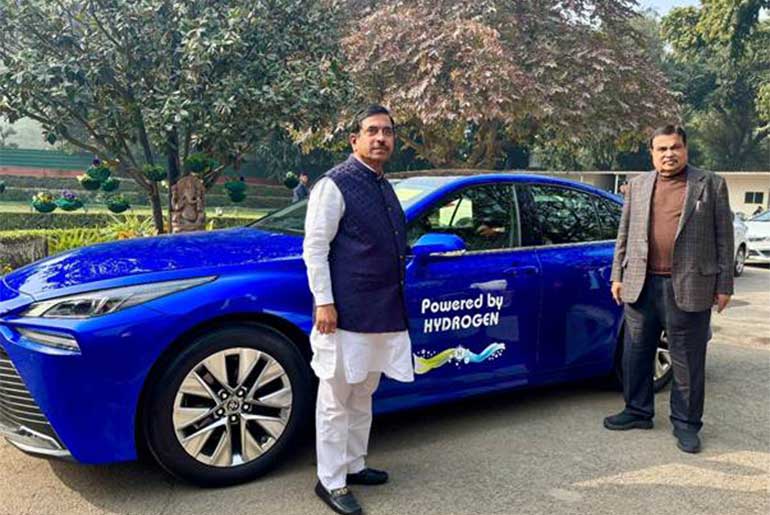
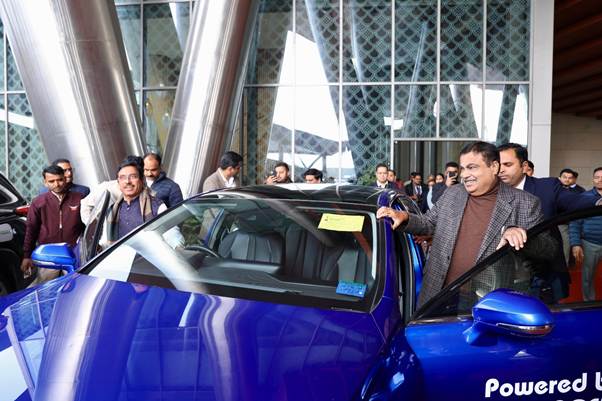
In a strong symbolic push for India’s clean mobility ambitions, Union Minister for New and Renewable Energy Pralhad Joshi and Union Minister for Road Transport and Highways Nitin Gadkari on Tuesday took a joint ride in a hydrogen fuel cell electric vehicle (FCEV), underlining the government’s commitment to green hydrogen–based transportation.
The ministers rode the Toyota Mirai, one of the world’s most advanced hydrogen-powered passenger vehicles. On the occasion, Shri Pralhad Joshi himself drove the vehicle from Bharat Mandapam to Shri Nitin Gadkari’s residence, sending a clear message on the readiness and practicality of H2-powered mobility in real-world Indian conditions.
The demonstration aligns closely with India’s broader clean energy roadmap, particularly the National Green Hydrogen Mission, which aims to position the country as a global hub for green hydrogen production, use, and export. H2 fuel cell vehicles are seen as a critical solution for long-range, high-utilisation transport segments where fast refuelling and zero tailpipe emissions are essential.
The Toyota Mirai, a second-generation FCEV, generates electricity through an electrochemical reaction between hydrogen and oxygen, emitting only water vapour. With a driving range of around 650 km and refuelling time of less than five minutes, it offers a compelling alternative to conventional internal combustion engines and even battery-electric vehicles for certain applications.
As India scales up H2 production, refuelling infrastructure, and pilot deployments, such high-visibility demonstrations signal growing policy confidence that hydrogen will play a key role in decarbonising road transport—complementing batteries and accelerating the transition to a net-zero mobility future.
 Electrify your feed! Click here to join our Whatsapp group and to get the latest updates, expert insights, and innovations driving India’s energy storage revolution.