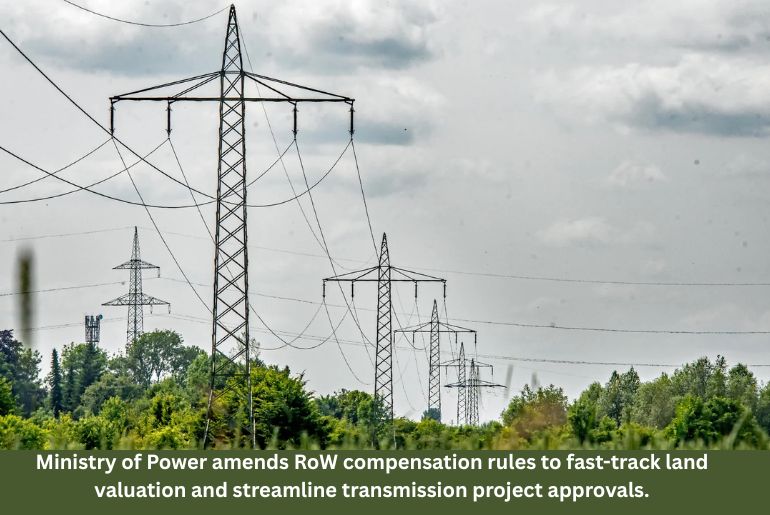
The Ministry of Power (MoP) has recently put forward important amendments to the compensation guidelines for “Right of Way” (RoW) for transmission projects. This initiative has taken place to expedite land assessments that have normally led to immense delays for important electricity transmission infrastructure projects.
These new rules have resulted in an update of the supplementary guidelines, which were issued in March 2025. The new rules cover areas such as making payments to landowners faster, fair, and transparent.
Solving Procedural Delays
In the past, transmission projects often faced roadblocks because naming land valuers and submitting their reports took too long. To fix this, the Ministry has mandated a strict, time-bound system for the Market Rate Committee (MRC).
Under the updated framework:
- Triple Appointment: The MRC must now appoint three independent valuers on the very same day it meets.
- Diverse Representation: To ensure fairness, one valuer is chosen by the affected landowners, one by the power company (Transmission Service Provider), and one by the District Magistrate (DM).
- Tight Deadlines: All three valuers must submit their reports in sealed envelopes directly to the District Magistrate within 21 days.
A Fair Selection Process
To prevent bias, the Ministry has introduced a unique “lottery” system. Once all three reports are handed in, the DM will randomly pick two reports to determine the land’s market rate.
The final compensation rate is calculated using a clear formula:
- If the two chosen valuations are close (less than 20% difference), their average is used.
- If they are far apart (more than 20% difference), the rate is set at 10% above the lower value.
- If there is still a disagreement, the third (unopened) report is brought in, and the average of the two lowest valuations becomes the final reference rate.
This system ensures that landowners are not stuck with outdated “circle rates” that are often much lower than actual market prices. The Ministry emphasized that these changes will protect landowners’ interests while ensuring India’s power grid grows without unnecessary hurdles.
 Electrify your feed! Click here to join our Whatsapp group and to get the latest updates, expert insights, and innovations driving India’s energy storage revolution.