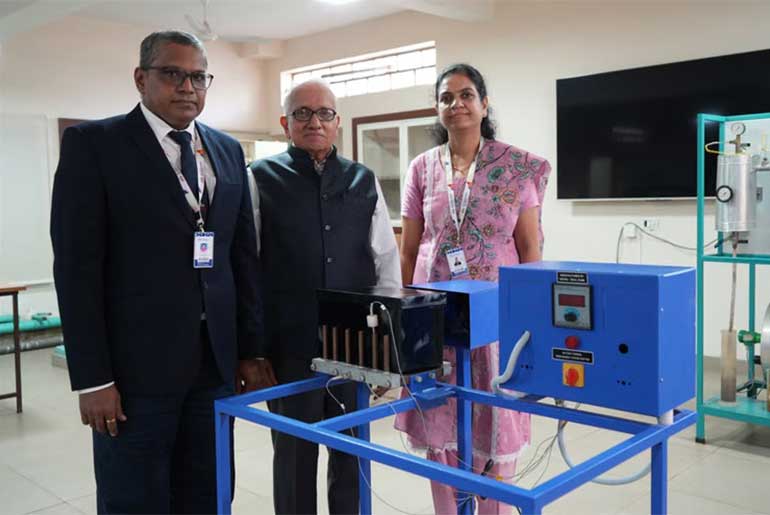
Researchers at MIT World Peace University (MIT-WPU), Pune, have developed a patented passive hybrid cooling system for electric vehicle (EV) batteries, addressing critical issues related to thermal management. The system, granted the Indian patent “System for Thermal Management of Battery of Vehicle” (Patent No. 202121029238), is designed to enhance both battery performance and safety, particularly in India’s high-temperature conditions, which have been linked to rising EV fire incidents.
Key Highlights:
- Innovative Cooling System: The patented cooling system combines high-efficiency heat pipes and a custom-engineered nanofluid, providing an energy-efficient, pump-free alternative to traditional EV battery cooling technologies.
- Passive Mechanism: Unlike conventional cooling systems, the hybrid passive system operates through natural convection and phase-change processes, requiring no additional electrical power or mechanical components such as pumps or fans.
- Enhanced Performance & Safety: This cooling system ensures that battery temperature remains stable, improving battery lifespan, charging efficiency, and user safety, especially in high-heat environments like India.
Research Team:
- Dr. Vaibhav Deshmukh – Associate Professor, Department of Mechanical Engineering
- Dr. S. Radhakrishnan—Professor Emeritus & Director Research, Department of Materials Science and Engineering
- Dr. Vaidehi Deshmukh – Assistant Professor, Department of Electrical and Electronics Engineering
This innovative system is designed to address the challenges posed by India’s high ambient temperatures, especially as the country accelerates its adoption of electric vehicles. Thermal runaway and battery overheating have been cited as major concerns in India’s growing EV market, leading to fire-related incidents, particularly in two- and three-wheelers. As a result, this cooling system is a much-needed solution to enhance safety and reliability in EVs.
Unique Features:
- No Active Mechanical Components: The system operates without pumps, fans, or additional power, making it more reliable and energy-efficient than existing systems.
- Nanofluid Integration: The specially engineered nanofluid with thermally conductive nanoparticles rapidly extracts heat from battery hotspots, maintaining optimal thermal conditions even in extreme temperatures.
- Longer Battery Life: By ensuring stable temperatures, the system extends battery lifespan and reduces the likelihood of dangerous thermal incidents.
Statement from Researchers:
Dr. Vaibhav Deshmukh emphasized the importance of safety, saying, “In an environment like India’s, where high ambient temperatures and increasing EV adoption are common, the challenge isn’t just about performance—safety is the priority. Our passive hybrid system ensures the battery stays within safe thermal limits, improving both reliability and operational efficiency.”
Dr. S. Radhakrishnan elaborated on the goal to leapfrog existing technologies, stating, “By removing active components that could fail or consume additional power, we’ve created a robust solution tailored to high-temperature markets and rising concerns around fire risks.”
Dr. Vaidehi Deshmukh added, “The integration of nanofluids with a heat-pipe system addresses two major challenges: energy overhead and thermal hotspots, significantly boosting EV safety, especially in India.”
Market Relevance:
- The global market for electric vehicle battery thermal management systems (BTMS) is projected to grow from USD 5.41 billion in 2024 to USD 29.09 billion by 2030, driven by the demand for longer-range EVs, faster charging, and enhanced safety.
- In India, the EV battery cooling systems market is expected to expand from USD 138 million in 2025 to nearly USD 470 million by 2034, with the broader Battery Management System (BMS) market projected to rise from USD 199 million in 2024 to USD 8.39 billion by 2035.
As India’s EV adoption surges, with around 7.8% market penetration in FY 2024-25, reliable thermal management solutions are more critical than ever. EV fire risks, especially in two- and three-wheelers, underscore the urgent need for improved cooling systems to ensure the safety and trust of consumers.
This breakthrough technology not only promises to elevate India’s EV industry by addressing safety concerns but also strengthens the global push for sustainable mobility and energy-efficient technologies.
 Electrify your feed! Click here to join our Whatsapp group and to get the latest updates, expert insights, and innovations driving India’s energy storage revolution.