The Ministry of New and Renewable Energy (MNRE) on February 20, 2026, held a Stakeholder Consultation Workshop under the chairmanship of Shri J.V.N. Subramanyam, Joint Secretary (JS), MNRE, to deliberate on the draft Floating Solar PV (FSPV) Potential Assessment Report and the draft floating solar policy.
The National Institute of Solar Energy (NISE) wrote the first draft of the FSPV Potential Assessment Report, and the Indian Institute of Technology Roorkee (IIT Roorkee) wrote the first draft of the floating solar policy.
Focus on Unlocking Floating Solar Potential
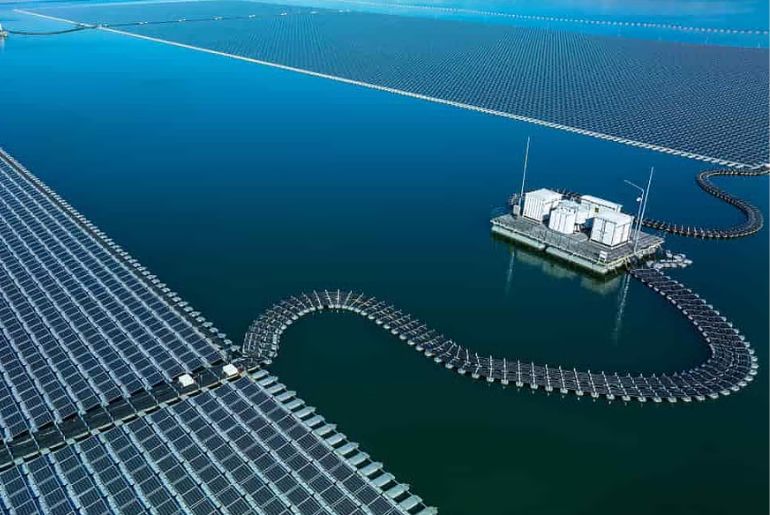
Floating Solar PV (FSPV) is being looked at as a good alternative because finding land for renewable energy projects is becoming harder. But even though India has a lot of water, only about 700 MW of floating solar capacity has been built so far. The slow growth is mostly because there isn’t enough reliable information about possible sites and there isn’t a clear plan for how to put things into action.
To address these issues, MNRE, in collaboration with NISE and IIT Roorkee, has prepared the draft assessment report and policy framework.
During the workshop, MNRE requested all States and Union Territories (UTs) to conduct internal consultations with key state-level stakeholders, including:
- Water Resources and Irrigation Departments
- Revenue Departments
- Fisheries and Forest Departments
- Agriculture Departments
- DISCOMs and Transcos
- Public Works Department (PWD)
- Tourism Departments
- Pollution Control Boards
States and UTs have been asked to share their comments and feedback on the draft policy and potential assessment.
Innovative Models and Next Steps
Discussions during the workshop also focused on introducing innovative solutions to reduce risks for developers and investors. These include:
- Plug-and-play models
- Plug-and-pay mechanisms
- Allotment of water bodies with necessary approvals
States and UTs may choose the best places for floating solar development based on the final policy and the potential they see.
MNRE will also hold detailed consultations with the Ministry of Environment, Forest and Climate Change (MoEFCC), Wetland Authority, and National Dam Safety Authority before finalizing the policy, incorporating feedback received from States.
The workshop was attended by senior officials from MNRE, Renewable Energy State Nodal Agencies, representatives of States and UTs, the Solar Energy Corporation of India (SECI), NISE, and IIT Roorkee.
 Electrify your feed! Click here to join our Whatsapp group and to get the latest updates, expert insights, and innovations driving India’s energy storage revolution.