

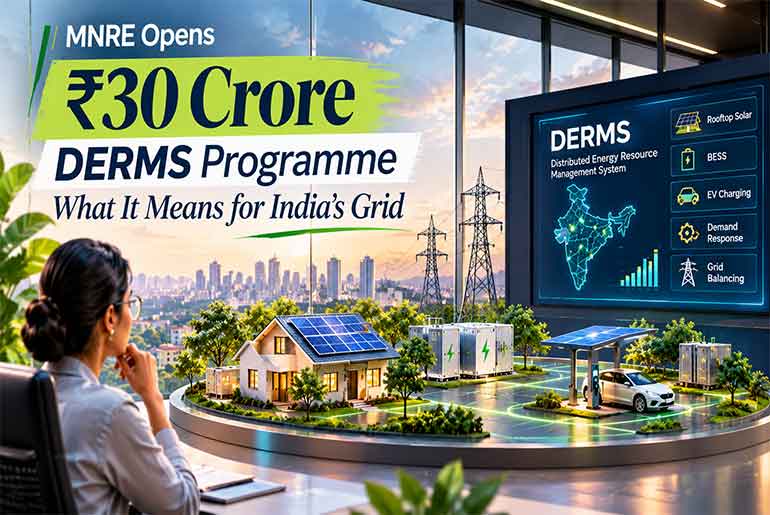
India’s rooftop solar expansion is changing more than the country’s renewable energy capacity. It is also changing how electricity moves through local distribution networks. As households increasingly generate their own electricity and feed surplus power back into the grid, distribution companies are facing a more complex operating environment. Managing this decentralised generation requires more than conventional grid infrastructure; it calls for better visibility, forecasting and coordination. Recognising this shift, the Ministry of New and Renewable Energy (MNRE) has opened a new opportunity for distribution utilities through its MNRE DERMS Programme, inviting proposals to pilot Distributed Energy Resource Management Systems (DERMS) under the Innovative Projects component of the PM Surya Ghar: Muft Bijli Yojana.
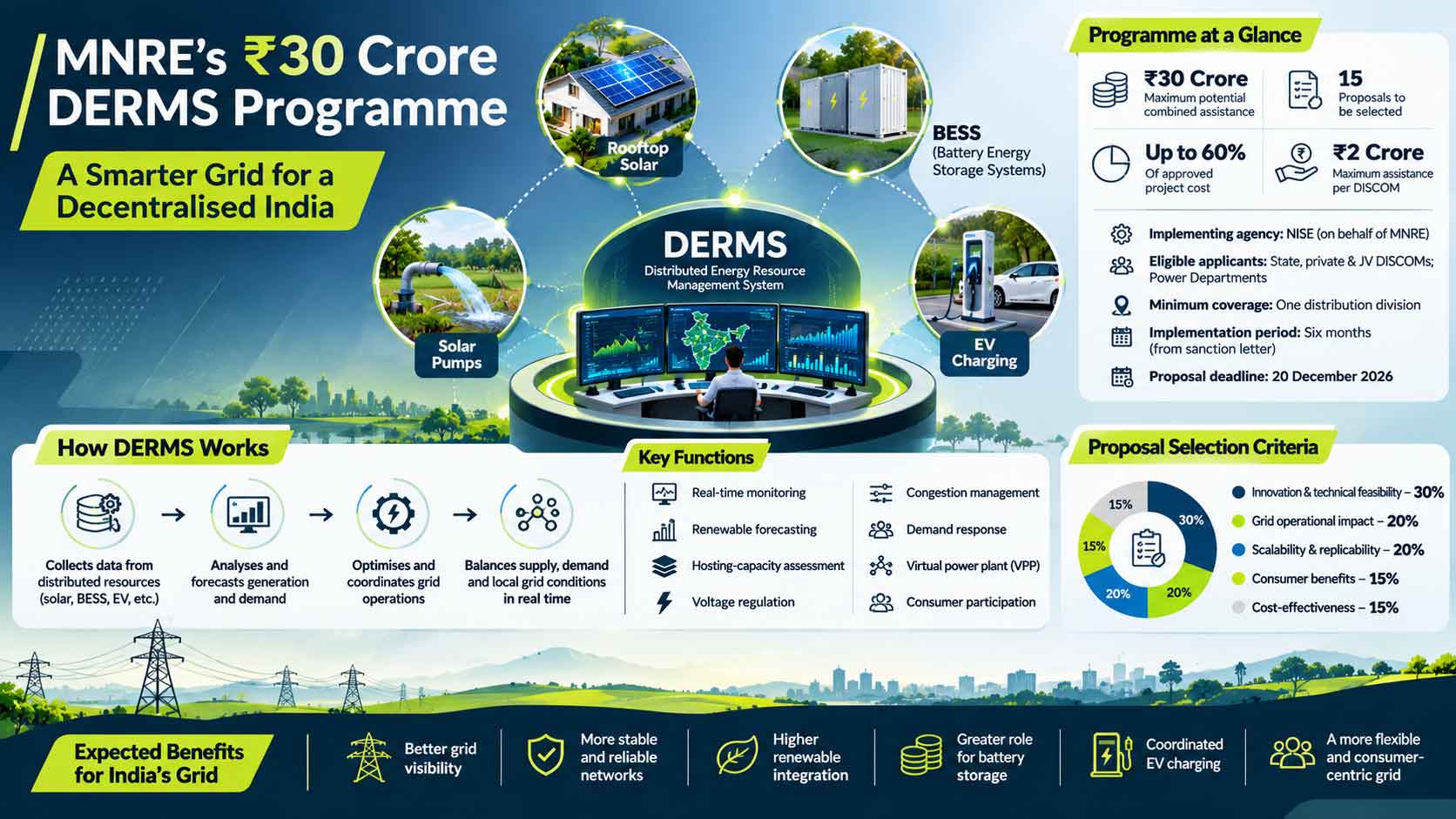
The National Institute of Solar Energy (NISE), on behalf of MNRE, issued the call for proposals on 20 November 2026. The programme aims to support up to 15 DISCOM projects, with financial assistance covering up to 60% of the approved project cost, subject to a maximum of ₹2 crore per DISCOM. The potential combined assistance could reach ₹30 crore if all 15 selected projects receive the maximum support.
The initiative signals a shift in India’s rooftop solar policy conversation: from accelerating installations to ensuring that distribution networks can manage the growing volume of decentralised energy resources.
MNRE DERMS Programme: What Does the Policy Provide?
Under the call for proposals, state, private and joint-venture DISCOMs, along with electricity Power Departments, are eligible to apply. Each proposed pilot must cover at least one distribution division, while selected projects are expected to be implemented within six months of receiving the sanction letter.
The selection process will be competitive, with the top 15 proposals chosen based on technical merit, project feasibility and budget availability. The evaluation framework gives the highest weightage to innovation and technical feasibility at 30%, followed by grid operational impact at 20% and scalability and replicability at another 20%. Consumer benefits and cost-effectiveness account for 15% each.
The application deadline is 20 December 2026. Importantly, the ₹30 crore figure represents the maximum potential combined assistance rather than an amount already distributed to selected utilities. DISCOMs will need to arrange the remaining project funding beyond the eligible central support.
The programme is designed as a competitive challenge-cum-project selection mechanism. It is intended to encourage utilities to demonstrate practical digital solutions for managing distributed energy resources within their networks, rather than simply procure standalone software platforms.
Why Does India’s Distribution Grid Need DERMS?
For decades, electricity distribution networks were largely designed around a relatively predictable direction of power flow: electricity moved from generating stations through transmission and distribution infrastructure towards consumers.
Rooftop solar is changing that arrangement. A household with a solar installation can consume electricity generated on its roof and export the surplus to the local distribution network. When many such systems operate across the same feeder, electricity can flow in both directions, making network management more complicated.
One challenge is reverse power flow, which occurs when local generation exceeds consumption and electricity flows back towards the distribution transformer or upstream network. Depending on the feeder’s design, solar penetration and operating conditions, this can contribute to voltage variations and create challenges for equipment and network operation.
Another concern is the changing relationship between generation and demand. Residential solar systems typically generate the most electricity during the day, while household consumption can rise in the evening. DISCOMs therefore need better information about where electricity is being generated, how much is being exported and when local demand is likely to increase.
These challenges are becoming more relevant as the PM Surya Ghar scheme expands. According to a PIB update dated 13 November 2026, 65.26 lakh households were benefiting from rooftop solar installations as of 2 November, with 19.1 GW of cumulative rooftop solar capacity commissioned under the scheme. Approximately ₹35,800 crore in subsidies had been transferred to beneficiaries.
The growing scale of decentralised generation makes real-time monitoring, forecasting and grid coordination increasingly important. This is the operational gap the MNRE DERMS Programme intends to address.
What Will the DERMS Platforms Actually Do?
A Distributed Energy Resource Management System is a digital platform that enables utilities to monitor, forecast, coordinate and optimise energy resources connected to their distribution networks.
Instead of treating every rooftop solar installation, battery system or EV charging point as an isolated asset, DERMS can help bring information from multiple distributed resources together. This gives DISCOMs a clearer picture of how local generation and consumption are affecting their networks.
Under the MNRE DERMS Programme, the proposed solutions can address several functions, including real-time monitoring of distributed energy resources, renewable generation forecasting, grid balancing, dynamic hosting-capacity assessment, voltage regulation and congestion management.
One particularly important function is hosting-capacity assessment. It helps a utility understand how much additional rooftop solar or other distributed generation a particular part of its network can accommodate without creating unacceptable operating conditions. This can support better planning and help identify locations where distribution infrastructure may require strengthening.
The programme also identifies GIS-based mapping, demand response, virtual power plant concepts and consumer participation as potential areas of implementation. Its indicative deliverables include an operational DERMS platform, a visibility dashboard, integration of rooftop solar databases, forecasting and analytics tools, network hosting-capacity assessments and performance reports.
The objective is therefore not limited to collecting data. The platforms are expected to help DISCOMs use that information to make more informed operational decisions and demonstrate measurable benefits.
Beyond Rooftop Solar: Where Do BESS and EV Charging Fit In?
For the battery and energy storage industry, one of the most relevant aspects of the MNRE DERMS Programme is its recognition that distribution networks will increasingly need to coordinate several types of decentralised energy resources.
The official call identifies rooftop solar, solar pumps, small PV grids, battery energy storage systems (BESS), EV charging infrastructure and demand-response resources among the categories that can be addressed through the proposed solutions. This broadens the scope of DERMS beyond solar monitoring.
Battery storage can become particularly useful in managing the difference between the timing of renewable generation and electricity demand. A behind-the-meter battery connected to a rooftop solar system can store surplus electricity during the day and supply it later, including during evening demand periods.
This can increase the household’s consumption of its own solar generation and potentially reduce the volume of electricity exported during periods of high solar output. At a wider network level, appropriately coordinated storage can also offer flexibility by shifting when electricity is injected into or drawn from the grid.
A recent Ember analysis, Plugging Storage into India’s Rooftop Solar Revolution, published on 22 October 2026, examines this opportunity. It highlights how residential rooftop solar can increase daytime exports while households continue to draw electricity during evening hours. The report argues that pairing rooftop solar with battery storage could help reduce this mismatch and create a distributed flexibility resource.
Ember
However, the economic case for household storage remains an important consideration. Ember points out that existing net-metering arrangements, which allow exported electricity to offset consumption at another time, can reduce the immediate financial incentive for consumers to install batteries. This suggests that storage adoption will depend not only on technology but also on tariff structures, settlement mechanisms and suitable incentives.
EV charging adds another dimension. As electric vehicles become more widespread, charging demand will increasingly interact with local distribution networks. Smart charging systems can potentially schedule or adjust charging according to grid conditions, helping utilities manage flexible demand rather than allowing all charging loads to operate without coordination.
The inclusion of BESS and EV charging in the MNRE DERMS Programme is therefore significant. It recognises that the distribution grid of the future will need to coordinate not just electricity generation but also storage and flexible consumption.
The Missing Link: Smart Inverters and Grid Interoperability
While digital platforms can provide utilities with better visibility, their effectiveness will depend on how well they communicate with the physical equipment connected to the network. Smart inverters, battery management systems, energy storage controllers and EV charging systems will need reliable communication and compatible interfaces to participate effectively in coordinated grid operations.
This is where standardisation and interoperability become important. Different manufacturers may use different communication protocols and system architectures. Unless these devices can exchange information with utility platforms, the ability of DERMS to coordinate distributed resources could remain limited.
The Central Electricity Authority’s October 2026 Unified Framework for Digitalisation of Distribution Sector provides a broader policy context for this requirement. It emphasises the integration of distribution management systems, smart meters, DERMS, GIS, SCADA, smart inverters and BESS. It also highlights the importance of common standards, open interfaces, data exchange and cybersecurity.
Highlighting the importance of combining digital grid management with intelligent hardware, Raman Bhatia, Managing Director, Servotech Renewable Power System Ltd., said:
“MNRE’s decision to fund Distributed Energy Resource Management Systems across 15 DISCOMs is a timely intervention as PM Surya Ghar pushes residential rooftop installations past three lakh additions a month. Unmanaged daytime solar exports are already causing feeder-level voltage fluctuations and reverse power flow challenges across local distribution transformers.
However, software-led grid visibility alone will only solve half the problem unless paired with intelligent edge hardware. Smart hybrid solar inverters and behind-the-meter Battery Energy Storage Systems (BESS) act as active grid-balancing assets—absorbing surplus midday solar generation locally and supplying clean power during evening peak hours.
As India scales decentralized solar, standardizing communication protocols between utility DERMS platforms and smart rooftop inverters will be critical. This convergence will allow DISCOMs to defer costly transformer upgrades while turning millions of solar households into reliable, grid-supportive assets.”
CEA’s Digitalisation Framework Adds a Wider Policy Dimension
The MNRE DERMS Programme also needs to be viewed alongside the CEA’s Unified Framework for Digitalisation of the Distribution Sector, published in October 2026.
The framework outlines a wider approach to modernising distribution networks through the integration of digital technologies, including Advanced Distribution Management Systems (ADMS), Advanced Metering Infrastructure (AMI), GIS, SCADA, Outage Management Systems and DERMS.
It recognises that distribution-sector digitalisation cannot be achieved through isolated technology deployments. Utilities will need to integrate different systems, improve data quality, strengthen cybersecurity and develop the technical capabilities required to operate increasingly complex networks.
For DISCOMs, this creates a larger implementation challenge. A DERMS platform must be able to work alongside existing utility systems and communicate with distributed assets supplied by different manufacturers. Interoperability, therefore, will be as important as the platform’s forecasting and monitoring capabilities.
The CEA framework provides the broader direction, while the MNRE DERMS Programme offers DISCOMs an opportunity to test specific solutions through pilot projects.
Can 15 DISCOM Pilots Become a Blueprint for India’s Grid?
The success of the MNRE DERMS Programme will ultimately depend on what the selected utilities can demonstrate after implementation.
The six-month deployment timeline places emphasis on practical execution. DISCOMs will need to integrate relevant data, establish communication between systems, deploy monitoring and forecasting capabilities and demonstrate how the platform improves network operations.
There are also challenges that financial support alone cannot resolve. Incomplete distribution-network data, legacy infrastructure, differences in equipment standards, cybersecurity risks and shortages of skilled personnel could affect implementation. The ability to replicate a successful pilot across other distribution divisions will also depend on local network conditions and the readiness of individual utilities.
For technology providers, the programme could create opportunities in DERMS software, smart inverters, communication systems, energy storage controls, GIS mapping and grid analytics. For the battery industry, it brings another important consideration into focus: storage systems may increasingly need to be designed not only around the requirements of individual consumers but also around their ability to participate in a coordinated electricity network.
India’s rooftop solar expansion has brought decentralised electricity generation closer to millions of households. The next challenge is to ensure that this growing network of energy resources can operate in coordination with the distribution grid.
The MNRE DERMS Programme is an initial step in that direction. Its real significance will be measured not by the number of proposals selected or the amount of financial assistance committed, but by whether these pilots demonstrate a practical, scalable way to make India’s distribution networks more intelligent, flexible and ready for a decentralised energy future.
 Electrify your feed! Click here to join our Whatsapp group and to get the latest updates, expert insights, and innovations driving India’s energy storage revolution.