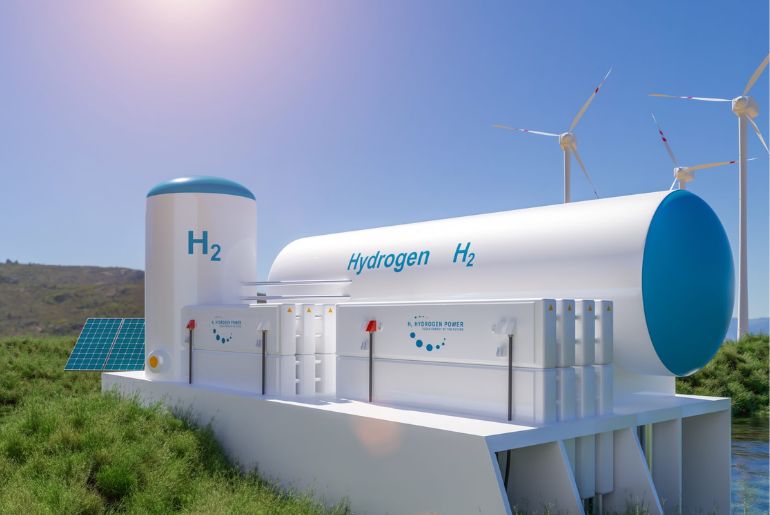
The Ministry of New and Renewable Energy (MNRE) has put out draft rules for measuring greenhouse gas (GHG) emissions that come from drawing and treating water off-site for green hydrogen production. The draft, which came out on February 25, 2026, aims to improve India’s green hydrogen framework and bring it up to global standards.
The new framework brings the Green Hydrogen Certification Scheme of India (GHCI) in line with ISO 19870:2023, which focuses on a detailed “Well-to-Gate” assessment of hydrogen production.
Closing the Emissions Accounting Gap
So far, emission calculations have mainly focused on activities within hydrogen production plants. However, water is a key raw material in green hydrogen production, especially for electrolysis.
The draft clarifies that drawing water from natural sources such as rivers or the sea will not be counted as emissions. But the total GHG intensity must include the chemicals and energy used to treat that water. This makes sure that hydrogen that is labelled as “green” is looked at over a longer period of time.
The framework outlines five main scenarios for water sourcing and provides clear methods to calculate emissions in each case.
Key Calculation Scenarios
- Captive Offsite Treatment: If a producer operates its own desalination or treatment plant outside the main facility, it must use primary data, including actual metered electricity consumption and chemical usage.
- Municipal Water Supply: If a producer gets their water from a state utility, they can use a default benchmark value of 0.603 kgCO2e per cubic metre.
- Industrial Clusters: When hydrogen producers share treatment infrastructure, emissions must be divided up based on how much water each one uses.
- Recycled Water: Only the extra energy needed to clean up wastewater to the level needed for electrolysis will be counted.
- Hybrid Systems: Producers that use more than one water source must keep daily records and use a weighted average method to figure out how much pollution they are causing.
To make sure everything is the same, MNRE has also set standard benchmarks for grid emission factors and transmission losses. The ministry has asked people in the industry to give their thoughts, and comments will be accepted until March 13, 2026.
 Electrify your feed! Click here to join our Whatsapp group and to get the latest updates, expert insights, and innovations driving India’s energy storage revolution.