NITI Aayog’s latest Trade Watch Quarterly highlights India’s growing dependence on imported metals and critical minerals, while identifying opportunities to strengthen domestic capabilities in exploration, processing, recycling and value addition. The findings have significant implications for India’s battery manufacturing, electric vehicle (EV) and broader energy-transition ecosystem.
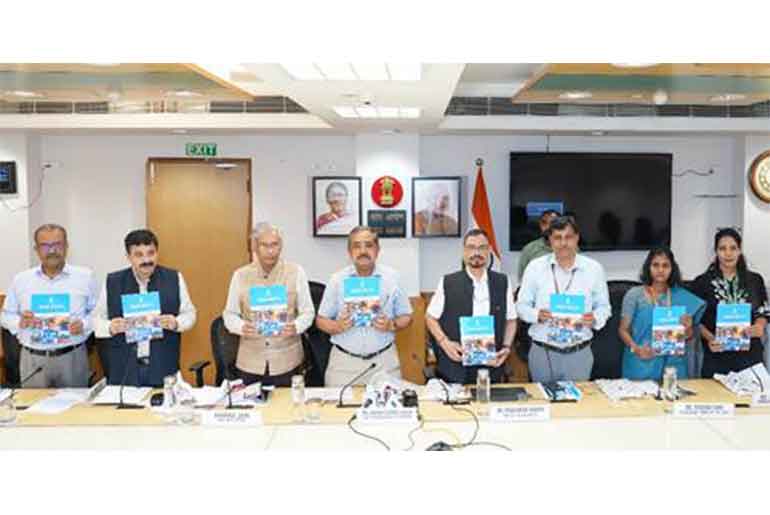
NITI Aayog Vice-Chairman Ashok Kumar Lahiri released the ninth edition of Trade Watch Quarterly, covering the first quarter of FY27 (April-June 2026), on September 16 in New Delhi.
While the publication assesses broader global and domestic trade trends, its thematic focus on India’s metals and ores trade highlights the growing importance of securing supplies of strategic minerals needed for manufacturing, infrastructure, energy transition and advanced industries.
Critical Minerals Gain Strategic Importance
According to the report, India’s metals and ores imports increased from $32.2 billion in 2015 to $60.5 billion in 2025. The rise reflects increasing demand for industrial and strategic minerals as India expands its manufacturing base, infrastructure and energy-transition activities.
The report specifically identifies copper, lithium, cobalt and nickel among the minerals witnessing growing demand.
These minerals are particularly important to the battery and EV value chain. Lithium, nickel and cobalt are key inputs for several lithium-ion battery chemistries, while copper is extensively used in battery cells, electrical systems, motors, charging infrastructure and power networks.
Key Takeaways for the Battery Industry
India’s metals and ores imports increased to $60.5 billion in 2025, up from $32.2 billion in 2015.
Lithium, cobalt, nickel and copper are identified as important industrial and strategic minerals.
The report calls attention to strengthening domestic exploration and processing capabilities.
Critical-mineral recycling is identified as an opportunity to improve resource security and value addition.
Higher-value non-ferrous metals could offer opportunities for expanding India’s domestic manufacturing capabilities.
The evolving global demand for critical minerals could support deeper integration of Indian companies into international supply chains.
Domestic Processing and Value Addition in Focus
For India’s battery ecosystem, access to raw materials is only one part of the supply-chain challenge. The ability to process minerals into battery-grade materials and manufacture higher-value components will also be critical.
NITI Aayog’s report highlights the need to develop specialised production and processing capabilities and increase value addition across the metals and minerals value chain.
Building these capabilities could help India move beyond dependence on raw-material imports and strengthen domestic supply chains supporting batteries, EVs, renewable energy and energy-storage applications.
Recycling Could Strengthen Battery Material Security
The report also points to critical-mineral recycling as an area that could contribute to resource security.
For the battery sector, recycling offers a potential source of secondary raw materials, particularly as India’s installed base of EVs and energy-storage systems expands. Developing efficient collection, recovery and refining capabilities could help recover valuable materials from end-of-life batteries and reduce pressure on primary mineral supplies.
A stronger recycling ecosystem could therefore complement domestic mining and international sourcing strategies.
MMDR Reforms Could Support Critical Mineral Investment
NITI Aayog has also highlighted recent reforms under the Mines and Minerals (Development and Regulation) Act, 1957, including the MMDR Amendment Act, 2026.
According to the report, these reforms could improve fiscal predictability and encourage investment in exploration, mine development and critical minerals.
For India’s emerging battery-material ecosystem, greater investment in exploration and domestic mineral development could help address some of the supply-chain constraints associated with critical raw materials.
CBAM Adds Pressure on Metals Producers
The report also highlights the European Union’s Carbon Border Adjustment Mechanism (EU CBAM) and its implications for Indian steel and aluminium exports.
For the battery and EV ecosystem, the issue extends beyond mineral availability. As global manufacturers increasingly focus on the carbon intensity of their supply chains, Indian producers may face growing pressure to reduce emissions associated with metals and battery materials.
NITI Aayog therefore recommends a coordinated value-chain approach covering resource security, streamlined processes, lower logistics and financing costs, renewable-energy access, CBAM preparedness, advanced materials and critical-mineral recycling.
India’s Broader Trade Continues to Expand
The report noted that India’s total merchandise and services trade reached $506.9 billion in Q1 FY27, representing 15.5% year-on-year growth.
India’s merchandise exports were supported by products including mineral fuels, electrical machinery, nuclear reactors, iron and steel, and vehicles. Imports also increased in areas such as capital goods, electronic components and copper, reflecting continued industrial activity and integration with global value chains.
India’s digitally delivered services exports also rose from $277 billion in 2024 to $317 billion in 2025, according to the report.
However, for the battery and clean-energy industry, the report’s findings on metals, critical minerals and domestic value addition are particularly significant as India seeks to expand its EV, battery manufacturing and energy-storage capabilities.
Strengthening India’s Battery Supply Chain
NITI Aayog Vice-Chairman Shri Ashok Kumar Lahiri said that strengthening India’s trade competitiveness would require greater diversification of export markets and products, deeper integration with global and regional value chains, stronger domestic capabilities in strategic sectors and a policy environment that enables Indian companies to compete internationally.
For the battery industry, this points to the importance of developing a more resilient end-to-end supply chain—from mineral exploration and imports to refining, active material production, cell manufacturing, battery deployment and recycling.
As demand for EVs, renewable energy storage and advanced electrical systems grows, securing critical minerals and increasing domestic value addition are likely to remain important components of India’s energy-transition strategy.
 Electrify your feed! Click here to join our Whatsapp group and to get the latest updates, expert insights, and innovations driving India’s energy storage revolution.