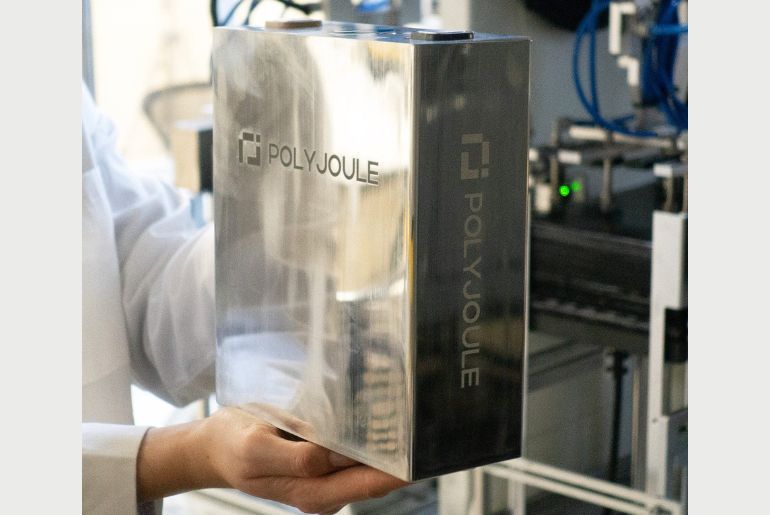
MIT spinout PolyJoule has launched its third-generation battery, swapping out traditional metals for a new “conductive polymer” chemistry and liquid salt electrolyte. Built into a large, sturdy prismatic cell, this battery is designed specifically to be fire-safe. The company is focusing on places where lithium-ion fire risks are a major concern, such as crowded apartment buildings, homes, and indoor factories.
Conventional battery chemistries—lithium-ion, lead-acid, nickel, sodium-ion—store charge in metallic crystalline lattices. Conductive polymers hold charge along an organic molecular backbone, removing the reactive metals and volatile liquid electrolytes responsible for thermal runaway and fire propagation. PolyJoule says the architecture also eliminates dendrite formation.
The self-extinguishing behavior was demonstrated using a propane blowtorch at approximately 3,600 °F (1,982 °C) applied directly to the cell’s internal components. Heat and gas were generated during the test, but the cell extinguished the moment the flame was removed. PolyJoule says it was the first company to validate through UL 9540A testing that its cells do not reach thermal runaway. Third-generation chemistry delivers a 10x energy density improvement over the company’s first generation while still achieving more than 10,000 cycles. No active thermal management is required.
PolyJoule will begin accepting applications from certified solar, battery, and generator installers in select regions. The company is looking for partners to help roll out its energy storage systems across the commercial, industrial, and residential sectors.
 Electrify your feed! Click here to join our Whatsapp group and to get the latest updates, expert insights, and innovations driving India’s energy storage revolution.