

In an age where energy must be not just abundant—but intelligent—Voltra Energy is quietly shaping India’s battery storage future with precision-engineered systems designed for scale, speed, and sustainability. At the core of this movement is Rachit Garg, Director of Sales, whose passion for modular energy storage reflects a new era of innovation in BESS technology.
Shweta Kumari, Sub-Editor of The Battery Magazine, sat down for an in-depth conversation with Rachit Garg to understand how Voltra is rewriting the energy playbook—cell by cell, pack by pack. From real-time cell diagnostics and seamless microgrid transitions, to air-liquid hybrid thermal management built for Indian summers, Garg reveals how Voltra is engineering systems that are both rugged and refined.
But the story doesn’t stop at hardware. With intelligent software capable of predictive load balancing, grid compliance, and virtual inertia, Voltra is preparing Indian infrastructure for a future of decentralized, AI-driven energy. As the company explores ultra-fast EV charging, compact urban deployments, and long-term grid compatibility, one thing becomes clear: Voltra isn’t just building batteries—it’s building the blueprint for India’s energy independence.
Let’s dive deeper into this revealing discussion with Rachit Garg.
1. Voltra recently opened a gigafactory with intelligent data integration. How does that digital-first approach ensure consistency in performance and quality across your BESS systems?
At Voltra, we focus on battery energy storage systems (BESS), which are typically large-scale systems used for grid utility, grid stability, grid regulation, and ensuring reliability across the grid. When our batteries are deployed for grid applications, consistency becomes critical—every pack, and even the cells within each pack, must deliver uniform performance.
So, when you’re delivering BESS solutions at gigawatt or megawatt-hour scale, you have to ensure the precision of every small modular unit. That’s where intelligent data integration plays a very crucial role. At our facility, we’ve developed advanced technical systems to monitor various parameters in real-time like Open Circuit Voltage (OCV), Internal Resistance (IR), State of Charge (SOC), State of Health (SOH), etc. across cells. This allows us to stack the cells and battery packs in such a way that the variation between the maximum and minimum performing cells is minimal. That consistency is vital for maintaining high reliability at scale.
2. Your modular BESS units support both microgrid and off-grid use cases. How do you handle scalability when integrating multiple units across commercial or rural sites?
I think it’s important to acknowledge that India is still a developing country, and microgrid and off-grid applications are extremely crucial in our context. When BESS systems are integrated with solar, we can significantly increase the reliability of renewable energy. For example, solar currently has a CUF (Capacity Utilization Factor) of around 20%, but with BESS, we can push that up to 40–50% by supporting grid infrastructure more reliably.
We’ve done significant engineering work so that our battery systems can switch from on-grid to off-grid in less than 100 milliseconds—about one-tenth of a second. This ensures that even during a switchover, critical equipment like pumps, motors, and machines continue running without interruption. It’s very similar to how an offline UPS works, where the transition is so fast that you don’t perceive any delay.
3. Thermal management is critical in Indian climates. What innovations are built into Voltra’s systems to maintain efficiency and longevity?
On thermal management, we’re working on a three-layer structure. First, we measure the temperature at the cell level, then at the pack level, and finally at the cabinet or cluster level. All of this data is analyzed by an in-built algorithm that processes it in real time.
We’ve also incorporated high-efficiency air conditioners, liquid cooling systems, and in some cases, a hybrid of both—where air conditioning is combined with a glycol-water liquid mix. This multi-layered approach helps us bring down the internal temperatures even in extreme Indian conditions, where ambient temperatures can reach 50 to 55 degrees Celsius.
4. Voltra’s EV charging arm supports ultra-fast stations. How do you integrate EV load with BESS to manage peak demand and grid stress?
We have developed both mobile BESS units and stationary units that can be plugged into EV fast-charging setups. These support both AC and DC charging.
We are working with partners to offer high C-rate discharge, going up to 1C, 2C, or even 4C. This enables us to deliver instantaneous energy output to the EV or the charging station. It’s especially helpful in reducing stress on the grid during peak demand hours.
5. Decentralization is a key industry trend. How does Voltra envision its role within a distributed energy ecosystem, particularly in enabling Virtual Power Plants (VPPs) and grid interoperability?
India’s energy demand is growing faster than we ever imagined. Modular BESS offers a great solution here. Instead of large upfront capital investment, you can start small—deploy only what’s needed—and then scale as demand grows.
Every six months or year, more BESS units can be added in parallel. Our systems are extremely compact, so space isn’t an issue. This model allows for forward planning spanning 50 to 100 years. BESS infrastructure can grow alongside India’s evolving energy needs and still remain reliable and flexible for the grid.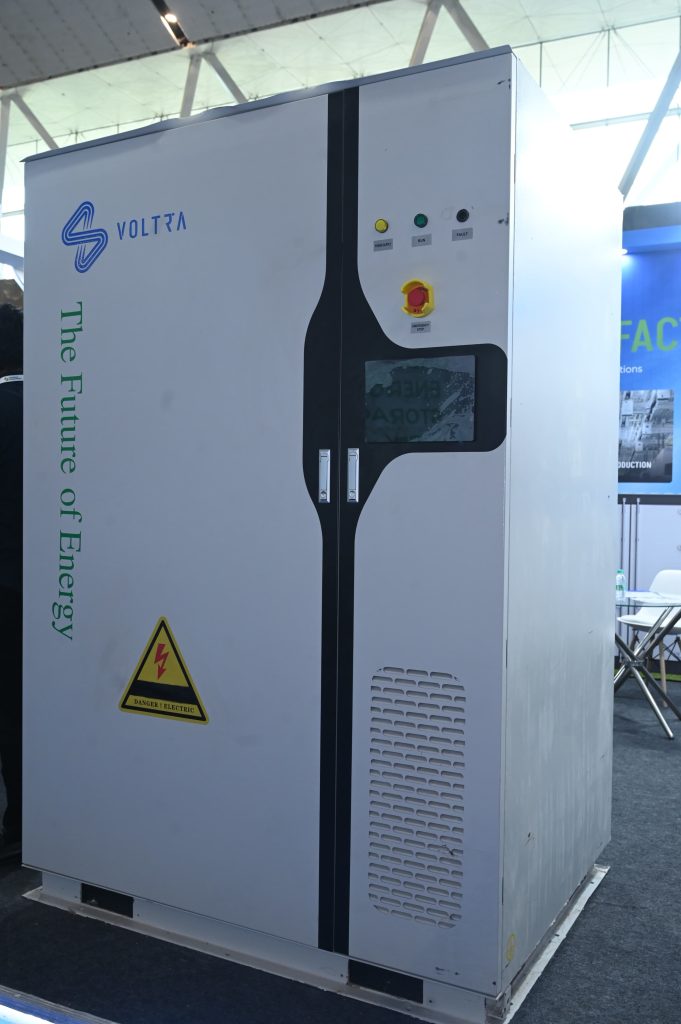
6. Urban deployments come with space, regulation, and interconnection challenges. How is Voltra adapting both hardware and software for success in dense areas?
Hardware becomes very crucial in urban settings due to space constraints. We’ve seen this especially in metro cities like Delhi, Mumbai, where space is tight. So we’ve designed ultra-compact units—some take up just one-tenth the space of a typical room and can power 4 to 6 homes.
At the same time, software plays an even bigger role. Hardware is just the front end; software is the backbone of our BESS. It helps optimize when to charge, when to discharge, and even enables features we don’t often realize BESS can perform—like providing virtual inertia, reactive power compensation, frequency regulation, voltage control, and acting as a generation source during peak hours by using stored solar energy.
7. What’s next for Voltra—whether it’s scaling capacity, exploring EV, expanding internationally, or integrating AI-driven grid services?
Right now, the China-plus-one strategy is creating new opportunities for India, especially in the renewable energy space. We believe India is on the path to becoming a global energy integration hub.
While EV and BESS intersect, we view them as distinct domains. Our focus going forward is on BESS infrastructure, software innovation, and cutting-edge research—particularly in thermal management, battery management systems, grid integration, and regulatory compliance. We believe these capabilities will define India’s rise in the global clean energy sector.
 Electrify your feed! Click here to join our Whatsapp group and to get the latest updates, expert insights, and innovations driving India’s energy storage revolution.