
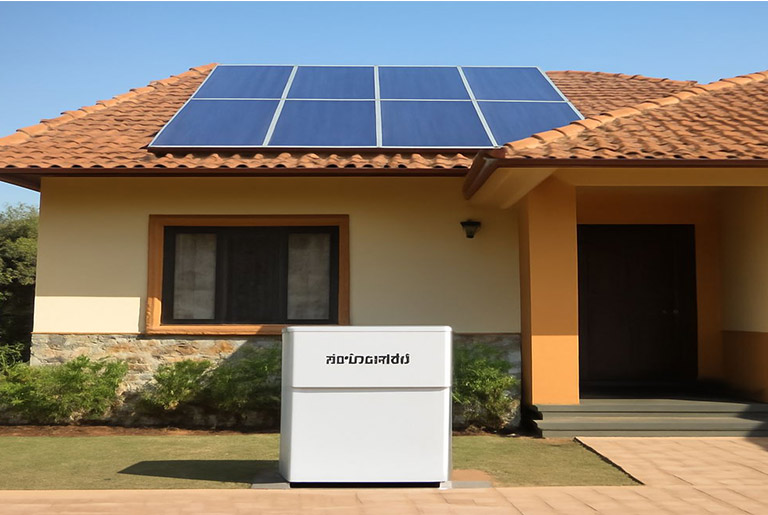
As India firmly strides into its clean energy future, a significant transformation is underway not just on rooftops but in the minds—and meter boxes—of homeowners. Gone are the days when rooftop solar panels were the cutting edge; in 2025, the real inflection point lies in solar battery storage for homes, powered by a wave of policy reforms, subsidies, and regulatory nudges. With climate commitments, rising utilities tariffs, and local grid instability, Indian consumers are asking: “Is it time to store power at home?” Thanks to central and state incentivization programs, the answer is increasingly becoming “yes.”
A Strategic Launchpad: PM Surya Ghar – Muft Bijli Yojana
At the heart of India’s residential solar boom is the nationally heralded PM Surya Ghar: Muft Bijli Yojana, launched in early 2024 with a ₹75,000 crore budget. Under this flagship initiative, households across India receive significant capital subsidy support—up to 60% for a standard rooftop PV system (up to 2 kW), and 40% for the third kilowatt—bringing low-cost solar access to tens of millions. Though the scheme does not directly subsidize batteries, it has indirectly enabled bundled solar-plus-storage packages to emerge in the market, especially in urban and semi-urban areas. Many homeowners now realize that adding a battery makes net-metering limitations more manageable, and turns solar into a true 24/7 energy solution.
Why Storage Matters: Grid Independence & Financial Sense
For many parts of India, nightly outages and load shedding remain real concerns. Even in metro areas, rising tariffs mean consuming solar-generated electricity outside of net-metering hours is increasingly expensive. Solar battery storage remedies both issues: it supplies uninterrupted backup and lets homeowners use stored energy during peak tariff windows—cutting reliance on expensive grid power. With round-trip efficiency rates of 90% becoming standard for modern lithium-ion systems, residential setups are showing financial viability. Households investing in a 5 kW solar + 5 kWh storage combination can now achieve payback within six to seven years, aided by subsidy structures and rising grid energy prices.
State-Level Policies: Adding Local Momentum to a National Push
India’s diversity means state-level policy plays a pivotal role in adoption. In Delhi, rooftop solar beneficiaries enjoy subsidies of ₹2,000/kW plus a ₹3/kWh generation-based incentive for small systems. Tamil Nadu and Uttar Pradesh, among others, offer fixed per-kW or per-system subsidies. When paired with the PM scheme, these add-ons significantly reduce out-of-pocket costs—and reduce payback periods. Some states are also piloting frameworks where solar installations are tariff-synced to encourage pairing with battery backup systems. These multilayered incentives highlight the powerful synergy between central and state energy goals.
Viability Gap Funding & National Battery Policy: Laying Framework for 30 GWh Scale
On the storage side, India has moved into new territory with a ₹5,400 crore Viability Gap Funding (VGF) scheme aimed at procuring up to 30 GWh of Battery Energy Storage Systems (BESS). Though primarily directed toward utility‑scale and community-level deployments, this significant financial push catalyzes industry readiness, scale benefits, and falling cost curves—which benefit residential buyers as well. It also signals a clear policy foundation for future incentives tailored to household storage systems, accelerating technology adoption at lower price thresholds.
Tackling Financing Innovation and Tax Effects: Avenues
The government is now working with financial intermediaries and agencies such as IREDA to promote new investments with low-interest loans (or even revolving credits) available for new renewable systems. The type of energizer I’m talking about, solar-plus-storage, is included in that loan. New middle-income owners can make the transformation without the burden on the capital structure. With these grants, an advancement on depreciation for taxes, and among the list of indirect tax incentives shown to the consumers, which extends beyond the depreciation, governments and agencies also offer excise duty on the solar hardware, which reduces the manufacturers’ input costs which is ultimately flow through to the end-use pricing. Residential battery systems may not currently be frontrunners for depreciation, and discussions on eco-friendly approaches on current government policy direction, could prompt future incentive on systems in that sector.
Quality & Safety: Building Trust in Residential Battery Systems
Recognizing the importance of reliability, MNRE and the Bureau of Energy Efficiency (BEE) have rolled out certification guidelines for rooftop solar installations—now expanding to include battery safety and performance protocols. Training modules ensure certified installers understand best practices for lithium-ion batteries. A central ₹100 crore Payment Security Corpus under the Surya Ghar model further protects consumer interests and builds confidence. These steps are essential to assure homeowners that paired solar-battery systems are both effective and safe.
Real-Life Examples: Rural Solar-Battery Villages & Urban Uptake
Small-scale pilots demonstrate the potential impact. In Gujarat’s Modhera village, a 15 MWh community battery bank has delivered seamless power—demonstrating how solar storage can drive energy access. In urban pockets of Delhi and UP, households that have installed storage see dramatic electricity savings and continuity even during grid deficits. These pilots help make the case that when policies and technology meet, adoption accelerates—even in harder-to-electrify zones.
Outstanding Issues: Where Policy Needs to Advance
These strong foundations aside, we find important gaps. Batteries are not currently included in capital subsidy schemes, thus the upfront cost is still prohibitive for many. Net-metering rules vary widely and often do not allow for storage benefits, if they allow for storage at all. Integration mandates are rare, and no conditions have been established for bundling solar with storage. In addition, consumer awareness is at a low level and the unregulated market creates a situation where quality and safety risks exist. Attention to these gaps is needed to support scaling.
How Policy Evolution Could Drive Further Adoption
India’s transition is entering the next phase. Here’s where policies can sharpen:
- Introduce battery-linked capital subsidies or concessional loans under central schemes.
- Expand net-metering rules to include storage-linked self-consumption credits.
- Fast-track BEE-certified standards for residential battery systems up to 10 kWh to ensure system quality and safety.
- Encourage state nodal agencies to pilot and report on storage-inclusive models in smart cities and rural electrification projects.
Why It Matters: Beyond Bills to Sustainability
At a time when India aims for 500 GW of renewable capacity by 2030 and net-zero emissions by 2070, household Solar + Battery storage plays a strategic role. It reduces reliance on coal-based grid power, cuts household expenses, and contributes to climate goals. Above all, storage transforms solar from a daytime asset into a continuous power resource—making homes resilient and energy sovereign.
A Policy-Driven Path to Energy Freedom
In 2025, Indian government policies—from PM Surya Ghar subsidies to BESS-level funding—have set the stage for a residential energy revolution. As innovation lowers costs and storage becomes a smart investment rather than a luxury, India is inching closer to decentralized, sustainable power homes. With proactive policy adjustments and consumer education, solar battery storage for homes is no longer just aspirational—it is becoming essential.
 Electrify your feed! Click here to join our Whatsapp group and to get the latest updates, expert insights, and innovations driving India’s energy storage revolution.